
People in this story


Explore this event
 The wider storyHow did General Sani Abacha consolidate absolute power after the 1993 coup?Following the ouster of Ernest Shonekan, General Sani Abacha implemented a series of decrees and military purges that placed his government above the law. This analysis details the mechanisms used to establish absolute…Read the full history
Key facts about the 1993 Nigerian coup d'état
| Event | General Sani Abacha forces Interim President Ernest Shonekan to resign |
|---|---|
| Date | November 17, 1993 |
| Location | Nigeria |
| Key Figure | General Sani Abacha |
| Source Detail | Defence Minister forced Interim President Chief Ernest Shonekan to resign |
| Confirmed Outcome | Abacha assumed control of the government |
Timeline: the road to General Sani Abacha and its aftermath
- June 12, 1993 General Ibrahim Babangida annuls the presidential election.
- August 26, 1993 Chief Ernest Shonekan assumes the interim presidency, succeeding General Ibrahim Babangida.
- November 17, 1993 General Sani Abacha forces Interim President Ernest Shonekan to resign in a military coup.
- November 18, 1993 The New York Times reports on the ouster of Ernest Shonekan by General Sani Abacha.
- September 1994 General Sani Abacha issues a decree placing his government above the jurisdiction of the courts.
- June 8, 1998 General Sani Abacha dies at the presidential complex in Abuja.
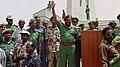
Sani Abacha: The coup marked a decisive shift in power within the Nigerian government

He forced Interim President Chief Ernest Shonekan to resign from his post. This action ended Shonekan's brief tenure, which had begun on August 26, 1993. Shonekan had succeeded General Ibrahim Babangida as head of state following the annulment of the June 12, 1993 presidential election. The coup marked a decisive shift in power within the Nigerian government.
The removal of Shonekan followed a period of political instability in the country. Babangida had previously voided the results of the presidential election, leading to his own resignation. Shonekan, a former business executive and ally of Babangida, took over the interim presidency in the aftermath. However, his government faced significant challenges in managing the democratic process. Abacha's intervention brought an end to this interim period, placing the military back in direct control of the state.
Sani Abacha: Following the coup, Abacha addressed the nation in a nationwide broadcast

Following the coup, Abacha addressed the nation in a nationwide broadcast. He cited the stagnant nature of Shonekan's government as a primary reason for the forced resignation. Abacha also pointed to Shonekan's inability to manage the democratic process in the country. These statements provided the official justification for the military's action. The broadcast served as the public record of the new leadership's rationale.
Shonekan was widely perceived as a puppet of General Abacha during his time in office. This perception colored the public understanding of the coup's dynamics. The New York Times reported on the ouster, noting Abacha's long history of involvement in Nigeria's political turmoil. The article highlighted Abacha's role in the 1983 coup and his influence over Babangida's rise to power. These details contextualized the 1993 event within a broader pattern of military intervention.
Sani Abacha: Abacha further entrenched his power through legislative decrees issued in the following year

In the weeks immediately following the coup, General Abacha moved to consolidate his control over the military establishment. He quickly purged top loyalists of General Babangida from the ranks, removing figures who had supported the previous head of state. This internal restructuring served to eliminate potential rivals and secure Abacha's position as the dominant force within the Armed Forces. The purge was a direct response to the political instability that had characterized the transition from Babangida to Shonekan.
Abacha further entrenched his power through legislative decrees issued in the following year. In September 1994, he promulgated a decree that placed his government above the jurisdiction of the courts, effectively granting him absolute legal immunity. A separate decree granted him the right to detain any individual for a period of up to three months without judicial oversight. These legal instruments stripped the judiciary of its ability to check executive power. The combination of military purges and judicial subordination created a system where Abacha operated without institutional constraints, centralizing all state authority in his office.
Sani Abacha: Following Abacha's death, the leadership of the state passed to Major General Abdulsalami Abubakar

Abacha held power until his death on June 8, 1998, at the presidential complex in Abuja. His passing ended a period of direct military rule that had begun with the 1993 coup, marked by the consolidation of power described in the preceding decrees and purges.
Following Abacha's death, the leadership of the state passed to Major General Abdulsalami Abubakar. Abubakar, who served as the Chief of the Defence Staff, succeeded Abacha as head of state. This transition marked the end of Abacha's personal rule and the beginning of a new phase in Nigeria's military leadership. The succession was internal to the military establishment, with Abubakar taking over the role previously held by Abacha.
Evidence Map: How We Checked the Central Claim
What the sources verify and how they were used
This comparison separates the event page selected for the account from the independently verified page used to corroborate it.
Central claim checked: He forced Interim President Chief Ernest Shonekan to resign from his post.
| Direct source | Verification role | Coverage |
|---|---|---|
| 1993 Nigerian coup d'état · Wikipedia Accessed 2026-11-16 | Selected event record | Selected event record used for the account; compare its text with the checked article claim above. |
| Nigerian Military Leader Ousts Interim President (Published 1993) · nytimes.com Accessed 2026-11-16 | Independent corroboration | Source excerpt: “Nigerian Military Leader Ousts Interim President - The New York Times World | Nigerian Military Leader Ousts Interim President https://www.nytimes.com/1993/11/18/world/nigerian-military-leader-ousts-interim-president.html…” |
| BBC News | Nigeria · news.bbc.co.uk Accessed 2026-11-16 | Independent corroboration | Source excerpt: “It is not immediately clear who will succeed General Abacha. Nigeria under Abacha The general seized power in 1993 after…” |
You Might Also Like


What caused the 1993 Nigerian coup d'état?
The recorded event date is November 17, 1993.
Key figures included Sani Abacha, Ernest Shonekan, Ibrahim Babangida.