People in this story
| Event | Amagiri Rams and Sinks PT-109, Kennedy Saves Crew |
|---|---|
| Date | August 2, 1943 |
| Location | Blackett Strait, near Kolombangara, Solomon Islands |
| Commander | Lt. (j.g.) John F. Kennedy, future 35th U.S. president |
| Outcome | Most of the crew survived; two men did not |
| Rescue | Kennedy and the survivors were rescued on August 8, 1943 |
| Aftermath | Kennedy was later given command of the gunboat PT-59 |




First Reports From the Scene
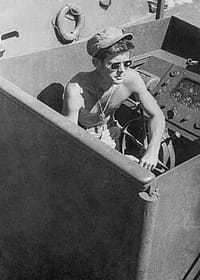
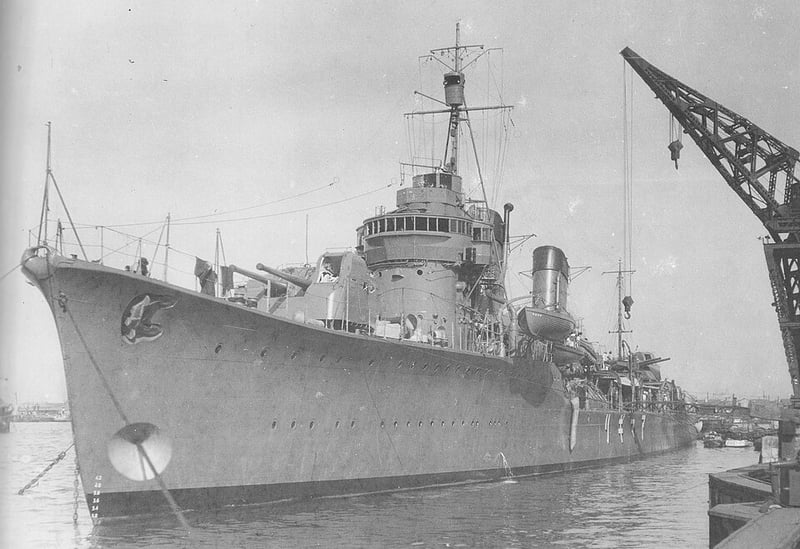
On the night of August 1 into August 2, 1943, PT-109 was on patrol in Blackett Strait near Kolombangara when the Japanese destroyer Amagiri, returning from a Tokyo Express transport run to Vila, cut through the smaller boat in the dark. The collision split PT-109 apart, and two of Kennedy's crew did not survive it. The official record has long held that the Amagiri's crew never even saw PT-109, a boat small and dark enough to vanish against the night water. The writer Robert J. Donovan reached a different conclusion in his book PT 109, after interviewing many of the Amagiri's own crew: he judged the ramming deliberate, and said he had spoken with the sailor at the wheel who told him he had been ordered to steer for a collision course.
Whatever really happened in the collision itself, what followed next in Blackett Strait was unambiguous. Kennedy gathered his surviving men and led them swimming more than three miles to an uninhabited island, towing wreckage and using timbers that had been lashed to the deck to mount a bartered 37 millimeter antitank gun as makeshift flotation. The crew held out on that island and a neighboring one for days before local islanders carried word of their location to an Australian coastwatcher stationed nearby, and the survivors were finally picked up on August 8, 1943, six days after PT-109 went down.
Timeline: the road to Amagiri Rams and its aftermath
- March 4, 1942 Keel laid for PT 109
- August 2, 1943 Amagiri rams PT 109
- August 8, 1943 Survivors rescued after PT 109 sinking
- September 1, 1943 Kennedy assumes command of PT 59
- November 1, 1943 Rescue of Marines on Choiseul Island
- November 18, 1943 Kennedy relinquishes command of PT 59
Rescue, Response, and Fallout
The physical toll on Kennedy did not end with the rescue. The back injury he suffered in the collision required months of treatment at Chelsea Naval Hospital and troubled him for the rest of his life. He was sent first to Tulagi Island to recover, but rather than accept a quieter posting he asked to get back into the fight, and on September 1, 1943, he took command of PT-59, a boat that had been stripped of its torpedo tubes and rebuilt as a gunboat armed with heavier machine guns for use against Japanese barges. He based the boat at Lambu Lambu Cove on Vella Lavella Island.
PT-59's most notable mission came on November 1, 1943, when Kennedy took part in evacuating Marines who had been surrounded by Japanese forces on Choiseul Island, a rescue that succeeded even though one of the wounded Marines died in Kennedy's own bunk aboard the boat. By mid November, after losing roughly 25 pounds over three exhausting months, Kennedy was ordered to the hospital at Tulagi. He gave up command of PT-59 on November 18, left the Solomon Islands in December, and was released from the Navy on a physical disability in March 1945.
The Questions the Disaster Left Behind
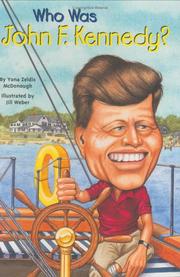
The sinking of PT-109 became one of the defining stories of Kennedy's public life. Robert J. Donovan's 1961 book and the 1963 film adapted from it fixed the rescue in the American public imagination, and Kennedy's postwar campaigns for Congress and the presidency returned to it often. The episode even reached the pop charts: a Jimmy Dean song about the collision, with the line describing a Japanese destroyer that "cut the 109 in two," made the Amagiri probably the only Japanese warship ever named in a top ten Billboard hit.
The two vessels at the center of the story had very different fates. The Amagiri continued running Tokyo Express missions until April 1944, when it struck a naval mine in the Makassar Strait and sank with few casualties, ending the career of the destroyer that gave PT-109 its name in American history. PT-59, the gunboat Kennedy commanded after the collision, survived the war intact and was shipped back to the Motor Torpedo Boat Training Base in Rhode Island in August 1944.
Analysis: Patrol torpedo boat PT-109
What the evidence supports and leaves unresolved
What the record supports
- A Well Documented Rescue: The account of Kennedy leading his surviving crew more than three miles to safety rests on more than a single retelling. Robert J. Donovan interviewed many of the Amagiri's own crew for his 1961 book, and the U.S. National Archives has separately documented Kennedy's rescue on August 8, 1943, and his transfer to command PT-59 barely three weeks later, giving the story a corroborated, multi-source foundation rather than a single convenient legend.
- Kennedy Returned to Combat Almost Immediately: Rather than accept a safe reassignment after nearly losing his life, Kennedy asked to get back into action and took command of PT-59 on September 1, 1943, just weeks after the collision. That gunboat went on to help evacuate surrounded Marines from Choiseul Island on November 1, 1943, a mission that succeeded despite the loss of one wounded Marine aboard.
- A Story That Outgrew the Battle: Few single-boat incidents from the Pacific War left as wide a cultural footprint. Lieutenant Commander Kohei Hanami, who commanded the Amagiri that night, later gave Kennedy a bronze medallion at his 1961 inauguration, and a Jimmy Dean song about the collision reached the Billboard Hot 100, a rare fate for an episode involving a 40 ton motor torpedo boat.
Limits and unresolved questions
- The Torpedoes Were Already a Liability: PT-109 carried Mark 8 torpedoes that one naval officer said failed to fire roughly 90 percent of the time the launch button was pressed, and even when they did fire, they often failed to detonate on impact until the Navy recalibrated the design near the end of the war. A boat that could not reliably use its principal weapon was operating at a serious disadvantage months before the Amagiri ever appeared.
- Whether the Ramming Was Deliberate Remains Disputed: The long-standing account holds that the Amagiri's crew never spotted PT-109 in the dark, but Robert J. Donovan's interviews with the destroyer's own crew produced a conflicting claim: that the man at the wheel had been ordered to steer for a collision course. The two versions cannot both be complete, and the surviving record does not resolve which one is correct.
- PT-109 Had No Radar: Unlike larger Navy vessels operating in the same waters, PT-109 was not equipped with radar, leaving her crew dependent on eyesight alone to spot other ships on a dark night in a strait already crowded with Japanese destroyer traffic. That gap in equipment left little warning before the Amagiri was on top of her.
We keep returning to the strange asymmetry at the center of this story: a 40 ton wooden boat with unreliable torpedoes and no radar, cut in half by a warship many times its size, and yet it is PT-109's name, not the Amagiri's, that survived in American memory. Kennedy's choice to swim his crew more than three miles rather than wait for rescue, and his decision weeks later to take command of PT-59 instead of a safer post, both come from the same record, not from the legend that grew up around them afterward. What stays with us is how quickly he went back to a war that had so nearly cost him his life.
Evidence Map: How We Checked the Central Claim
What the sources verify and how they were used
This comparison separates the event page selected for the account from the independently verified page used to corroborate it.
Central claim checked: World War II: After the Motor Torpedo Boat PT-109 is rammed and sunk by the Japanese destroyer Amagiri, Lt. John F. Kennedy, future U.S. president, saves all but two of his crew.
| Direct source | Verification role | Coverage |
|---|---|---|
| Patrol torpedo boat PT-109 · Wikipedia Accessed 2026-08-02 | Selected event record | Supports the central claim shown above. |
| John F. Kennedy and PT Boat 59 · prologue.blogs.archives.gov Accessed 2026-08-02 | Independent corroboration | Supports the central claim shown above. |
You Might Also Like


Questions readers ask about Amagiri Rams
The lead-up included Keel laid for PT 109.
Key figures included John F. Kennedy.
In the aftermath: Survivors rescued after PT 109 sinking; Kennedy assumes command of PT 59; Rescue of Marines on Choiseul Island.