
People in this story
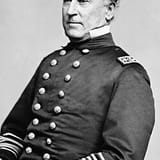
| Event | Farragut's Fleet Storms Mobile Bay |
|---|---|
| Date | August 5, 1864 |
| Location | Mobile Bay, near Mobile, Alabama |
| Union commander | Rear Admiral David G. Farragut |
| Confederate commander | Admiral Franklin Buchanan, aboard the ironclad CSS Tennessee |
| Defenses | Forts Morgan, Gaines, and Powell, plus a minefield of 67 torpedoes |
| Outcome | The Confederate fleet surrendered and the three forts fell within days |
| Significance | Closed the last major Confederate port on the Gulf of Mexico |



Reports From the Front

On the morning of August 5, 1864, Farragut sent his fleet of wooden warships and ironclad monitors straight at the narrow channel between Fort Morgan and the Confederate minefield, lashing himself into the rigging of his flagship, the Hartford, so he could see over the smoke of battle. Early in the run, the monitor Tecumseh struck one of the mines and sank within minutes, and the ships behind her began to falter under the fort's guns rather than follow her into what looked like a death trap. It was in that moment of hesitation that Farragut is said to have given the order remembered ever since, urging his fleet to push through the mined water rather than turn back into range of the fort's cannon.
The gamble worked. Farragut's ships crossed the minefield without further loss and came out into open water beyond the reach of Fort Morgan's shore guns, where they turned to face the waiting Confederate flotilla. The three small Confederate gunboats scattered or were driven off in short order, leaving the ironclad Tennessee to fight the entire Union fleet alone. Admiral Franklin Buchanan, who had commanded the Confederate ironclad Virginia in her famous duel with the Monitor two years earlier, pressed the attack anyway, and for a time Tennessee's iron plating let her absorb far more punishment than she handed out. Union ships rammed her repeatedly and pounded her armor at close range until her steering chains were shot away and her gun ports jammed, and with the ship reduced to a helpless hulk, Buchanan finally struck his flag and surrendered.
Timeline: the road to this event and its aftermath
- April 1862 New Orleans fell to Union forces
- May 1864 CSS Tennessee reached lower Mobile Bay after caisson work
- August 5, 1864 Rear Admiral David G. Farragut led Union fleet through Mobile Bay minefield
- August 6, 1864 Fort Powell abandoned and blown up by its garrison
- August 8, 1864 Fort Gaines surrendered to Union forces
- August 23, 1864 Fort Morgan surrendered after three weeks of bombardment
- April 1865 City of Mobile occupied by Union forces
The Military and Political Fallout

With Tennessee gone, the Confederate Navy at Mobile had nothing left to contest the bay, and the three forts guarding its entrance now stood alone against Farragut's fleet and a supporting force of Union soldiers who had landed on the barrier islands. Fort Powell, the smallest and weakest of the three, was abandoned and blown up by its own garrison the night after the naval battle rather than face a bombardment it could not survive. Fort Gaines surrendered on August 8, and Fort Morgan, the strongest of the three, held out under bombardment for another three weeks before its garrison surrendered on August 23, giving the Union complete control of lower Mobile Bay.
The city of Mobile itself did not fall in 1864. Union forces controlled the bay and had shut off its use as a port, but the city stayed in Confederate hands for the rest of the war and would not be occupied until April 1865, in the war's final weeks. Even so, the practical purpose of the campaign was achieved the moment the forts fell, since closing Mobile Bay to blockade runners completed the Union naval blockade along that stretch of the Gulf coast and cut off one of the Confederacy's last working links to the outside world.
How the Balance of Power Shifted
Mobile Bay turned out to be Farragut's last engagement of the war and the last naval battle fought in Alabama waters. He had already become the Union Navy's first rear admiral after New Orleans, and Mobile Bay stands as the last of the battles that built that reputation. News of the victory reached Northern newspapers alongside reports of the fall of Atlanta that same summer, and the two victories together gave a meaningful lift to Abraham Lincoln's re election campaign just three months before voters went to the polls that November.
The men who fought in the confined, smoke filled decks of Farragut's fleet were remembered too. John Lawson, a Black fireman who kept passing gunpowder up from below deck aboard Farragut's flagship even after being wounded and knocked unconscious by an exploding shell, was among the first Black sailors awarded the Medal of Honor for his conduct that day, a recognition that took its place alongside the more famous story of Farragut's run through the minefield.
Analysis: Battle of Mobile Bay
What the evidence supports and leaves unresolved
What the record supports
- A Calculated Risk, Not a Reckless One: David Farragut had studied the minefield's buoys off Mobile Bay for weeks before the battle and knew that most of the mines in the channel had likely been sitting in salt water long enough to have gone inert, a detail modern accounts of the battle still debate but one that fits how deliberately he had prepared his approach rather than simply gambling his fleet on a single dramatic order.
- The Union Fleet Adapted Under Fire: When the monitor Tecumseh sank within minutes of striking a mine, Farragut did not call off the attack on Mobile Bay. He pushed the rest of his fleet past the danger and reorganized his ships to isolate the ironclad Tennessee once they reached open water, turning what could have been a stalled, costly assault into a battle fought on his own terms.
- Bravery Recognized Across Ranks: John Lawson's Medal of Honor for continuing to serve gunpowder to the guns after being wounded and knocked unconscious shows that recognition from the Mobile Bay battle reached beyond its admirals. He was one of the first Black sailors to receive the nation's highest military honor, for conduct performed in the same battle that made Farragut famous.
Limits and unresolved questions
- The Human Cost Aboard Tecumseh: The monitor Tecumseh sank within minutes of striking a single mine near Fort Morgan, taking most of her crew down with her. Farragut's decision to press the fleet forward past the wreck undoubtedly saved the wider attack on Mobile Bay, but it came at the cost of the men still trapped inside a sinking ironclad in the middle of the battle.
- Mobile Itself Held Out Eight Months Longer: Closing Mobile Bay to blockade runners was a real strategic win, but the city of Mobile stayed in Confederate hands until April 1865, nearly eight months after the naval battle. The victory secured the water approaches without delivering the city that gave the bay its name, and Union troops did not occupy Mobile until the war's final weeks.
- Fort Morgan's Long Bombardment: While Fort Powell fell within a day and Fort Gaines surrendered within three, Fort Morgan endured nearly three weeks of siege and bombardment before its garrison gave up on August 23, 1864. The naval victory did not translate into a quick land campaign, and the forts around Mobile Bay extracted a slower toll than the single day of ship to ship fighting suggests.
We keep coming back to the image of Farragut lashed into the rigging above his own flagship, watching a monitor sink in the Mobile Bay minefield ahead of him and choosing to push forward anyway. It would be easy to read that as recklessness, and generations of retellings have shortened it into four words on a placard. The fuller record shows a commander who had studied those buoys for weeks and gambled on knowledge rather than nerve alone, then spent the rest of that August grinding down three separate forts one at a time until the bay was actually his. That patience after the famous moment tends to get left out of the story we tell about it.
Evidence Map: How We Checked the Central Claim
What the sources verify and how they were used
This comparison separates the event page selected for the account from the independently verified page used to corroborate it.

Central claim checked: American Civil War: The Battle of Mobile Bay begins at Mobile Bay near Mobile, Alabama, Admiral David Farragut leads a Union flotilla through Confederate defenses and seals one of the last major Southern ports.
| Direct source | Verification role | Coverage |
|---|---|---|
| Battle of Mobile Bay · Wikipedia Accessed 2026-08-05 | Selected event record | Supports the central claim shown above. |
| Battle Of Mobile Bay: Medal Of Honor · apr.org Accessed 2026-08-05 | Independent corroboration | Supports the central claim shown above. |
You Might Also Like


Questions readers ask about this event
The lead-up included New Orleans fell to Union forces; CSS Tennessee reached lower Mobile Bay after caisson work.
Key figures included David Farragut.
In the aftermath: Fort Powell abandoned and blown up by its garrison; Fort Gaines surrendered to Union forces; Fort Morgan surrendered after three weeks of bombardment.
Closed the last major Confederate port on the Gulf of Mexico