April 12 in History

52 events 240 – 2026

April 12 spans 52 recorded events across recorded history, from 240 to 2026. Below is a curated digest of the most significant moments tied to this date.

By · Wikipedia

2026 — The Tisza Party, led by Péter Magyar wins the 2026 Hungarian parliamentary election, defeating Viktor Orbán's Fidesz party, which had ruled the country for 16 years, marking the first change in government in Hungary for over a decade

More major events on April 12

The featured story and these ranked highlights form a quick summary. Every recorded event remains available in the chronology below.

  1. 1983 Harold Washington is elected as the first black mayor of Chicago. Source
  2. 1981 The first launch of a Space Shuttle (Columbia) takes place: The STS-1 mission. Source
  3. 1961 Space Race: The Soviet cosmonaut Yuri Gagarin becomes the first human to travel into outer space and perform the first crewed orbital flight, Vostok 1. Source

Did you know

The 2026 Hungarian parliamentary election was held on 12 April 2026 to elect all 199 members of the National Assembly.

Did you know

Péter Magyar, the leader of the Tisza Party, is a former member of the Fidesz party and a Member of the European Parliament.

Did you know

The Tisza Party won a two-thirds supermajority in the National Assembly, allowing them to amend the Fundamental Law.

Did you know

Viktor Orbán's Fidesz party had been in power for 16 years prior to the 2026 election, making it one of the longest-ruling parties in Hungarian history.

Did you know

The 2026 Hungarian parliamentary election had the highest turnout since Hungary's transition to democracy in 1990, marking a significant shift in the country's political landscape.


Shapur_I
Shapur I becomes co-emperor of the Sasanian Empire with his father Ardashir I.
Shahanshah of the Sasanian Empire from 240 to 270
Shapur I also known as Shapur I the Great was the second Sasanian King of Kings of Iran. The precise dating of his reign is disputed, but it is generally agreed that he ruled from 240 to 270, with his father Ardashir I as co-regent until the death of the latter in 242. Shapur also consolidated and expanded the empire of Ardashir I, waged war against the Roman Empire, and seized its cities of Nisibis and Carrhae while he was advancing as far as Roman Syria. Although he was defeated at the Battle of Resaena in 243 by Roman emperor Gordian III, the following year he was able to win the Battle of Misiche and force the new Roman emperor Philip the Arab to sign a favorable peace treaty that was regarded by the Romans as "a most shameful treaty".
240
Anthemius
Anthemius is elevated to Emperor of the Western Roman Empire.
Western Roman emperor from 467 to 472
Procopius Anthemius was the Western Roman emperor from 467 to 472. Born in the Eastern Roman Empire, Anthemius quickly worked his way up the ranks. He married into the Theodosian dynasty through Marcia Euphemia, daughter of Eastern emperor Marcian. He soon received a significant number of promotions to various posts, and was presumed to be Marcian's planned successor. However, Marcian's sudden death in 457, together with that of Western emperor Avitus, left the imperial succession in the hands of Aspar. He instead appointed Leo, a low-ranking officer, to the Eastern throne, probably out of fear that Anthemius would be too independent. Eventually, this same Leo designated Anthemius as Western emperor in 467, following a two-year interregnum that started in November 465.
467
Edwin_of_Northumbria
King Edwin of Northumbria is converted to Christianity by Paulinus, Bishop of York.
King of Deira and Bernicia from 616 to 632/633
Edwin, also known as Eadwine or Æduinus, was the King of Deira and Bernicia – which later became known as Northumbria – from around 616 until his death. He was the second monarch to rule both of these northern English kingdoms and the first to convert to Christianity. After he died in battle, he was venerated as a saint.
627
Nikephoros I of Constantinople is consecrated as patriarch of Constantinople.
806
Prince_of_Antioch
Having received the submission of the prince of Antioch, Raynald of Châtillon, Byzantine Emperor Manuel I Komnenos enters triumphantly the city of Antioch.
Ruling monarch of the Principality of Antioch (1098–1268)
Prince of Antioch was the title given during the Middle Ages to Norman rulers of the Principality of Antioch, a region surrounding the city of Antioch. The Princes originally came from the County of Sicily. Prince Bohemond IV of Antioch additionally came into possession of the County of Tripoli, combining these two Crusader states for the rest of their histories.
1159
Crusades
The Crusaders of the Fourth Crusade breach the walls of Constantinople and enter the city, which they completely occupy the following day.
Religious wars of the High Middle Ages
The Crusades were a series of military campaigns launched by the papacy between 1095 and 1291 against Muslim rulers for the recovery and defence of the Holy Land, as part of a wider crusading movement. The First Crusade was proclaimed by Pope Urban II at the Council of Clermont in November 1095—a call to arms for Christians to reconquer Jerusalem from the Muslims, with promises of spiritual reward. By this time, the papacy's position as head of the Catholic Church had strengthened, and earlier conflicts with secular rulers and wars on the frontiers of Western Christendom had prepared it for the direction of armed force in religious causes. The successes of the First Crusade led to the establishment of four Crusader states in the Levant, where their defence required further expeditions from Catholic Europe. The organisation of such large-scale campaigns demanded complex religious, social, and economic institutions, including crusade indulgences, military orders, and the taxation of clerical income. Over time, the crusading movement expanded to include campaigns against pagans, Christian dissidents, and other enemies of the papacy, promoted with similar spiritual rewards and continuing into the 18th century.
1204
The Instruction of 12 April 1588 was enacted, which is widely regarded as the formal establishment of the Dutch Republic.
Act formally establishing the Dutch Republic
In the history of the Netherlands, the instruction of 12 April 1588 is a decision of the States General of the Netherlands passed on 12 April 1588 during the Eighty Years' War. It transferred the duties of the executive branch of government from the landvoogd to the Council of State. In conjunction with a separate decision taken by the States General to transfer the oaths of allegiance of all officials from Leicester to themselves on the same day, the instruction is widely regarded as the formal establishment of the Dutch Republic.
1588
Union_Jack
The Union Flag is adopted as the flag of English and Scottish ships.
Flag of the United Kingdom
The Union Jack or Union Flag is the national flag of the United Kingdom. While no law has been enacted making the Union Flag the national flag of the United Kingdom, it has become so through precedent.
1606
American_Revolution
American Revolution: With the Halifax Resolves, the North Carolina Provincial Congress authorizes its Congressional delegation to vote for independence from Britain.
Founding of the United States
The American Revolution (1765–1789) was a political movement in the Thirteen Colonies of Great Britain. It began as a rebellion and turned into a revolution eventually creating the sovereign United States, which was the outcome of the associated American Revolutionary War (1775-1783). The Second Continental Congress, as the provisional government, established the Continental Army and appointed George Washington as its commander-in-chief in 1775. The following year, the Congress passed the Lee Resolution on July 2nd and unanimously adopted the Declaration of Independence on July 4th. Throughout most of the war, the outcome appeared uncertain, but a 1781 victory by Washington and the Continental Army in the Siege of Yorktown led King George III and the Fox–North coalition in government to negotiate the cessation of colonial rule and the acknowledgment of American sovereignty, which was formalized in the Treaty of Paris, signed on September 3, 1783. The Constitution took effect in 1789 and the Bill of Rights was ratified in 1791.
1776
Royal_Navy
American Revolution: A Royal Navy fleet led by Admiral George Rodney defeats a French fleet led by the Comte de Grasse at the Battle of the Saintes off Dominica in the Caribbean Sea.
Naval warfare force of the United Kingdom
The Royal Navy (RN) is the naval warfare force of the United Kingdom, responsible for defending the country, the Crown Dependencies, and the Overseas Territories from naval attack or invasion. It is a component of His Majesty's Naval Service, and its officers hold their commissions from the King. Although warships were used by English and Scottish kings from the early medieval period, the first major maritime engagements were fought in the Hundred Years' War against France. The modern Royal Navy traces its origins to the English Navy of the early 16th century, making it the oldest of the United Kingdom's armed services. It is consequently known as the Senior Service.
1782
War_of_the_First_Coalition
War of the First Coalition: Napoleon Bonaparte wins his first victory as an army commander at the Battle of Montenotte, splitting the Austrian and Piedmontese armies away from each other, and marking the beginning of the Piedmontese surrender in the war.
1792–1797 wars between France and European powers
The War of the First Coalition was a set of wars between a coalition of several European powers and France fought between 1792 and 1797. The coalition was only loosely allied and fought without much coordination; each power wanted to annex a different part of France should they defeat the French, something that never occurred.
1796
Froberg_mutiny
The Froberg mutiny on Malta ends when the remaining mutineers blow up the magazine of Fort Ricasoli.
1807 mutiny against the British in Malta
The Froberg mutiny was a mutiny within the British armed forces staged between 4 and 12 April 1807 at Fort Ricasoli on the island of Malta, then a British protectorate, by the Froberg Regiment. The regiment had been formed using dubious methods, with personnel recruited from various nationalities in Albania and the Ottoman Empire. The troops, who had arrived on Malta in 1806, were unhappy with their rank and pay. The mutiny lasted for eight days, during which several people were killed and the fort was damaged. The mutiny was put down and the ringleaders were executed. It was one of the most serious mutinies of the Napoleonic Wars.
1807
Alexander_Ypsilantis
Alexander Ypsilantis is declared leader of Filiki Eteria, a secret organization to overthrow Ottoman rule over Greece.
Greek revolutionary and commander (1792–1828)
Alexandros Ypsilantis was a Greek nationalist politician who was member of a prominent Phanariot Greek family, a prince of the Danubian Principalities, a senior officer of the Imperial Russian cavalry during the Napoleonic Wars, and a leader of the Filiki Etaireia, a secret organization that coordinated the beginning of the Greek War of Independence against the Ottoman Empire.
1820
Broughton_Suspension_Bridge
Soldiers marching on the Broughton Suspension Bridge in Manchester, England, cause it to collapse.
Bridge in Manchester, England, completed in 1826
Broughton Suspension Bridge was an iron chain suspension bridge built in 1826 to span the River Irwell between Broughton and Pendleton, now in Salford, Greater Manchester, England. One of Europe's first suspension bridges, it has been attributed to Samuel Brown, although some suggest it was built by Thomas Cheek Hewes, a Manchester millwright and textile machinery manufacturer.
1831
American_Civil_War
American Civil War: Battle of Fort Sumter.
The war begins with Confederate forces firing on Fort Sumter, in the harbor of Charleston, South Carolina.
The American Civil War was a civil war in the United States between the Union and the Confederacy, which was formed in 1861 by states that had seceded from the Union to preserve slavery in the United States. The South saw slavery as threatened because of the election of Abraham Lincoln and the growing abolitionist movement in the North. The war ended with Union victory, the dissolution of the Confederacy and the abolition of slavery, freeing four million African Americans.
1861
Great_Locomotive_Chase
American Civil War: The Andrews Raid (the Great Locomotive Chase) occurs, starting from Big Shanty, Georgia (now Kennesaw).
1862 raid during the American Civil War
The Great Locomotive Chase was a military raid that occurred April 12, 1862, in northern Georgia during the American Civil War. Volunteers from the Union Army, led by civilian scout James J. Andrews, commandeered a steam locomotive, The General, and took it northward toward Chattanooga, Tennessee, doing as much damage as possible to the vital Western and Atlantic Railroad (W&A) line from Atlanta to Chattanooga as they went. They were pursued by Confederate forces at first on foot, and later on a succession of locomotives, including The Texas, for 87 miles (140 km).
1862
Battle_of_Fort_Pillow
American Civil War: The Battle of Fort Pillow: Confederate forces kill most of the African American soldiers that surrendered at Fort Pillow, Tennessee.
1864 battle of the American Civil War
The Battle of Fort Pillow, also known as the Fort Pillow Massacre, was fought on April 12, 1864, at Fort Pillow on the Mississippi River in Henning, Tennessee, during the American Civil War. The battle ended with Confederate soldiers commanded by Major General Nathan Bedford Forrest massacring Union soldiers attempting to surrender. Military historian David J. Eicher concluded: "Fort Pillow marked one of the bleakest, saddest events of American military history."
1864
Mobile,_Alabama
American Civil War: Mobile, Alabama, falls to the Union Army.
City in Alabama, United States
Mobile is a city and the county seat of Mobile County, Alabama, United States. The population was 187,041 at the 2020 census and estimated at 204,689 following an annexation in 2023, making it the second-most populous city in Alabama. The Mobile metropolitan area, with an estimated 412,000 people, is the third-most populous metropolitan area in the state.
1865
United_Kingdom
The United Kingdom annexes the Transvaal.
Country in northwestern Europe
The United Kingdom of Great Britain and Northern Ireland, commonly known as the United Kingdom (UK) or Britain, is a country in northwestern Europe, off the coast of the continental mainland. It comprises England, Scotland, Wales and Northern Ireland, with a population of over 69 million in 2024. The UK includes the island of Great Britain, the north-eastern part of the island of Ireland, and most of the smaller islands within the British Isles, covering 94,354 square miles (244,376 km2). It shares a land border with the Republic of Ireland and is surrounded by the Atlantic Ocean, the North Sea, the English Channel, the Celtic Sea and the Irish Sea, while maintaining sovereignty over the Crown Dependencies and the British Overseas Territories. The capital and largest city of England and the UK is London; Edinburgh, Cardiff and Belfast are the national capitals of Scotland, Wales and Northern Ireland, respectively.
1877
United_States_Congress
One day after its enactment by the Congress, President William McKinley signs the Foraker Act into law, giving Puerto Rico limited self-rule.
Bicameral legislature of the United States
The United States Congress is the legislative branch of the federal government of the United States. It is a bicameral legislature, including a lower body, the U.S. House of Representatives, and an upper body, the U.S. Senate. They both meet in the United States Capitol in Washington, D.C.
1900
SMS_Zrínyi
SMS Zrínyi, one of the last pre-dreadnought battleships built by the Austro-Hungarian Navy, is launched.
Austro-Hungarian battleship
SMS Zrínyi was a Radetzky-class semi-dreadnought battleship (Schlachtschiff) of the Austro-Hungarian Navy, named for the Zrinski, a Croatian-Hungarian noble family. Zrínyi and her sisters, Erzherzog Franz Ferdinand and Radetzky, were the last pre-dreadnoughts built for the Austro-Hungarian Navy.
1910
World_War_I
World War I: Canadian forces successfully complete the taking of Vimy Ridge from the Germans.
Global conflict from 1914 to 1918
World War I, or the First World War, also known as the Great War, was a global conflict between two coalitions: the Allies and the Central Powers. Major theatres of war included Europe and the Middle East, and well as parts of Africa and the Asia-Pacific. One of the deadliest conflicts in history, World War I resulted in an estimated 15 to 22 million deaths, including in mass war crimes against civilians and genocides. The conflict saw important developments in weaponry, including the first large-scale use of machine guns, artillery, aircraft, chemical weapons, and tanks, and was a major factor in the deadly Spanish flu pandemic.
1917
Shanghai_massacre
Shanghai massacre of 1927: Chiang Kai-shek orders the Chinese Communist Party members executed in Shanghai, ending the First United Front.[citation needed]
Massacre on 12 April 1927
The Shanghai massacre of 12 April 1927, the April 12 Purge or the April 12 Incident as it is commonly known in China, was the violent suppression of Chinese Communist Party (CCP) organizations and leftist elements in Shanghai by forces supporting General Chiang Kai-shek and conservative factions in the Kuomintang. The event began the campaign of anti-communist repression in Nationalist China.
1927
Rocksprings,_Texas
Rocksprings, Texas is hit by an F5 tornado that destroys 235 of the 247 buildings in the town, kills 72 townspeople, and injures 205; third deadliest tornado in Texas history.
Town in Texas, United States
Rocksprings is a town in and the county seat of Edwards County, Texas, United States. At the 2020 census, the town population was 874, down from 1,182 at the 2010 census and 1,285 at the 2000 census. The town received its name from natural springs associated with the porous limestone rocks in the area.
1927
Bremen_(aircraft)
The Bremen, a German Junkers W 33 type aircraft, takes off for the first successful transatlantic aeroplane flight from east to west.
Historic German Junkers W 33 aircraft
The Bremen is a German Junkers W 33 aircraft that made the first successful transatlantic aeroplane flight from east to west on April 12 and 13, 1928.
1928
Wind_speed
The strongest surface wind gust in the world at the time of 231 mph, is measured on the summit of Mount Washington, New Hampshire.
It has since been surpassed.
In meteorology, wind speed, or wind flow speed, is a fundamental atmospheric quantity caused by air moving from high to low pressure, usually due to changes in temperature. Wind speed is now commonly measured with an anemometer.
1934
The U.S.
Auto-Lite strike begins, culminating in a five-day melee between Ohio National Guard troops and 6,000 strikers and picketers.
The Toledo Auto-Lite strike was a strike by a federal labor union of the American Federation of Labor (AFL) against the Electric Auto-Lite company of Toledo, Ohio, from April 12 to June 3, 1934.
1934
Frank_Whittle
Sir Frank Whittle ground-tests the first jet engine designed to power an aircraft, at Rugby, England.
British Royal Air Force engineer and air officer (1907–1996)
Air Commodore Sir Frank Whittle was an English engineer, inventor and Royal Air Force (RAF) air officer. He is credited with co-creating the turbojet engine. A patent was submitted by Maxime Guillaume in 1921 for a similar invention which was technically unfeasible at the time. Whittle's jet engines were developed some years earlier than those of Germany's Hans von Ohain, who designed the first-to-fly turbojet engine as well as Austria’s Anselm Franz.
1937
Franklin_D._Roosevelt
U.S.
President Franklin D. Roosevelt dies in office; Vice President Harry S. Truman succeeds him.
Franklin Delano Roosevelt, also known as FDR, was the 32nd president of the United States, serving from 1933 until his death in 1945. He is the longest-serving US president and the only one to have served more than two terms. His first two terms were centered on combating the Great Depression, while his third and fourth focused on US involvement in World War II. A member of the Democratic Party, Roosevelt served in the New York State Senate from 1911 to 1913 and as the 44th governor of New York from 1929 to 1932.
1945
World_War_II
World War II: The U.S.
Ninth Army under General William H. Simpson crosses the Elbe River astride Magdeburg, and reaches Tangermünde—only 80 kilometres from Berlin.
World War II, or the Second World War, was a global conflict between two coalitions: the Allies and the Axis powers. Nearly all of the world's countries participated. World War II was the deadliest conflict in history, causing the death of 60 to 75 million people. Millions died as a result of massacres, starvation, disease, and genocides, including the Holocaust. After the Allied victory, Germany, Austria, Japan, and Korea were occupied, and German and Japanese leaders were tried for war crimes.
1945
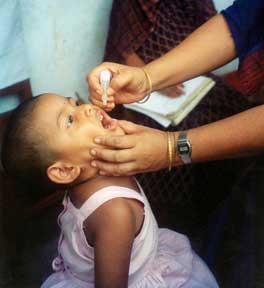
Polio_vaccine
The polio vaccine, developed by Dr.
Jonas Salk, is declared safe and effective.
Polio vaccine is a vaccine used to prevent poliomyelitis (polio). Two types are used: an inactivated poliovirus given by injection (IPV) and a weakened poliovirus given by mouth (OPV). The World Health Organization (WHO) recommends all children be fully vaccinated against polio. The two vaccines have eliminated polio from most of the world, and reduced the number of cases reported each year from an estimated 350,000 in 1988 to 33 in 2018.
1955
Space_Race
Space Race: The Soviet cosmonaut Yuri Gagarin becomes the first human to travel into outer space and perform the first crewed orbital flight, Vostok 1.
US–USSR spaceflight capability rivalry
The Space Race was a 20th-century competition between the Cold War rivals, the United States and the Soviet Union, to achieve superior spaceflight capability. It had its origins in the ballistic missile-based nuclear arms race between the two nations following World War II and the onset of the Cold War. The technological advantage demonstrated by spaceflight achievement was seen as necessary for national security, particularly in regard to intercontinental ballistic missile and satellite reconnaissance capability, but also became part of the cultural symbolism and ideology of the time. The Space Race brought pioneering launches of artificial satellites, robotic landers to the Moon, Venus, and Mars, and human spaceflight in low Earth orbit and ultimately to the Moon.
1961
Soviet_Union
The Soviet nuclear-powered submarine K-33 collides with the Finnish merchant vessel M/S Finnclipper in the Danish straits.
Country in Eurasia from 1922 to 1991
The Soviet Union, officially the Union of Soviet Socialist Republics (USSR), was a transcontinental country that spanned much of Eurasia from its formation in 1922 until its dissolution in 1991. It was the world's third-most populous country, the largest by area, and bordered twelve other countries. A diverse multinational state, it was organized as a federal union of national republics, with the largest and most populous being the Russian Soviet Federative Socialist Republic (SFSR). The world's flagship communist state, it was governed by the Communist Party under Marxism–Leninism, through soviet councils. The Soviet economy was also centrally planned. Its capital and largest city was Moscow.
1963
Soviet submarine K-8, carrying four nuclear torpedoes, sinks in the Bay of Biscay four days after a fire on board.
November-class submarine
K-8 was a November-class submarine of the Soviet Northern Fleet that sank in the Bay of Biscay with her nuclear weapons on board on April 12, 1970. A fire on April 8 had disabled the submarine and it was being towed in rough seas. Fifty-two crewmen were killed attempting the salvage of the submarine when it sank.
1970
The Americo-Liberian government of Liberia is violently deposed.
Military overthrow and execution of President William Tolbert
The 1980 Liberian coup d'état happened on April 12, 1980, when President William Tolbert of Liberia was overthrown and murdered in a violent coup. The coup was staged by an indigenous Liberian faction of the Armed Forces of Liberia (AFL) under the command of Master Sergeant Samuel Doe. Following a period of transition, Doe ruled Liberia throughout the 1980s, until his murder in 1990 during the First Liberian Civil War.
1980
Transbrasil_Flight_303
Transbrasil Flight 303, a Boeing 727, crashes on approach to Hercílio Luz International Airport in Florianópolis, Brazil.
Fifty-five out of the 58 people on board are killed.
Transbrasil Flight 303 was a scheduled flight from Congonhas-São Paulo Airport in São Paulo, Brazil, to Hercílio Luz International Airport in Florianópolis, Brazil, on 12 April 1980. The Boeing 727-27C crashed on approach to Hercílio Luz International Airport. Only 3 of the 58 people on board survived.
1980
Terry_Fox
Canadian runner and athlete, Terry Fox begins his Marathon of Hope Run in St.
John's, NF
Terrance Stanley Fox was a Canadian athlete, humanitarian, and cancer research activist. In 1980, having had one leg amputated due to cancer, he embarked on a cross-Canada run to raise money and awareness for cancer research. The annual Terry Fox Run, first held in 1981, has grown to involve millions of participants in over 60 countries and is the world's largest one-day fundraiser for cancer research; over C$1 billion has been raised in his name through the Terry Fox Research Institute as of February 2026.
1980
Space_Shuttle
The first launch of a Space Shuttle (Columbia) takes place: The STS-1 mission.
Partially reusable launch system and space plane
The Space Shuttle is a retired, partially reusable low Earth orbital spacecraft system operated from 1981 to 2011 by the U.S. National Aeronautics and Space Administration (NASA) as part of the Space Shuttle program. Its official program name was the Space Transportation System (STS), taken from the 1969 plan led by U.S. vice president Spiro Agnew for a system of reusable spacecraft where it was the only item funded for development.
1981
Harold_Washington
Harold Washington is elected as the first black mayor of Chicago.
Illinois politician and 51st mayor of Chicago
Harold Lee Washington was an American politician and lawyer who was the 51st mayor of Chicago from 1983 until his death in 1987. A member of the Democratic Party, he was the first Black person to hold the office.
1983
Space_Shuttle_Discovery
Space Shuttle Discovery launches on STS-51D to deploy two communications satellites.
Space Shuttle orbiter (1984–2011)
Space Shuttle Discovery is a retired American Space Shuttle orbiter. The spaceplane was one of the orbiters from NASA's Space Shuttle program and the third of five fully operational orbiters to be built. Its first mission, STS-41-D, flew from August 30 to September 5, 1984. Over 27 years of service it launched and landed 39 times, aggregating more spaceflights than any other spacecraft as of December 2024. The Space Shuttle launch vehicle had three main components: the Space Shuttle orbiter, a single-use central fuel tank, and two reusable solid rocket boosters. Nearly 25,000 heat-resistant tiles cover the orbiter to protect it from high temperatures on re-entry.
1985
Jim Gary's "Twentieth Century Dinosaurs" exhibition opens at the Smithsonian Institution National Museum of Natural History in Washington, D.C.
He is the only sculptor ever invited to present a solo exhibition there.
Jim Gary was an American sculptor popularly known for his large, colorful creations of dinosaurs made from discarded automobile parts. These sculptures were typically finished with automobile paint although some were left to develop a natural patina during display outdoors.
1990
Widerøe_Flight_839
Widerøe Flight 839 crashes after takeoff from Værøy Airport in Norway, killing five people.
1990 aviation accident in Norway
Widerøe Flight 839, also known as the Værøy Accident, was a de Havilland Canada DHC-6-300 Twin Otter that crashed shortly after takeoff from Værøy Airport in Værøy Municipality in Lofoten, Norway. The accident occurred on 12 April 1990 at 14:44, killing all five people on board. The cause of the accident was strong winds that exceeded the structure's tolerance, causing the tail rudder and tailplane to crack and the aircraft to become uncontrollable. Impact occurred 63 seconds after takeoff and 8 seconds after the crack. The aircraft crashed into the water and a search was conducted for several days to locate the wreckage.
1990
Disneyland_Park_(Paris)
The Euro Disney Resort officially opens with its theme park Euro Disneyland; the resort and its park's name are subsequently changed to Disneyland Resort Paris.
Theme park within Disneyland Paris
Disneyland Park, originally Euro Disneyland Park, is a theme park found at Disneyland Paris in Marne-la-Vallée, France. The park opened on 12 April 1992, as the first of the two parks built at the resort. Designed and built by Walt Disney Imagineering, its layout is similar to Disneyland Park at Disneyland Resort in California and Magic Kingdom Park at Walt Disney World in Florida. Spanning 56.656 ha —the second largest Disney park based on the original, after Shanghai Disneyland—it is dedicated to fairy tales and Disney characters.
1992
Bill_Clinton
United States President Bill Clinton is cited for contempt of court for giving "intentionally false statements" in a civil lawsuit; he is later fined and disbarred.
President of the United States from 1993 to 2001
William Jefferson Clinton is an American former politician and lawyer who served as the 42nd president of the United States from 1993 to 2001. A member of the Democratic Party, he previously served as the attorney general of Arkansas from 1977 to 1979 and as the governor of Arkansas from 1979 to 1981, and again from 1983 to 1992. His centrist "Third Way" political philosophy became known as Clintonism, which dominated his presidency and the succeeding decades of Democratic Party history.
1999
NATO_bombing_of_Yugoslavia
During the NATO bombing of Yugoslavia, an American McDonnell Douglas F-15E Strike Eagle shoots a passenger train, killing between 20 and 60 people.
1999 military operation
The North Atlantic Treaty Organization (NATO) carried out an aerial bombing campaign against the Federal Republic of Yugoslavia during the Kosovo War. The air strikes lasted from 24 March 1999 to 10 June 1999. The bombings continued until an agreement was reached that led to the withdrawal of the Yugoslav Army from Kosovo, and the establishment of the United Nations Interim Administration Mission in Kosovo, a UN peacekeeping mission in Kosovo. The official NATO operation code name was Operation Allied Force whereas the United States called it Operation Noble Anvil ; in Yugoslavia, the operation was incorrectly called Merciful Angel, possibly as a result of a misunderstanding or mistranslation.
1999
2002_Mahane_Yehuda_Market_bombing
A suicide bomber blows herself up at the entrance to Jerusalem's Mahane Yehuda Market, killing seven people and wounding 104.
Terrorist attack in Jerusalem
A suicide bombing occurred on 12 April 2002 at a bus stop located at the entrance to the Mahane Yehuda Market, Jerusalem's main fruit and vegetable market. The site of the attack was chosen in order to cause maximum number of casualties. 6 civilians were killed in the attack and 104 were injured. The al-Aqsa Martyrs' Brigades claimed responsibility for the attack.
2002
2007_Iraqi_Parliament_bombing
A suicide bomber penetrates the Green Zone and detonates in a cafeteria within a parliament building, killing Iraqi MP Mohammed Awad and wounding more than twenty other people.
Terrorist attack in Baghdad, Iraq
On 12 April 2007, the canteen of the Council of Representatives of Iraq building was attacked by a suicide bomber, killing one to eight people and wounding 23 others. The attack, in the heavily fortified Green Zone of Baghdad, occurred ten minutes after the Council of Representatives had adjourned for lunch. It was on the first floor of the Baghdad Convention Center, which houses the parliament. Two further unexploded suicide vests were found near the canteen. The building had earlier been searched by dogs – very rare considering dogs are considered ritually unclean by Iraqis – suggesting the authorities suspected an attack was imminent. Following the attack the government closed down mobile phone networks and Apache helicopters flew overhead.
2007
Zimbabwe
Zimbabwe officially abandons the Zimbabwean dollar as its official currency.
Country in Southeastern Africa
Zimbabwe, officially the Republic of Zimbabwe, is a landlocked country in Southeast Africa, between the Zambezi and Limpopo River, bordered by South Africa to the south, Botswana to the southwest, Zambia to the north, and Mozambique to the east. The capital and largest city is Harare, and the second largest is Bulawayo.
2009
Merano_derailment
Merano derailment: A rail accident in South Tyrol kills nine people and injures a further 28.
2010 railway accident in Italy
The Merano derailment occurred on 12 April 2010 when a train derailed between Latsch and Kastelbell, near Merano, Italy, after running into a landslide, causing nine deaths and injuring 28 people.
2010
Two suicide bombers kill three Chadian soldiers and injure dozens of civilians at a market in Kidal, Mali.
Terrorist attack in Mali
On 12 April 2013, four Chadian soldiers were killed, and five civilians were injured, in an attack by two suicide bombers affiliated with the MOJWA in Kidal, Mali.
2013
The Great Fire of Valparaíso ravages the Chilean city of Valparaíso, killing 16 people, displacing nearly 10,000, and destroying more than 2,500 homes.
2014 natural disaster in Chile
The Great Fire of Valparaíso started on 12 April 2014 at 16:40 local time, in the hills of the city of Valparaíso, Chile. The wildfire destroyed at least 2,500 homes, leaving 11,000 people homeless. An additional 6,000 people were evacuated from the city, which was placed on red alert and declared a disaster zone. Fifteen people were confirmed killed and ten suffered serious injuries.
2014

History runs on facts, and this project runs on coffee!

Your support is incredibly helpful and genuinely appreciated.

Support with a coffee ☕