July 14 in History

In a decree called the Gleichschaltung, Adolf Hitler abolishes all German politi

1933 — In a decree called the Gleichschaltung, Adolf Hitler abolishes all German political parties except the Nazis

July 14 spans 43 recorded events across recorded history, from 982 to 2019. Below is a curated digest of the most significant moments tied to this date.

By · Wikipedia

Historical Events 43 events 982 – 2019

More major events on July 14

The featured story and these ranked highlights form a quick summary. Every recorded event remains available in the chronology below.

  1. 1798 The Sedition Act of 1798 becomes law in the United States making it a federal crime to write, publish, or utter false or malicious statements about the United States government. Source
  2. 1902 Peruvian explorer and farmer Agustín Lizárraga discovers Machu Picchu, the "Lost City of the Incas". Source
  3. 1942 In the Wardha session of Congress, the "Quit India" resolution is approved, authorising Mahatma Gandhi to campaign for India's independence from Britain. Source

Did you know

Adolf Hitler was born in Braunau am Inn, Austria, on April 20, 1889, and died on April 30, 1945, in Berlin, Germany.

Did you know

The Nazi Party, led by Hitler, gained popularity in Germany during the Great Depression, which started in 1929.

Did you know

Hitler's invasion of Poland on September 1, 1939, led to the declaration of war by France and the United Kingdom.

Did you know

The Holocaust, perpetrated under Hitler's leadership, resulted in the deaths of approximately six million Jews during World War II.

Did you know

Hitler's title of Führer und Reichskanzler, taken in 1934, solidified his position as the dictator of Germany until his death in 1945.


Otto_II,_Holy_Roman_Emperor
King Otto II and his Frankish army are defeated by the Muslim army of al-Qasim at Cape Colonna, Southern Italy.
Holy Roman Emperor from 973 to 983
Otto II, called the Red, was Holy Roman Emperor from 973 until his death in 983. A member of the Ottonian dynasty, he was the youngest and sole surviving son of Otto the Great and Adelaide of Italy.
982
Louis_VIII_of_France
Louis VIII becomes King of France upon the death of his father, Philip II.
King of France from 1223 to 1226
Louis VIII, nicknamed The Lion, was King of France from 1223 to 1226. As a prince, he invaded England on 21 May 1216 and was excommunicated by a papal legate on 29 May 1216. On 2 June 1216, Louis was proclaimed "King of England" by rebellious barons in London, though never crowned. With the assistance of allies in England and Scotland he gained control of approximately one third of the English kingdom and part of southern Wales. He was eventually defeated by English loyalists and those barons who swapped sides following the death of King John. After the Treaty of Lambeth, he was paid 10,000 marks, pledged never to invade England again, and was absolved of his excommunication.
1223
Battle_of_Vítkov_Hill
Battle of Vítkov Hill, decisive victory of Czech Hussite forces commanded by Jan Žižka against Crusade army led by Sigismund, Holy Roman Emperor.
1420 battle in Prague
The Battle of Vítkov Hill was a part of the Hussite Wars. The battle pitted the forces of King Sigismund, against Hussite forces under command of Jan Žižka. Vítkov Hill was located on the edge of the city of Prague and the battle occurred in a vineyard established by Sigismund's father, Charles IV. It ended with a decisive Hussite victory.
1420
Joan_of_Arc
Joan of Arc, taken by the Burgundians in May, is handed over to Pierre Cauchon, the bishop of Beauvais.
French folk heroine and saint (1412–1431)
Joan of Arc is a patron saint of France, honored as a defender of the French nation for her role in the siege of Orléans and her insistence on the coronation of Charles VII of France during the Hundred Years' War. Stating that she acted under divine guidance, she became a military leader who gained recognition as a savior of France.
1430
John_Hunyadi
John Hunyadi and his forces defeat the Ottoman fleet on the Danube, allowing them to reinforce and supply the besieged city of Belgrade.
Hungarian military and political figure (c. 1406–1456)
John Hunyadi was a leading Hungarian military and political figure during the 15th century, who served as regent of the Kingdom of Hungary from 1446 to 1453, under the minor Ladislaus V.
1456
Anglo-Spanish_War_(1585–1604)
Anglo-Spanish War: English and Dutch troops sack the Spanish city of Cádiz before leaving the next day.
War between the kingdoms of Spain and England
The Anglo-Spanish War (1585–1604) was an intermittent conflict between Habsburg Spain and the Kingdom of England that was never formally declared. It began with England's military expedition in 1585 to what was then the Spanish Netherlands under the command of Robert Dudley, Earl of Leicester, in support of the Dutch rebellion against Spanish Habsburg rule.
1596
Portolá_expedition
An expedition led by Gaspar de Portolá leaves its base in San Diego and sets out to find the Port of Monterey (now Monterey, California).
Exploration of the present-day state of California, United States, 1769–1770
The Portolá expedition was a Spanish voyage of exploration in 1769–1770 that was the first recorded European exploration of the interior of the present-day California. It was led by Gaspar de Portolá, governor of Las Californias, the Spanish colonial province that included California, Baja California, and other parts of present-day Mexico and the United States. The expedition led to the founding of Alta California and contributed to the solidification of Spanish territorial claims in the disputed and unexplored regions along the Pacific coast of North America.
1769
Mission_San_Antonio_de_Padua
Foundation of the Mission San Antonio de Padua in modern California by the Franciscan friar Junípero Serra.
18th-century Spanish mission in California
Mission San Antonio de Padua is a Spanish mission established by the Franciscan order in present-day Monterey County, California, near the present-day town of Jolon. Founded on July 14, 1771, it was the third mission founded in Alta California by Father Presidente Junípero Serra. The mission was the first use of fired tile roofing in Upper California. Today the mission is a parish church of the Diocese of Monterey and is no longer active in the mission work which it was set up to provide.
1771
Storming_of_the_Bastille
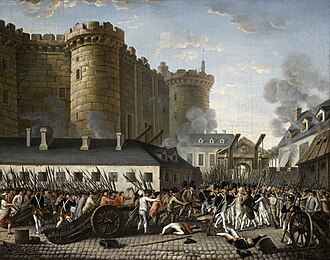
Storming of the Bastille in Paris.
This event escalates the widespread discontent into the French Revolution. Bastille Day is still celebrated annually in France.
The Storming of the Bastille, also known as Fall of the Bastille, which occurred in Paris, France, on 14 July 1789, was an act of political violence by revolutionary insurgents who attempted to storm and seize control of the medieval armoury, fortress, and political prison known as the Bastille. After four hours of fighting and 94 deaths, the insurgents were able to enter the Bastille. The governor of the Bastille, Bernard-René Jourdan de Launay, and several members of the garrison were killed after surrendering. At the time, the Bastille represented royal authority in the centre of Paris. The prison contained only seven inmates at the time of its storming and was already scheduled for demolition but was seen by the revolutionaries as a symbol of the monarchy's abuse of power. Its fall was the flashpoint of the French Revolution.
1789
Fête_de_la_Fédération
Inaugural Fête de la Fédération is held to celebrate the unity of the French people and the national reconciliation.
1790 national holiday festival in France
The Fête de la Fédération was a massive holiday festival held throughout France in 1790 in honour of the French Revolution, celebrating the Revolution itself, as well as national unity.
1790
Priestley_Riots
Beginning of Priestley Riots (to 17 July) in Birmingham targeting Joseph Priestley as a supporter of the French Revolution.
1791 religious riots in Birmingham, England
The Priestley Riots took place from 14 July to 17 July 1791 in Birmingham, Warwickshire, England; the rioters' main targets were religious dissenters, most notably the politically and theologically controversial Joseph Priestley. Both local and national issues stirred the passions of the rioters, from disagreements over public library book purchases, controversies over Dissenters' attempts to gain full civil rights and their support of the French Revolution.
1791
The Sedition Act of 1798 becomes law in the United States making it a federal crime to write, publish, or utter false or malicious statements about the United States government.
Set of 1798 laws in the United States
The Alien and Sedition Acts of 1798 were four U.S. statutes that restricted naturalization, empowered the president of the United States to detain and deport foreigners, and criminalized false or malicious statements against the federal government. The laws were endorsed by the Federalist Party, led by President John Adams, on national security grounds in response to the later stages of the French Revolution and ongoing disputes with the French revolutionary government which had culminated in naval skirmishes. The prosecution of American journalists under the Sedition Act rallied public support for the opposition, led by Thomas Jefferson, who defeated Adams in the presidential election of 1800.
1798
Finnish_War
The Finnish War: the Battle of Lapua is fought.
1808–1809 war between Russia and Sweden
The Finnish War was fought between the Kingdom of Sweden and the Russian Empire from 21 February 1808 to 17 September 1809 as part of the Napoleonic Wars. As a result of the war, the eastern third of Sweden was established as the autonomous Grand Duchy of Finland within the Russian Empire. Other notable effects were the Swedish parliament's adoption of a new constitution and the establishment of the House of Bernadotte, the new Swedish royal house, in 1818.
1808
World's_fair
Opening of the first major US world's fair, the Exhibition of the Industry of All Nations in New York City.
Large international exhibition
A world's fair, also known as a universal exhibition, is a large global exhibition designed to showcase the achievements of nations. These exhibitions vary in character and are held in different parts of the world at a specific site for a period of time, typically between three and six months.
1853
First_ascent_of_the_Matterhorn
The first ascent of the Matterhorn is completed by Edward Whymper and his party, four of whom die on the descent.
1865 expedition in the Pennine Alps
The first ascent of the Matterhorn was a mountaineering expedition of the Matterhorn made by Edward Whymper, Lord Francis Douglas, Charles Hudson, Douglas Hadow, Michel Croz, and two Zermatt guides, Peter Taugwalder and his son of the same name, on 14 July 1865. Douglas, Hudson, Hadow and Croz were killed on the descent when Hadow slipped and pulled the other three with him down the north face. Whymper and the Taugwalder guides, who survived, were later accused of having cut the rope below to ensure that they were not dragged down with the others, but the subsequent inquiry found no evidence of this and they were acquitted.
1865
Chicago_Fire_of_1874
The Chicago Fire of 1874 burns down 47 acres of the city, destroying 812 buildings, killing 20, and resulting in the fire insurance industry demanding municipal reforms from Chicago's city council.
American fire
The Chicago Fire of 1874 took place on July 14. Reports of the extent of the damage vary somewhat, but sources generally agree that the fire burned 47 acres (19 ha) just south of the Loop, destroyed 812 structures and killed 20 people. The affected neighborhood had been home to Chicago's community of Jewish immigrants from Russia and Poland, as well as to a significant population of middle-class African-American families; both ethnic groups were displaced in the aftermath of the fire to other neighborhoods on the city's West and South Sides.
1874
Billy_the_Kid
American outlaw Billy the Kid is shot and killed by Sheriff Pat Garrett in the Maxwell House at Fort Sumner, New Mexico.
American outlaw and gunfighter (1859–1881)
Henry McCarty, alias William H. Bonney, better known as Billy the Kid, was an American outlaw and gunfighter of the Old West who was linked to nine murders. He was solely responsible for four of them, and he may have played a role in five, alongside other men. He is also noted for his involvement in New Mexico's Lincoln County War.
1881
Eight-Nation_Alliance
Armies of the Eight-Nation Alliance capture Tientsin during the Boxer Rebellion.
Coalition that invaded China (1900–01)
The Eight-Nation Alliance was a multinational military coalition that invaded northern China in 1900 during the Boxer Rebellion, with the stated aim of relieving the foreign legations in Beijing, which were being besieged by the popular Boxer militiamen, who were determined to remove foreign imperialism in China. The allied forces consisted of about 45,000 troops from the eight nations of Germany, Japan, Russia, Britain, France, the United States, Italy, and Austria-Hungary. Neither the Chinese nor the quasi-concerted foreign allies issued a formal declaration of war.
1900
Agustín_Lizárraga
Peruvian explorer and farmer Agustín Lizárraga discovers Machu Picchu, the "Lost City of the Incas".
Peruvian explorer and farmer (1865–1912)
Agustín Lizárraga Ruiz was a Peruvian explorer and farmer who visited the Inca site of Machu Picchu on 14 July 1902, nine years before American explorer Hiram Bingham brought it to international attention.
1902
St_Mark's_Campanile
The Campanile in St Mark's Square, Venice collapses, also demolishing the loggetta.
Basilica bell tower in Venice, Italy
St Mark's Campanile is the bell tower of St Mark's Basilica in Venice, Italy. The campanile is a reconstruction completed in 1912, the previous tower having collapsed in 1902. At 98.6 metres (323 ft) in height, it is the tallest structure in Venice and is colloquially termed "el paròn de casa". It is one of the most recognizable symbols of the city.
1902
Harry_Atwood
Harry Atwood, an exhibition pilot for the Wright brothers, is greeted by president William Howard Taft after he lands his aeroplane on the South Lawn of the White House, having flown from Boston.
American inventor, engineer, and aviation pioneer (1883–1967)
Harry Nelson Atwood was an American engineer and inventor known for pioneering work in the early days of aviation, including setting long-distance flying records and delivering the first air mail in New England.
1911
Beginning of the McMahon–Hussein Correspondence between Hussein bin Ali, Sharif of Mecca and the British official Henry McMahon concerning the Arab Revolt against the Ottoman Empire.
1915–16 letters on UK recognition of Arab independence
The McMahon–Hussein correspondence is a series of letters that were exchanged during World War I, in which the government of the United Kingdom agreed to recognize Arab independence in a large region after the war in exchange for the Sharif of Mecca launching the Arab Revolt against the Ottoman Empire. The correspondence had a significant influence on Middle Eastern history during and after the war; a dispute over Palestine continued thereafter.
1915
World_War_I
World War I: Battle of Delville Wood begins as an action within the Battle of the Somme, lasting until 3 September 1916.
Global conflict from 1914 to 1918
World War I, or the First World War, also known as the Great War, was a global conflict between two coalitions: the Allies and the Central Powers. Major theatres of war included Europe and the Middle East, and well as parts of Africa and the Asia-Pacific. One of the deadliest conflicts in history, World War I resulted in an estimated 15 to 22 million deaths, including in mass war crimes against civilians and genocides. The conflict saw important developments in weaponry, including the first large-scale use of machine guns, artillery, aircraft, chemical weapons, and tanks, and was a major factor in the deadly Spanish flu pandemic.
1916
Nazi_eugenics
Nazi eugenics programme begins with the proclamation of the Law for the Prevention of Hereditarily Diseased Offspring requiring the compulsory sterilization of any citizen who suffers from alleged genetic disorders.
Nazi German policy of the murder of "undesirable" persons
The social policies of eugenics in Nazi Germany were composed of various ideas about genetics. The racial ideology of Nazism placed the biological improvement of the German people by selective breeding of "Nordic" or "Aryan" traits at its center. These policies were used to justify the involuntary sterilization and mass murder of those deemed "undesirable".
1933
Wardha
In the Wardha session of Congress, the "Quit India" resolution is approved, authorising Mahatma Gandhi to campaign for India's independence from Britain.
City in Maharashtra, India
Wardha is a city and a municipal council in Wardha district in the Indian state of Maharashtra. The administrative headquarter of Wardha district is situated here. Wardha gets its name from the Wardha River which flows on the northern, western and southern boundaries of the district. Founded in 1866, the town is now an important centre for cotton trade.
1942
Diamond,_Missouri
In Diamond, Missouri, the George Washington Carver National Monument becomes the first United States National Monument in honor of an African American.
City in Missouri, United States
Diamond is a city in north central Newton County, Missouri, United States, located southeast of Joplin. The population was 831 at the 2020 census. It is part of the Joplin, Missouri, Metropolitan Statistical Area. Diamond is primarily renowned as the birthplace of George Washington Carver.
1943
Palmiro_Togliatti
Palmiro Togliatti, leader of the Italian Communist Party, is shot and wounded near the Italian Parliament.
Italian politician and statesman (1893–1964)
Palmiro Michele Nicola Togliatti was an Italian politician and statesman who led the Italian Communist Party for nearly forty years, from 1927 until his death. Born into a middle-class family, Togliatti received an education in law at the University of Turin, later served as an officer and was wounded in World War I, and became a tutor. Described as "severe in approach but extremely popular among the Communist base" and "a hero of his time, capable of courageous personal feats", his supporters gave him the nickname il Migliore. In 1930, Togliatti renounced Italian citizenship, and he became a citizen of the Soviet Union; upon his death, a Soviet city was named after him. Considered one of the founding fathers of the Italian Republic, he led Italy's Communist party from a few thousand members in 1943 to two million members in 1946.
1948
Korean_War
Korean War: beginning of the Battle of Taejon.
1950–1953 conflict on the Korean Peninsula
The Korean War was an armed conflict fought on the Korean Peninsula between North Korea and South Korea and their allies. North Korea was supported by China and the Soviet Union, while South Korea was supported by the United Nations led by the United States under the auspices of the United Nations Command (UNC).
1950
Scuderia_Ferrari
Ferrari take their first Formula One grand prix victory at the British Grand Prix at Silverstone.
Italian Formula One team
Ferrari S.p.A, currently competing as Scuderia Ferrari HP, is the racing division of luxury Italian auto manufacturer Ferrari and the racing team that competes in Formula One racing. The team is also known by the nickname "the Prancing Horse", in reference to their logo. It is the oldest surviving and most successful Formula One team, having competed in every World Championship since 1950.
1951
Rawya_Ateya
Rawya Ateya takes her seat in the National Assembly of Egypt, thereby becoming the first female parliamentarian in the Arab world.
Egyptian politician (1926 – 1997)
Rawya Ateya[I] was an Egyptian woman who became the first female parliamentarian in the Arab world in 1957.
1957
14_July_Revolution
In the 14 July Revolution in Iraq, the monarchy is overthrown by popular forces led by Abd al-Karim Qasim, who becomes the nation's new leader.
Iraqi military coup in 1958
The 14 July Revolution, also known as the 1958 Iraqi military coup, was a military coup that took place on 14 July 1958 in Iraq, resulting in the toppling of King Faisal II and the overthrow of the Hashemite-led Kingdom of Iraq. The Iraqi Republic established in its wake ended the Hashemite Arab Federation between Iraq and Jordan that had been established just six months earlier.
1958
Jane_Goodall
Jane Goodall arrives at the Gombe Stream Reserve in present-day Tanzania to begin her study of chimpanzees in the wild.
English zoologist (1934–2025)
Dame Valerie Jane Morris Goodall was an English primatologist and anthropologist. Regarded as a pioneer in primate ethology, and described by many publications as "the world's preeminent chimpanzee expert", she was best known for more than six decades of field research on the social and family life of wild chimpanzees in the Kasakela chimpanzee community at Gombe Stream National Park in Tanzania. Beginning in 1960, under the mentorship of the palaeontologist Louis Leakey, Goodall's research demonstrated that chimpanzees share many key traits with humans, such as using tools, having complex emotions, forming lasting social bonds, engaging in organised warfare, and passing on knowledge across generations, which redefined the traditional view that humans are uniquely different from other animals.
1960
Northwest_Orient_Airlines_Flight_1-11
Northwest Orient Airlines Flight 1-11 ditches off Polillo Island in the Philippines, killing one person and injuring 44.
1960 aviation accident
Northwest Orient Airlines Flight 1–11 was a Northwest Orient Airlines flight from New York City to Manila, with stopovers in Seattle, Anchorage, Tokyo, and Okinawa. On July 14, 1960, the Douglas DC-7C serving the flight ditched in the ocean 8 km (5.0 mi) northeast off Polillo Island, Quezon, Philippines. Of the 58 people on board, 57 survived with 44 suffering from minor injuries and 1 passenger losing her life.
1960
Mariner_4
Mariner 4 flyby of Mars takes the first close-up photos of another planet.
The photographs take approximately six hours to be transmitted back to Earth.
Mariner 4 was the fourth in a series of spacecraft intended for planetary exploration in a flyby mode. It was designed to conduct closeup scientific observations of Mars and to transmit these observations to Earth. Launched on November 28, 1964, Mariner 4 performed the first successful flyby of the planet Mars, returning the first close-up pictures of the Martian surface. It captured the first images of another planet ever returned from deep space; their depiction of a cratered, dead planet largely changed the scientific community's view of life on Mars. Other mission objectives were to perform field and particle measurements in interplanetary space in the vicinity of Mars and to provide experience in and knowledge of the engineering capabilities for interplanetary flights of long duration. Initially expected to remain in space for eight months, Mariner 4's mission lasted about three years in solar orbit. On December 21, 1967, communications with Mariner 4 were terminated.
1965
Mario_Bros.
Mario Bros.
is released in Japan, beginning the popular Super Mario Bros franchise.
Mario Bros. is a 1983 platform game developed and published by Nintendo for arcades. It was designed by Shigeru Miyamoto and Gunpei Yokoi, Nintendo's chief engineer. Players control Italian twin brother plumbers Mario and Luigi as they exterminate turtle-like creatures, giant flies, and crabs emerging from the sewers of New York City by knocking them upside-down and kicking them away. The Famicom/NES version was the first game to be developed by Intelligent Systems. It is part of the Mario franchise and the first spin-off of the Donkey Kong series.
1983
Bradley_John_Murdoch
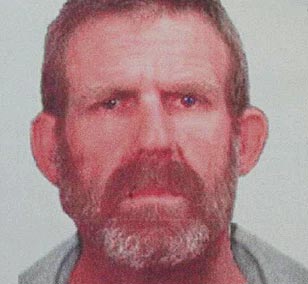
Australian criminal Bradley John Murdoch murders British tourist Peter Falconio and abducts his girlfriend in the Northern Territory.
Australian murderer (1958–2025)
Bradley John Murdoch was an Australian criminal who served a sentence of life imprisonment for the July 2001 murder of English backpacker Peter Falconio in Australia. Murdoch was held in Darwin Correctional Centre in Darwin, Northern Territory. He lodged two appeals against his conviction, both of which were unsuccessful. He was forbidden to talk to the press.
2001
Rus_Flight_9633
Rus Flight 9633 crashes during takeoff from Chkalovsky Airport, killing all 10 people on board.
2001 aviation accident in Russia
Rus Flight 9633 refers to the crash involving an IL-76TD aircraft operated by Rus Airlines from Chkalovsky Airport to Taiyuan Wusu Airport with intermediate stops at Alykel Airport and Bratsk Airport. On July 14, 2001, the plane crashed a few seconds after takeoff from Chkalovsky Airport. All 10 people on board were killed.
2001
Jacques_Chirac
French president Jacques Chirac escapes an assassination attempt from Maxime Brunerie during a Bastille Day parade at Champs-Élysées.
President of France from 1995 to 2007
Jacques René Chirac was President of France from 1995 to 2007. He was previously Prime Minister of France from 1974 to 1976 and 1986 to 1988, as well as Mayor of Paris from 1977 to 1995.
2002
Statue_of_Rachel_Carson
Dedication of the statue of Rachel Carson, a sculpture of the environmentalist, in Woods Hole, Massachusetts.
Monument in Woods Hole, Massachusetts, United States
An outdoor sculpture depicting the biologist, conservationist, and author Rachel Carson by David Lewis was installed in Waterfront Park in Woods Hole, Massachusetts, United States, on July 14, 2013.
2013
NASA
NASA's New Horizons probe performs the first flyby of Pluto, and thus completes the initial survey of the Solar System.
American space and aeronautics agency
The National Aeronautics and Space Administration is an independent agency of the U.S. federal government responsible for the United States' civil space program, as well as research in aeronautics and space. Headquartered in Washington, D.C., NASA operates ten field centers across the US and is organized into three mission directorates: Human Spaceflight, Research and Technology, and Science. Established in 1958 amid the Space Race, NASA succeeded the National Advisory Committee for Aeronautics (NACA) to give the US space program a distinct civilian orientation focused on peaceful applications. Since then, it has led most American spaceflight programs, including Project Mercury, Project Gemini, the Apollo program, Skylab, the Space Shuttle, the International Space Station (ISS), and the ongoing multi-national Artemis program.
2015
2016_Nice_truck_attack
A man ploughs a truck into a Bastille Day celebration in Nice, France, killing 86 people and injuring another 434 before being shot by police.
2016 Islamist terrorist attack in France
On the evening of 14 July 2016, a 19-tonne cargo truck was deliberately driven into crowds of people celebrating Bastille Day on the Promenade des Anglais in Nice, France, resulting in the deaths of 86 people and injuring 458 others. The driver was Mohamed Lahouaiej-Bouhlel, a Tunisian living in France. The attack ended following an exchange of gunfire, during which he was shot and killed by police.
2016
GippsAero_GA8_Airvan
A GippsAero GA8 Airvan crashes in Umeå, Sweden, killing all nine aboard.
Single engine shoulder-wing utility aircraft
The GippsAero GA8 Airvan is a single-engined utility aircraft manufactured by GippsAero of Victoria, Australia. It can seat up to eight people, including the pilot.
2019

History runs on facts, and this project runs on coffee!

Your support is incredibly helpful and genuinely appreciated.

Support with a coffee ☕