July 6 in History

First Battle of Algeciras: Outnumbered French Navy ships defeat the Royal Navy i

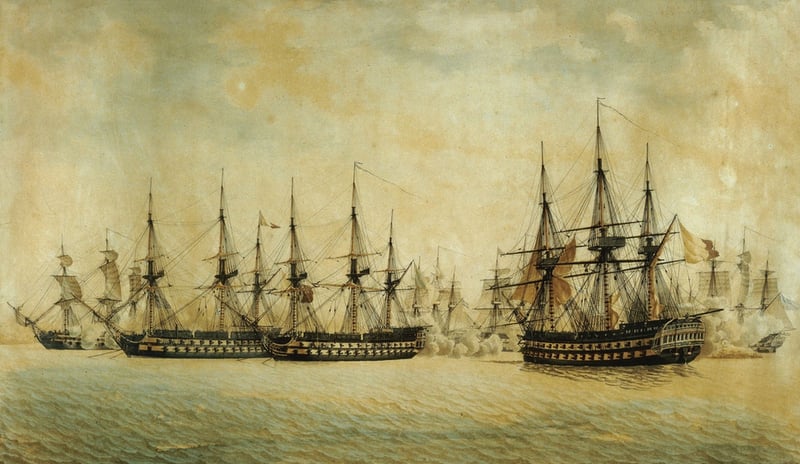
1801 — First Battle of Algeciras: Outnumbered French Navy ships defeat the Royal Navy in the fortified Spanish port of Algeciras

July 6 spans 67 recorded events across recorded history, from 371 BC to 2022. Below is a curated digest of the most significant moments tied to this date.

By · Wikipedia

Historical Events 67 events 371 BC – 2022

More major events on July 6

The featured story and these ranked highlights form a quick summary. Every recorded event remains available in the chronology below.

  1. 1495 First Italian War: Battle of Fornovo: Charles VIII defeats the Holy League. Source
  2. 1791 At Padua, the Emperor Leopold II calls on the monarchs of Europe to join him in demanding the king of France Louis XVI's freedom. Source
  3. 1809 The second day of the Battle of Wagram; France defeats the Austrian army in the largest battle to date of the Napoleonic Wars. Source

Did you know

In 1801, First Battle of Algeciras: Outnumbered French Navy ships defeat the Royal Navy in the fortified Spanish port of Algeciras. This featured entry focuses on the immediate decision and its direct historical impact.
Did you know

The First Battle of Algeciras was fought on 6 July 1801 between a Royal Navy squadron and a smaller French Navy squadron lying at anchor in the Spanish port of Algeciras during the Algeciras campaign of the War of the Second Coalition. This helps explain why the event mattered beyond the initial announcement.

Did you know

The French squadron, under Counter-Admiral Charles-Alexandre Léon Durand Linois, had stopped at Algeciras en route to the major Spanish naval base at Cádiz, where they were to form a combined French and Spanish fleet for operations against Britain and its allies in the French Revolutionary Wars. This clarifies the institutional and public response around the event.

Did you know

The British, under Rear-Admiral Sir James Saumarez, sought to eliminate the French squadron before it could reach Cádiz and form a force powerful enough to overwhelm Saumarez and launch attacks against British forces in the Mediterranean Sea. This shows how the event shaped policy and public communication in the same period.

Did you know

Although the British heavily outnumbered their opponents, Linois found a strong defensive position that combined Spanish coastal defences with the complicated shoals that obscured the entrance to Algeciras Bay. This helps explain why the event mattered beyond the initial announcement.


Battle_of_Leuctra
The Battle of Leuctra shatters Sparta's reputation of military invincibility.
Thebes' victory against Sparta in 371 BC
The Battle of Leuctra was fought on 6 July 371 BC between the Boeotians led by the Thebans, and the Spartans along with their allies. The battle occurred in the context of the King's Peace, or Peace of Antalcidas, which had ended the Corinthian War in 386 BC. The Peace was formally renewed in 375 BC, but a disagreement between the Spartans and the Thebans over the protocol for renewing the Peace again in 371 led directly to the battle, which took place in the vicinity of Leuctra, a village in Boeotia in the territory of Thespiae. The mainly Theban victory shattered Sparta's immense influence over the Greek peninsula, and the wider Aegean Greek world, which Sparta had gained with its victory in the Peloponnesian War a generation earlier.
-371
Temple_of_Jupiter_Optimus_Maximus
The Temple of Jupiter on the Capitoline Hill in Rome is burned down and the Sibylline books of prophecy destroyed with it.
Temple on the Capitoline Hill of Ancient Rome
The Temple of Jupiter Optimus Maximus, also known as the Temple of Jupiter Capitolinus, was the most important temple in Ancient Rome, located on the Capitoline Hill. It was surrounded by the Area Capitolina, a precinct where numerous shrines, altars, statues and victory trophies were displayed.
-83
Battle of Heliopolis: The Muslim Arab army under 'Amr ibn al-'As defeat the Byzantine forces near Heliopolis (Egypt).
640 battle between the Byzantine Empire and Rashidun Caliphate
The Battle of Heliopolis or Ayn Shams was a decisive battle in 640 between Arab Muslim armies and Byzantine Empire forces for the control of Egypt. Though there were several major skirmishes after this battle, it effectively decided the fate of the Byzantine rule in Egypt, and opened the door for the Muslim conquest of the Roman Exarchate of Africa.
640
Mindaugas
Mindaugas is crowned King of Lithuania.
Grand Duke (1236–1251) and King (c. 1251–1263) of Lithuania
Mindaugas was the first known Grand Duke of Lithuania and the only crowned King of Lithuania. Little is known of his origins, early life, or rise to power; he is mentioned in a 1219 treaty as an elder duke, and in 1236 as the leader of all the Lithuanians. The contemporary and modern sources discussing his ascent mention strategic marriages along with banishment or murder of his rivals. He extended his domain into regions southeast of Lithuania proper during the 1230s and 1240s. In 1250 or 1251, during the course of internal power struggles, he was baptised as a Roman Catholic; this action enabled him to establish an alliance with the Livonian Order, a long-standing antagonist of the Lithuanians. By 1245, Mindaugas was already being referred to as "the highest king" in certain documents. During the summer of 1253, he was crowned king, ruling between 300,000 and 400,000 subjects, and was nicknamed as Mindaugas the Sapient by the Livonians.
1253
Pope_Clement_VI
Pope Clement VI issues a papal bull protecting the Jews accused of having caused the Black Death.
Head of the Catholic Church from 1342 to 1352
Pope Clement VI, born Pierre Roger, was head of the Catholic Church from 7 May 1342 to his death, in December 1352. He was the fourth Avignon pope. Clement reigned during the first visitation of the Black Death (1348–1350), during which he granted remission of sins to all who died of the plague.
1348
Ming_dynasty
Ming China's Admiral Zheng He returns to Nanjing after the third treasure voyage and presents the Sinhalese king, captured during the Ming–Kotte War, to the Yongle Emperor.
Imperial dynasty of China (1368–1644)
The Ming dynasty, officially the Great Ming, was an imperial dynasty of China that ruled from 1368 to 1644, following the collapse of the Mongol-led Yuan dynasty. The Ming was the last imperial dynasty of China ruled by the Han people, the majority ethnic group in China. Although the primary capital of Beijing fell in 1644 to a rebellion led by Li Zicheng, numerous rump regimes ruled by remnants of the Ming imperial family, collectively called the Southern Ming, survived until 1662.
1411
Jan_Hus
Jan Hus is condemned by the assembly of the council in the Konstanz Cathedral as a heretic and sentenced to be burned at the stake.
Czech theologian, philosopher, and martyr (c. 1369–1415)
Jan Hus, sometimes anglicized as John Goose or John Huss, and referred to in historical texts as Iohannes Hus or Johannes Huss, was a Czech theologian and philosopher who became a Church reformer and the inspiration of Hussitism, a key predecessor to Protestantism, and a seminal figure in the Bohemian Reformation. Hus is considered to be the first Church reformer, even though some designate the theorist John Wycliffe. His teachings had a strong influence, most immediately in the approval of a reformed Bohemian religious denomination and, over a century later, on Martin Luther.
1415
A temporary compromise between the rebellious Transylvanian peasants and the noblemen is signed in Kolozsmonostor Abbey.
1437–38 revolt in Kingdom of Hungary
The Transylvanian peasant revolt, also known as the Bábolna revolt was a popular revolt in the eastern territories of the Kingdom of Hungary in 1437. The revolt broke out after George Lépes, bishop of Transylvania, had failed to collect the tithe for years because of a temporary debasement of the coinage, but then demanded the arrears in one sum when coins of higher value were again issued. Most commoners were unable to pay the demanded sum, but the bishop did not renounce his claim and applied interdict and other ecclesiastic penalties to enforce the payment.
1438
Catholic_Church
The reunion of the Catholic and Orthodox Church is proclaimed and celebrated with a public holiday.
Christian church based in Rome
The Catholic Church, also called the Roman Catholic Church, is the largest Christian church, with an estimated 1.28 to 1.41 billion baptized members worldwide as of 2026. It consists of 24 autonomous churches—the Latin Church and 23 Eastern Catholic Churches—organized into nearly 3,500 dioceses and eparchies governed by bishops. Throughout history, the church has had a large role in the development of Western civilization. Catholic communities are present worldwide through missions, immigration, and conversions. The majority of Catholics live in the Global South, reflecting rapid demographic growth in Africa, Asia, and Latin America, as well as secularization in parts of Europe and North America.
1439
Richard_III_of_England
Richard III and Anne Neville are crowned King and Queen of England.
King of England from 1483 to 1485
Richard III was King of England from 26 June 1483 until his death in 1485. He was the last king of the Plantagenet dynasty and its cadet branch, the House of York. His defeat and death at the Battle of Bosworth Field marked the end of the Middle Ages in England.
1483
Diogo_Cão
Portuguese sea captain Diogo Cão finds the mouth of the Congo River.
Portuguese explorer (1452–1486)
Diogo Cão, also known as Diogo Cam, was a Portuguese mariner and one of the most notable explorers of the fifteenth century. He made two voyages along the west coast of Africa in the 1480s, exploring the Congo River and the coasts of present-day Angola and Namibia.
1484
Italian_War_of_1494–1495
First Italian War: Battle of Fornovo: Charles VIII defeats the Holy League.
First phase of the Italian Wars (1494–1497)
The First Italian War, or Charles VIII's Italian War, was the opening phase of the Italian Wars. The war pitted Charles VIII of France, who had initial Milanese aid, against the Holy Roman Empire, Spain and an alliance of Italian powers led by Pope Alexander VI, known as the League of Venice.
1495
Thomas_More
Thomas More is executed after having been condemned on perjured evidence.
English politician, author and philosopher (1478–1535)
Sir Thomas More, venerated in the Catholic Church as a martyr and saint, was an English lawyer, judge, social philosopher, author, statesman, theologian and Renaissance humanist. He also served Henry VIII as Lord Chancellor from October 1529 to May 1532. He wrote Utopia, published in 1516, which describes the political system of an imaginary island state.
1536
Jacques_Cartier
The explorer Jacques Cartier lands at St.
Malo at the end of his second expedition to North America. He returns with none of the gold he expected to find.
Jacques Cartier was a French maritime explorer from Brittany. Jacques Cartier was the first European to describe and map the Gulf of Saint Lawrence and the shores of the Saint Lawrence River, which he named "Canada" after the Iroquoian names for the two big settlements he saw at Stadacona and at Hochelaga.
1536
Philip_II_of_Spain
King Philip II of Spain, consort of Queen Mary I of England, sets out from Dover to war with France, which eventually resulted in the loss of the city of Calais, the last English possession on the continent, and Mary I never seeing her husband again.
King of Spain (1556–1598) and Portugal (1580–1598)
Philip II, sometimes known in Spain as Philip the Prudent, was King of Spain from 1556, King of Portugal from 1580, and King of Naples and Sicily from 1554 until his death in 1598. He was also jure uxoris King of England and Ireland from his marriage to Queen Mary I in 1554 until her death in 1558. Further, he was Duke of Milan from 1540. From 1555, he was Lord of the Seventeen Provinces of the Netherlands.
1557
The Treaty of Edinburgh is signed by Scotland and England.
Anglo-French treaty ending the siege of Leith, 1560
The Treaty of Edinburgh was a treaty drawn up on 5 July 1560 between the Commissioners of Queen Elizabeth I of England with the assent of the Scottish Lords of the Congregation, and the French representatives of King Francis II of France to formally conclude the siege of Leith and replace the Auld Alliance with France with a new Anglo-Scottish accord, while maintaining the peace between England and France agreed by the Treaty of Cateau-Cambrésis.
1560
Córdoba,_Argentina
Córdoba, Argentina, is founded by Jerónimo Luis de Cabrera.
City in Argentina
Córdoba is a city in central Argentina, in the foothills of the Sierras Chicas on the Suquía River, about 700 km (435 mi) northwest of Buenos Aires. It is the capital of Córdoba Province and the second-most populous city in Argentina after Buenos Aires, with about 1.6 million urban inhabitants according to the 2020 census.
1573
French_Wars_of_Religion
French Wars of Religion: Siege of La Rochelle ends.
1562–1598 Catholic-Protestant conflicts
The French Wars of Religion were a series of civil wars between French Catholics and Protestants from 1562 to 1598. Between two and four million people died from violence, famine or disease directly caused by the conflict, and it severely damaged the power of the French monarchy. The fighting ended with a compromise in 1598, when Henry of Navarre, who converted to Catholicism in 1593, was proclaimed King Henry IV of France and issued the Edict of Nantes, which granted substantial rights and freedoms to the Huguenots. However, Catholics continued to disapprove of Protestants and of Henry, and his assassination in 1610 triggered a fresh round of Huguenot rebellions in the 1620s.
1573
Raid_on_Żejtun
Raid on Żejtun: The south east of Malta, and the town of Żejtun, suffer a raid from Ottoman forces.
This was the last unsuccessful attempt by the Ottomans to conquer the island of Malta.
The Raid on Żejtun, also known as The Last Attack, was the last major attack made by the Ottoman Empire against Hospitaller-ruled Malta. The attack took place in July 1614, when raiders pillaged the town of Żejtun and the surrounding area before being beaten back to their ships by the Order's cavalry and by the inhabitants of the south-eastern towns and villages.
1614
Thirty_Years'_War
Thirty Years' War: Four thousand Swedish troops under Gustavus Adolphus land in Pomerania, Germany.
Major war in Central Europe (1618–1648)
The Thirty Years' War, fought primarily in Central Europe between 1618 and 1648, was one of the most destructive conflicts in European history. An estimated 4.5 to 8 million soldiers and civilians died from the effects of battle, famine, or disease, with parts of Germany reporting population declines of more than 50%. Related conflicts include the Eighty Years' War, the War of the Mantuan Succession, the Franco-Spanish War, the Torstenson War, the Dutch–Portuguese War, and the Portuguese Restoration War.
1630
Battle_of_Sedgemoor
Battle of Sedgemoor: Last battle of the Monmouth Rebellion.
Troops of King James II defeat troops of James Scott, 1st Duke of Monmouth.
The Battle of Sedgemoor was the final and decisive engagement of the Monmouth Rebellion, between forces loyal to James II and rebel forces led by the Duke of Monmouth. It was fought on 6 July 1685 at Westonzoyland near Bridgwater in Somerset, England.
1685
Pope_Benedict_XIV
Pope Benedict XIV suppresses the Patriarchate of Aquileia and establishes from its territory the Archdiocese of Udine and Gorizia.
Head of the Catholic Church from 1740 to 1758
Pope Benedict XIV, born Prospero Lorenzo Lambertini, was head of the Catholic Church and ruler of the Papal States from 17 August 1740 to his death on 3 May 1758.
1751
American_Revolutionary_War
American Revolutionary War: Siege of Fort Ticonderoga: After a bombardment by British artillery under General John Burgoyne, American forces retreat from Fort Ticonderoga, New York.
1775–1783 conflict in North America
The American Revolutionary War, also known as the Revolutionary War or American War of Independence or simply the American Revolution, was the armed conflict that comprised the final eight years of the broader American Revolution, in which American Patriot forces organized as the Continental Army and commanded by George Washington defeated the British Army. The conflict was fought in North America, the Caribbean, and the Atlantic Ocean. The war's outcome seemed uncertain for most of the war, but Washington and the Continental Army's decisive victory in the Siege of Yorktown in 1781 led King George III and the Kingdom of Great Britain to negotiate an end to the war. In 1783, in the Treaty of Paris, the British monarchy acknowledged the independence of the Thirteen Colonies, leading to the establishment of the United States as an independent and sovereign nation.
1777
Battle_of_Grenada
Battle of Grenada: The French defeat British naval forces in the Caribbean during the American Revolutionary War.
1779 battle of the American Revolutionary War
The Battle of Grenada took place on 6 July 1779 during the American Revolutionary War in the West Indies between the British Royal Navy and the French Navy, just off the coast of Grenada. A British fleet led by Admiral John Byron had sailed in an attempt to relieve Grenada, which French forces under Charles Henri Hector, Count of Estaing had just captured.
1779
Padua
At Padua, the Emperor Leopold II calls on the monarchs of Europe to join him in demanding the king of France Louis XVI's freedom.
City in Veneto, Italy
Padua is a city and comune (municipality) in Veneto, northern Italy, and the capital of the province of Padua. The city lies on the banks of the river Bacchiglione, 40 kilometres west of Venice and 29 km southeast of Vicenza. With a population of 207,694 as of 2025, Padua is the third-largest city in Veneto. It is also the economic and communications hub of the area. Padua is sometimes included, with Venice and Treviso, in the Padua–Treviso–Venice metropolitan area (PATREVE), which has a population of around 2,600,000.
1791
Battle_of_Wagram
The second day of the Battle of Wagram; France defeats the Austrian army in the largest battle to date of the Napoleonic Wars.
1809 battle during the War of the Fifth Coalition
The Battle of Wagram was a military engagement of the Napoleonic Wars that ended in a costly but decisive victory for Emperor Napoleon's French and allied army against the Austrian army under the command of Archduke Charles of Austria-Teschen. The battle led to the breakup of the Fifth Coalition, the Austrian and British-led alliance against France. Wagram was the largest battle in European history up to that time.
1809
The Republican Party of the United States held its first convention in Jackson, Michigan.
Political party in the United States
The Republican Party, also known as the Grand Old Party (GOP), is a right-wing populist and nationalist political party in the United States, sitting on the right-wing to far-right of the political spectrum. Founded in 1854, it emerged as the main rival of the Democratic Party in the 1850s, and the two parties have dominated American politics since then.
1854
Louis_Pasteur
Louis Pasteur successfully tests his vaccine against rabies on Joseph Meister, a boy who was bitten by a rabid dog.
French chemist, pharmacist and microbiologist (1822–1895)
Louis Pasteur was a French chemist, pharmacist, and microbiologist renowned for his discoveries of the principles of vaccination, microbial fermentation, and pasteurization, the last of which was named after him. His research in chemistry led to remarkable breakthroughs in the understanding of the causes and prevention of diseases, which laid down the foundations of hygiene, public health and much of modern medicine. Pasteur's works are credited with saving millions of lives through the development of vaccines for rabies and anthrax. He is regarded as one of the founders of modern bacteriology and has been honored as the "father of bacteriology" and the "father of microbiology".
1885
Kalākaua
David Kalākaua, monarch of the Kingdom of Hawaii, is forced to sign the Bayonet Constitution, which transfers much of the king's authority to the Legislature of the Kingdom of Hawaii.
King of Hawaii from 1874 to 1891
Kalākaua, was the last king and penultimate monarch of the Kingdom of Hawaiʻi, reigning from February 12, 1874, until his death in 1891. Succeeding Lunalilo, he was elected to the vacant throne of Hawaiʻi against Queen Emma. Kalākaua was known as the Merrie Monarch for his convivial personality – he enjoyed entertaining guests with his singing and ukulele playing. At his coronation and his birthday jubilee, the hula, which had hitherto been banned in public in the kingdom, became a celebration of Hawaiian culture.
1887
Strike_action
Three thousand eight hundred striking steelworkers engage in a day-long battle with Pinkerton agents during the Homestead Strike, leaving ten dead and dozens wounded.
Work stoppage by employees
Strike action, also called labor strike, labour strike in British English, or simply strike, is a form of direct action in which employees collectively refuse to work. It is usually a response to employee grievances. Generally, strikes are intended to bring an employer to accede to employees' demands for improved working conditions or unionisation, particularly when other avenues of change, such as negotiations or legal redress, have been exhausted. Strike actions can be called by trade unions or be instigated by rank-and-file activists.
1892
World_War_I
World War I: Arabian troops led by T.
E. Lawrence ("Lawrence of Arabia") and Auda ibu Tayi capture Aqaba from the Ottoman Empire during the Arab Revolt.
World War I, or the First World War, also known as the Great War, was a global conflict between two coalitions: the Allies and the Central Powers. Major theatres of war included Europe and the Middle East, and well as parts of Africa and the Asia-Pacific. One of the deadliest conflicts in history, World War I resulted in an estimated 15 to 22 million deaths, including in mass war crimes against civilians and genocides. The conflict saw important developments in weaponry, including the first large-scale use of machine guns, artillery, aircraft, chemical weapons, and tanks, and was a major factor in the deadly Spanish flu pandemic.
1917
Left_SR_uprising
The Left SR uprising in Russia starts with the assassination of German ambassador Wilhelm von Mirbach by Cheka members.
1918 anti-Bolshevik uprising by the Left Socialist Revolutionary Party
The Left SR uprising, or Left SR revolt, was a rebellion against the Bolsheviks by the Left Socialist Revolutionary Party in Moscow, Soviet Russia, on 6–7 July 1918. It was one of a number of left-wing uprisings against the Bolsheviks that took place during the Russian Civil War.
1918
R33-class_airship
The British dirigible R34 lands in New York, completing the first crossing of the Atlantic Ocean by an airship.
Class of British rigid airships within the Royal Naval Air Service during WWI
The R.33 class of British rigid airships were built for the Royal Naval Air Service during the First World War, but were not completed until after the end of hostilities, by which time the RNAS had become part of the Royal Air Force. The lead ship, R.33, served successfully for ten years and also survived one of the most alarming incidents in airship history when she was torn from her mooring mast in a gale. She was called a "Pulham Pig" by the locals, as the blimps based there had been, and is immortalised in the village sign for Pulham St Mary. The only other airship in the class, R.34, became the first aircraft to make an east to west transatlantic flight in July 1919 and, with the return flight, made the first two-way crossing. It was decommissioned two years later, after being damaged during a storm. The crew nicknamed her "Tiny".
1919
Major_League_Baseball_All-Star_Game
The first Major League Baseball All-Star Game is played in Chicago's Comiskey Park.
The American League defeated the National League 4–2.
The Major League Baseball All-Star Game, also known as the "Midsummer Classic", is an annual professional baseball game sanctioned by Major League Baseball (MLB) and contested between the all-stars from the American League (AL) and National League (NL). Starting position players and designated hitters are selected by fans, pitchers are selected by managers, and reserves are selected by players and managers.
1933
Manchester,_Bolton_and_Bury_Canal
A major breach of the Manchester, Bolton and Bury Canal in England sends millions of gallons of water cascading 200 feet (61 m) into the River Irwell.
Canal in Greater Manchester, England
The Manchester, Bolton and Bury Canal is a disused canal in Greater Manchester, England, built to link Bolton and Bury with Manchester. The canal, when fully opened, was 15 miles 1 furlong (24 km) long. It was accessed via a junction with the River Irwell in Salford. Seventeen locks were required to climb to the summit as it passed through Pendleton, heading northwest to Prestolee before it split northwest to Bolton and northeast to Bury. Between Bolton and Bury the canal was level and required no locks. Six aqueducts were built to allow the canal to cross the rivers Irwell and Tonge and several minor roads.
1936
Spanish_Civil_War
Spanish Civil War: Battle of Brunete: The battle begins with Spanish Republican troops going on the offensive against the Nationalists to relieve pressure on Madrid.
1936–1939 civil war in Spain
The Spanish Civil War was fought from 1936 to 1939 between the Republicans and the Nationalist rebels. Republicans loyal to the left-leaning Popular Front government of the Second Spanish Republic included socialists, anarchists, communists, and separatists, supported by the Soviet Union. The opposing Nationalists were an alliance of fascist Falangists, monarchists, conservatives, and traditionalists, supported by Nazi Germany and Fascist Italy. Initially led by a military junta, until General Francisco Franco was appointed supreme leader on 1 October 1936 of what he called the Spanish State. Due to the international political climate at the time, the war was variously viewed as class struggle, religious struggle, or struggle between republican democracy and dictatorship, revolution and counterrevolution, or between fascism and communism. The Nationalists won the war in early 1939, and ruled Spain until Franco's death in November 1975.
1937
Anti-Jewish_legislation_in_pre-war_Nazi_Germany
Anti-Jewish legislation in prewar Nazi Germany closes the last remaining Jewish enterprises.
Laws enacted in the late 1930s
Anti-Jewish legislation in pre-war Nazi Germany comprised several laws that segregated the Jews from German society and restricted Jewish people's political, legal and civil rights. Major legislative initiatives included a series of restrictive laws passed in 1933, the Nuremberg Laws of 1935, and a final wave of legislation preceding Germany's entry into World War II and the Holocaust.
1939
Story_Bridge
Story Bridge, a major landmark in Brisbane, as well as Australia's longest cantilever bridge is formally opened.
Steel cantilever bridge in Brisbane, Queensland, Australia
The Story Bridge is a heritage-listed steel cantilever bridge spanning the Brisbane River built to carry vehicular, bicycle and pedestrian traffic between the northern and the southern suburbs of Brisbane, Queensland, Australia. It is the longest cantilever bridge in Australia.
1940
World_War_II
World War II: The German army launches its offensive to encircle several Soviet armies near Smolensk.
Global conflict (1939–1945)
World War II, or the Second World War, was a global conflict between two coalitions: the Allies and the Axis powers. Nearly all of the world's countries participated, with many engaging in total war on an unprecedented scale. World War II was the deadliest conflict in history, causing the deaths of 60 to 75 million people, a majority of whom were civilians. Millions died as a result of massacres, starvation, disease, and genocides including the Holocaust. After the Allied victory, Germany, Austria, Japan, and Korea were occupied, and German and Japanese leaders were tried for war crimes.
1941
Anne_Frank
Anne Frank and her family go into hiding in the "Secret Annexe" above her father's office in an Amsterdam warehouse.
German-born diarist and Holocaust victim (1929–1945)
Annelies Marie Frank was a German-born Jewish diarist and Holocaust victim. She gained worldwide notability posthumously for keeping a diary documenting her life in hiding during the German occupation of the Netherlands. In the diary, she regularly described her family's everyday life in their hiding place in a secret annex in Amsterdam from 1942 until their arrest in 1944.
1942
Jackie_Robinson
Jackie Robinson refuses to move to the back of a bus, leading to his court-martial.
American baseball player (1919–1972)
Jack Roosevelt Robinson was an American professional baseball player who was the first African American to play in Major League Baseball (MLB) in the modern era. Robinson broke the color line when he started at first base for the Brooklyn Dodgers on April 15, 1947. The Dodgers signing Robinson heralded the end of racial segregation in professional baseball, which had relegated black players to the Negro leagues since the 1880s.
1944
Hartford_circus_fire
The Hartford circus fire, one of America's worst fire disasters, kills approximately 168 people and injures over 700 in Hartford, Connecticut.
1944 mass fatality fire disaster in Hartford, Connecticut
A circus fire occurred on July 6, 1944, in Hartford, Connecticut, killing at least 167 people and leaving more than 700 injured. It was one of the worst fire disasters in United States history. The fire broke out during an afternoon performance of the Ringling Bros. and Barnum & Bailey Circus that was attended by 6,000 to 8,000 people. It was the deadliest disaster ever recorded in Connecticut.
1944
1947_Sylhet_referendum
Referendum held in Sylhet to decide its fate in the Partition of India.
Referendum in British India
The 1947 Sylhet referendum was held in the Sylhet district of the Assam Province of British India to decide whether the district would remain in undivided Assam and therefore within the post-independence Dominion of India, or leave Assam for East Bengal and consequently join the newly created Dominion of Pakistan. The referendum's turnout was in favour of joining the Pakistani union; however, the district's Karimganj subdivision remained within the Indian state of Assam.
1947
AK-47
The AK-47 goes into production in the Soviet Union.
Soviet 7.62×39mm assault rifle
The AK-47, officially known as the Avtomat Kalashnikova, is an assault rifle chambered for the 7.62×39mm cartridge. Developed in the Soviet Union by Russian small-arms designer Mikhail Kalashnikov, it is the originating firearm of the Kalashnikov family of rifles. After more than seven decades since its creation, the AK-47 model and its variants remain one of the most popular and widely used firearms in the world.
1947
Althea_Gibson
Althea Gibson wins at the Wimbledon Championships, becoming the first black athlete to do so.
American tennis player (1927–2003)
Althea Neale Gibson was an American tennis player and professional golfer, and one of the first Black athletes to cross the color line of international tennis. In 1956, she became the first Black player to win a Grand Slam event. The following year she won both Wimbledon and the US Nationals, then won both again in 1958 and was voted Female Athlete of the Year by the Associated Press in both years. In all, she won 11 Grand Slam titles: five singles titles, five doubles titles, and one mixed doubles title. "She is one of the greatest players who ever lived," said Bob Ryland, a tennis contemporary and former coach of Venus and Serena Williams. "Martina [Navratilova] couldn't touch her. I think she'd beat the Williams sisters." Gibson was inducted into the International Tennis Hall of Fame in 1971 and the International Women's Sports Hall of Fame in 1980. In the early 1960s, she also became the first Black player to compete in the Ladies Professional Golf Association.
1957
John_Lennon
John Lennon and Paul McCartney meet for the first time, as teenagers at Woolton Fete, three years before forming the Beatles.
English musician, songwriter and activist (1940–1980)
John Winston Ono Lennon was an English musician, songwriter and activist. He gained global fame as the founder, co-lead vocalist and rhythm guitarist of the Beatles. Lennon's songwriting partnership with Paul McCartney remains the most successful in history.
1957
Project_Plowshare
As a part of Operation Plowshare, the Sedan nuclear test takes place.
U.S. program examining the peaceful applications of nuclear explosives (1961–1977)
Project Plowshare was the overall United States program for the development of techniques to use nuclear explosives and large non-nuclear explosions for peaceful construction purposes. The program was organized in June 1957 as part of the worldwide Atoms for Peace efforts. As part of the program, 35 nuclear warheads were detonated in 27 separate tests. A similar program was carried out in the Soviet Union under the name Nuclear Explosions for the National Economy, although the Soviet program consisted of 124 tests.
1962
The_Late_Late_Show_(Irish_talk_show)
The Late Late Show, the world's longest-running chat show by the same broadcaster, airs on RTÉ One for the first time.
Irish chat show
The Late Late Show, with its title often shortened to The Late Late, is an Irish chat show. It is the world's second longest-running late-night talk show, after the American The Tonight Show, and is the longest-running live talk show. Perceived as the official flagship television programme of RTÉ, it is regarded as an Irish television institution, and is broadcast live across normally two hours in front of a studio audience on Friday nights at 9:30 pm between September and May. Certain segments are sometimes pre-recorded and aired within the live parts of the show.
1962
Malawi
Malawi declares its independence from the United Kingdom.
Country in Southeastern Africa
Malawi, officially the Republic of Malawi, is a landlocked country in Southeast Africa. It is bordered by Zambia to the west, Tanzania to the north and northeast, and Mozambique to the east, south, and southwest. Malawi spans over 118,484 km2 (45,747 sq mi) and has a population of 22,224,282. Lilongwe is its capital and largest city.
1964
Malawi becomes a republic, with Hastings Banda as its first President.
Form of government
A republic, based on the Latin phrase res publica, is a state in which political power rests with the public (people), typically through their representatives—in contrast to a monarchy or a direct democracy. Although a republic is most often a single sovereign state, subnational state entities that have governments that are republican in nature may be referred to as republics.
1966
Nigerian_Civil_War
Nigerian Civil War: Nigerian forces invade Biafra, beginning the war.
1967–1970 war
The Nigerian Civil War, also known as the Biafran War, Nigeria-Biafra War, or Biafra War, was an armed conflict fought between Nigeria and the Republic of Biafra, a secessionist state that had declared its independence from Nigeria in 1967. During the war years, General Yakubu Gowon served as the head of state of Nigeria, while Biafra was led by Lieutenant Colonel Chukwuemeka "Emeka" Odumegwu Ojukwu. The conflict emerged from political, ethnic, cultural, and religious tensions that preceded the United Kingdom's formal decolonisation of Nigeria from 1960 to 1963. Immediate causes of the war in 1966 included a military coup, a counter-coup, and anti-Igbo pogroms in the Northern Region. As a consequence of these pogroms, alongside the mass exodus of surviving Igbos from the Northern Region to the Igbo homelands in the Eastern Region, the leadership of the Eastern Region concluded that the Nigerian federal government was either unwilling or unable to guarantee them an adequate protection, therefore, the only remaining solution seemed to be to secure their compatriots' security by establishing a sovereign and independent country of Biafra.
1967
Comoros
The Comoros declares independence from France.
African island country in the Indian Ocean
The Comoros, officially the Union of the Comoros, is an archipelagic country made up of three islands in Southeast Africa, located at the northern end of the Mozambique Channel in the Indian Ocean. Its capital and largest city is Moroni. The predominant religion of the population—and the official state religion—is Islam. Comoros proclaimed its independence from France on 6 July 1975. The country has three official languages: Comorian, French and Arabic. The Comoros is the only country of the Arab League which is entirely in the Southern Hemisphere. It is also a member state of the African Union, the Organisation internationale de la Francophonie, the Organisation of Islamic Co-operation, and the Indian Ocean Commission.
1975
Sheremetyevo_International_Airport
While attempting to return to Sheremetyevo International Airport, Aeroflot Flight 411, an Ilyushin Il-62, crashes near Mendeleyevo, Moscow Oblast, killing all 90 people on board.
International airport serving Moscow, Russia
Alexander S. Pushkin Sheremetyevo International Airport, more commonly known as Sheremetyevo International Airport or simply Sheremetyevo is the busiest of the four international airports that serve the city of Moscow. It is the busiest airport in Russia and the post-Soviet states, as well as the ninth-busiest airport in Europe. Originally built as a military airbase, Sheremetyevo was converted into a civilian airport in 1959. The airport was originally named after a nearby village, and a 2019 contest extended the name to include the name of the Russian poet Alexander Pushkin.
1982
Piper_Alpha
The Piper Alpha drilling platform in the North Sea is destroyed by explosions and fires.
One hundred sixty-seven oil workers are killed, making it the world's worst offshore oil disaster in terms of direct loss of life.
Piper Alpha was an oil platform located in the North Sea about 120 miles (190 km) north-east of Aberdeen, Scotland. It was operated by Occidental Petroleum and began production in December 1976, initially as an oil-only platform, but later converted to add gas production.
1988
1989_Tel_Aviv–Jerusalem_bus_attack
The Tel Aviv–Jerusalem bus 405 suicide attack: Sixteen bus passengers are killed when a member of the Palestinian Islamic Jihad took control of the bus and drove it over a cliff.
1989 suicide attack on civilians by Palestinian Islamic Jihad
On 6 July 1989, Abd al-Hadi Ghanim, a 25-year-old militant of the Palestinian Islamic Jihad, seized the steering wheel of a crowded Egged commuter bus line No. 405 en route from Tel Aviv to Jerusalem and ran it off a steep cliff into a ravine in the area of Qiryat Ye'arim. Sixteen civilians—including two Canadians and one American—died in the attack, and 27 were wounded.
1989
Bosnian_War
In the Bosnian War, under the command of General Ratko Mladić, Serbia begins its attack on the Bosnian town of Srebrenica.
1992–1995 armed conflict in Bosnia and Herzegovina
The Bosnian War was an armed conflict that took place in Bosnia and Herzegovina, from 1992 until 1995. Following several earlier violent incidents, the war is commonly seen as having started on 6 April 1992 when the newly independent Republic of Bosnia and Herzegovina was internationally recognized. It ended on 21 November 1995 when the Dayton Accords were initialed. The main belligerents were the forces of the government of the Republic of Bosnia and Herzegovina, and those of the breakaway proto-states of the Republic of Herzeg-Bosnia and the Republika Srpska which were led and supplied by Croatia and Serbia, respectively.
1995
McDonnell_Douglas_MD-80
A McDonnell Douglas MD-88 operating as Delta Air Lines Flight 1288 experiences a turbine engine failure during takeoff from Pensacola International Airport, killing two and injuring five of the 147 people on board.
Jet airliner model, series based on the DC-9
The McDonnell Douglas MD-80 is a series of five-abreast single-aisle airliners developed by McDonnell Douglas. It was produced by the developer company until August 1997 and then by Boeing Commercial Airplanes. The MD-80 was the second generation of the DC-9 family, originally designated as the DC-9-80 and later stylized as the DC-9 Super 80 . With a stretched, enlarged wing and powered by higher bypass Pratt & Whitney JT8D-200 engines, the aircraft program was launched in October 1977. The MD-80 made its first flight on October 18, 1979, and was certified on August 25, 1980. The first airliner was delivered to launch customer Swissair on September 13, 1980, which introduced it into service on October 10, 1980.
1996
The_Troubles
The Troubles: In response to the Drumcree dispute, five days of mass protests, riots and gun battles begin in Irish nationalist districts of Northern Ireland.
1960s–1998 conflict in Northern Ireland
The Troubles were an ethno-nationalist conflict in Northern Ireland that lasted for about 30 years from the late 1960s to 1998. Also known internationally as the Northern Ireland conflict, it began in the late 1960s and is usually deemed to have ended with the Good Friday Agreement of 1998. Although the Troubles mostly took place in Northern Ireland, at times violence spilled over into parts of the Republic of Ireland, England, and mainland Europe.
1997
Hong_Kong_International_Airport
Hong Kong International Airport opens in Chek Lap Kok, Hong Kong, replacing Kai Tak Airport as the city's international airport.
International Airport serving Hong Kong
Hong Kong International Airport is an international airport located on the island of Chek Lap Kok in western Hong Kong. It is sometimes referred to Chek Lap Kok airport to distinguish it from its predecessor, Kai Tak Airport.
1998
Yevpatoria
The 70-metre Yevpatoria Planetary Radar sends a METI message (Cosmic Call 2) to five stars: Hip 4872, HD 245409, 55 Cancri (HD 75732), HD 10307 and 47 Ursae Majoris (HD 95128).
The messages will arrive to these stars in 2036, 2040, 2044, and 2049, respectively.
Yevpatoria is a city in western Crimea, north of Kalamita Bay. Yevpatoria serves as the administrative center of Yevpatoria Municipality, one of the districts (raions) into which Crimea is divided. It had a population of 105,719 .
2003
Nathu_La
The Nathu La pass between India and China, sealed during the Sino-Indian War, re-opens for trade after 44 years.
Mountain pass on the Sikkim, India–China border
Nathu La is a mountain pass in the Dongkya Range of the Himalayas between China's Yadong County in Tibet, and the Indian states of Sikkim. The pass, at 4,310 m (14,140 ft), connects the towns of Kalimpong and Gangtok to the villages and towns of the lower Chumbi Valley.
2006
At least 42 people are killed in a shooting at a school in Yobe State, Nigeria.
2013 Boko Haram attack in Mamudo, Nigeria
On 6 July 2013, Boko Haram insurgents attacked the Government Secondary School in the village of Mamudo in Yobe State, Nigeria and killed at least 42 people. Most of the victims were students, although some staff members were also killed.
2013
Boeing_777
A Boeing 777 operating as Asiana Airlines Flight 214 crashes at San Francisco International Airport, killing three and injuring 181 of the 307 people on board.
Large twin-aisle airliner family
The Boeing 777, commonly referred to as the Triple Seven, is an American long-range wide-body airliner developed and manufactured by Boeing Commercial Airplanes. The 777 is the world's largest twinjet and the most-built wide-body airliner. The jetliner was designed to bridge the gap between Boeing's other wide body airplanes, the twin-engined 767 and quad-engined 747, and to replace aging DC-10 and L-1011 trijets. Developed in consultation with eight major airlines, the 777 program was launched in October 1990, with an order from United Airlines. The prototype aircraft rolled out in April 1994, and first flew that June. The 777 entered service with the launch operator United Airlines in June 1995. Longer-range variants were launched in 2000, and first delivered in 2004. Over 2,300 Boeing 777 aircraft have been ordered, with over 70 operators worldwide.
2013
Lac-Mégantic_rail_disaster
A 73-car oil train derails in the town of Lac-Mégantic, Quebec and explodes into flames, killing at least 47 people and destroying more than 30 buildings in the town's central area.
2013 oil train crash in Québec, Canada
On July 6, 2013, at approximately 1:14 a.m. EDT, an unattended 73-car Montreal, Maine and Atlantic Railway (MMA) freight train carrying Bakken Formation crude oil rolled down a 1.2% grade and derailed in downtown Lac-Mégantic, resulting in the explosion and fire of multiple tank cars. Forty-seven people were killed. More than 30 buildings in Lac-Mégantic's town centre were destroyed, and all but three of the thirty-nine remaining buildings had to be demolished due to petroleum contamination. Initial newspaper reports described a 1 km (0.6-mile) blast radius.
2013
Antonov_An-26
An Antonov An-26 operating as Petropavlovsk-Kamchatsky Air Flight 251 crashes on approach to Palana Airport, killing all 28 aboard.
Soviet turboprop transport aircraft
The Antonov An-26 is a twin-engined turboprop regional airliner and military transport aircraft, designed and produced in the Soviet Union from 1969 to 1986. It is the third member of the Antonov An-24 family, coming after the An-24 and An-30, while preceding the An-32 and cancelled An-132. The An-26 is license-produced in China as the Xi'an Y-7.
2021
Georgia_Guidestones
The Georgia Guidestones, a monument in the United States, are heavily damaged in a bombing, and are dismantled later the same day.
Former granite monument in Georgia, US
The Georgia Guidestones was a granite monument that stood in Elbert County, Georgia, United States, from 1980 to 2022. It was 19 feet 3 inches (5.87 m) tall and made from six granite slabs weighing a total of 237,746 pounds (107,840 kg). The structure was sometimes referred to as an "American Stonehenge". The monument's creators believed that there was going to be an upcoming social, nuclear, or economic calamity and they wanted the monument to serve as a guide for humanity in the world which would exist after it. Controversial from its time of construction, it ultimately became the subject of conspiracy theories which alleged that it was actually connected to Satanism, as opposed to Christianity as its creator claimed.
2022

History runs on facts, and this project runs on coffee!

Your support is incredibly helpful and genuinely appreciated.

Support with a coffee ☕