June 1 in History

Cold War: George H. W. Bush and Mikhail Gorbachev sign a treaty to end chemical

1990 — Cold War: George H

W. Bush and Mikhail Gorbachev sign a treaty to end chemical weapon production.

June 1 spans 69 recorded events across recorded history, from 193 to 2015. Below is a curated digest of the most significant moments tied to this date.

By · Wikipedia

Historical Events 69 events 193 – 2015

More major events on June 1

The featured story and these ranked highlights form a quick summary. Every recorded event remains available in the chronology below.

  1. 1918 World War I: Western Front: Battle of Belleau Wood: Allied Forces under John J. Pershing and James Harbord engage Imperial German Forces under Wilhelm, German Crown Prince. Source
  2. 1670 In Dover, England, Charles II of England and Louis XIV of France sign the Secret Treaty of Dover, which will force England into the Third Anglo-Dutch War. Source
  3. 1412 The Treaty of Lubowla between the kingdoms of Hungary and Poland is confirmed with one of the largest and magnificent royal meetings and feasts ever held in Buda. King Sigismund of Hungary host king Władysław II Jagiełło while several thousand nobles attend. Source

Did you know

Mikhail Gorbachev was born on March 2, 1931, in Privolnoye, Russian SFSR, Soviet Union.

Did you know

He graduated from Moscow State University in 1955 with a degree in law.

Did you know

Gorbachev introduced the policies of glasnost and perestroika to reform the Soviet Union.

Did you know

The Soviet Union was officially dissolved on December 26, 1991, under Gorbachev's leadership.

Did you know

Gorbachev was awarded the Nobel Peace Prize in 1990 for his efforts to end the Cold War.


Roman_Senate
The Roman Senate passes a motion proclaiming Septimius Severus emperor, awards divine honours to Pertinax, and sentences current emperor Didius Julianus to death.
Political institution in ancient Rome
The Roman Senate was the highest and constituting assembly of ancient Rome and its aristocracy. With different powers throughout its existence, it lasted from the first days of the city of Rome as the Senate of the Roman Kingdom, to the Senate of the Roman Republic and Senate of the Roman Empire and eventually the Byzantine Senate of the Eastern Roman Empire, existing well into the post-classical era and Middle Ages.
193
Alfonso_X_of_Castile
Alfonso X is proclaimed king of Castile and León.
King of Castile and León from 1252 to 1284
Alfonso X was King of Castile, León and Galicia from 1 June 1252 until his death in 1284. During the election of 1257, a dissident faction chose him to be king of Germany on 1 April. He renounced his claim to Germany in 1275, and in creating an alliance with the Kingdom of England in 1254, his claim on the Duchy of Gascony as well.
1252
Riga
Residents of Riga and the Grand Duchy of Lithuania defeat the Livonian Order in the Battle of Turaida.
Capital and largest city of Latvia
Riga, officially Riga State City, is the capital, primate, and largest city of Latvia and the second largest in the Baltics. Home to 588,911 inhabitants, the city accounts for a third of Latvia's total population. The population of Riga metropolitan area, which stretches beyond the city limits, is estimated at 847,162. The city lies on the Gulf of Riga at the mouth of the Daugava river where it meets the Baltic Sea. Riga's territory covers 307.17 km2 (118.60 sq mi) and lies 1–10 m (3–33 ft) above sea level on a flat and sandy plain.
1298
Treaty_of_Lubowla
The Treaty of Lubowla between the kingdoms of Hungary and Poland is confirmed with one of the largest and magnificent royal meetings and feasts ever held in Buda.
King Sigismund of Hungary host king Władysław II Jagiełło while several thousand nobles attend.
Treaty of Lubowla of 1412 was a treaty between Władysław II, King of Poland, and Sigismund of Luxemburg, King of Hungary. Negotiations took place in the town of Lublo and a treaty confirmed later that year in Buda.
1412
Monk
A monk, John Cor, records the first known batch of Scotch whisky.
Member of a monastic religious order
A monk is a man who is a member of a religious order and lives in a monastery. A monk usually lives his life in prayer and contemplation. The concept is ancient and can be seen in many religions, and in philosophy, across numerous cultures.
1494
Anne_Boleyn
Anne Boleyn is crowned Queen of England.
Queen of England from 1533 to 1536
Anne Boleyn was Queen of England from 1533 to 1536, as the second wife of King Henry VIII. The circumstances of her marriage and execution, by beheading for treason, made her a key figure in the political and religious upheaval that marked the start of the English Reformation.
1533
Charles_V,_Holy_Roman_Emperor
Combined forces loyal to Charles V attack and expel the Ottomans from Tunis during the Conquest of Tunis.
Holy Roman Emperor from 1519 to 1556
Charles V was Holy Roman Emperor and Archduke of Austria from 1519 to 1556, King of Spain from 1516 to 1556, King of Sicily and Naples from 1516 to 1554, and also Lord of the Netherlands and titular Duke of Burgundy from 1506 to 1555. He was heir to and then head of the rising House of Habsburg. His dominions in Europe included the Holy Roman Empire, extending from Germany to northern Italy with rule over the Austrian hereditary lands and Burgundian Low Countries, and Spain with its possessions of the southern Italian kingdoms of Sicily, Naples, and Sardinia. In the Americas, he oversaw the continuation of Spanish colonisation and a short-lived German colonisation. The personal union of the European and American territories he ruled was the first collection of realms labelled "the empire on which the sun never sets".
1535
Roundhead
The Roundheads defeat the Cavaliers at the Battle of Maidstone in the Second English Civil War.
Parliament supporter in the English Civil War
The Parliamentarians, commonly called Roundheads by their enemies and in modern historiography, were the supporters of the Parliament of England during the English Civil War (1642–1651). They fought against King Charles I of England and his supporters, known as the Cavaliers or Royalists, who claimed rule by absolute monarchy and the principle of the divine right of kings. The goal of the Roundheads was to give to Parliament the supreme control over executive administration of England.
1648
Start of the Sumuroy Revolt: Filipinos in Northern Samar led by Agustin Sumuroy revolt against Spanish colonial authorities.
List of rebellions in the Philippines during Spanish colonial rule (1565–1898)
During the Spanish colonial period in the Philippines (1565–1898), dozens of revolts against the Spanish colonial government were made by Indios, Moros, Lumad, Chinese (Sangleys), and Insulares, often with the goal of re-establishing the traditional rights and powers of their respective communities. Some revolts stemmed from land disputes, most of which transpired in the agricultural provinces of Batangas, Ilocos sur, Cavite, and Laguna. Natives also rebelled over unjust taxation and forced labor.
1649
Dover
In Dover, England, Charles II of England and Louis XIV of France sign the Secret Treaty of Dover, which will force England into the Third Anglo-Dutch War.
Town and port in Kent, England
Dover is a town, major ferry port and civil parish in Kent, England. It faces France across the Strait of Dover, the narrowest part of the English Channel at 33 kilometres (21 mi) from Cap Gris-Nez in France. It lies southeast of Canterbury and east of Maidstone. The town is the administrative centre of the Dover District and home of the Port of Dover. In 2024 it had an estimated population of 44,209.
1670
Battle_of_Öland
Battle of Öland: allied Danish-Dutch forces defeat the Swedish navy in the Baltic Sea, during the Scanian War (1675–79).
1676 naval battle of the Scanian War
The Battle of Öland was a naval battle between an allied Danish and Dutch fleet and the Swedish navy in the Baltic Sea, off the east coast of Öland on 1 June 1676. The battle was a part of the Scanian War (1675–1679) fought for supremacy over the southern Baltic. Sweden was in urgent need of reinforcements for its north German possessions; Denmark sought to ferry an army to Scania in southern Sweden to open a front on Swedish soil.
1676
Covenanters
The Scottish Covenanters defeat John Graham of Claverhouse at the Battle of Drumclog.
17th-century Scottish Presbyterians
Covenanters were members of a 17th-century Scottish religious and political movement, who supported a Presbyterian Church of Scotland and the primacy of its leaders in religious affairs. It originated in disputes with James VI and his son Charles I over church organisation and doctrine, but expanded into political conflict over the limits of royal authority.
1679
Wolraad_Woltemade
Wolraad Woltemade rescues 14 sailors at the Cape of Good Hope from the sinking ship De Jonge Thomas by riding his horse into the sea seven times.
Both he and his horse, Vonk, are drowned on his eighth attempt.
Wolraad Woltemade was a Cape Dutch dairy farmer, who died while rescuing sailors from the wreck of the ship De Jonge Thomas in Table Bay on 1 June 1773. The story was reported by the Swedish naturalist Carl Peter Thunberg who was in South Africa as a surgeon for the Dutch East India Company at the time.
1773
Court-martial
The court-martial for malfeasance of Benedict Arnold, a general in the Continental Army during the American Revolutionary War, begins.
Judicial action in military forces
A court-martial is a military court or a trial conducted in such a court. A court-martial is empowered to determine the guilt of members of the armed forces subject to military law, and, if the defendant is found guilty, to decide upon punishment. In addition, courts-martial may be used to try prisoners of war for war crimes. The Geneva Conventions require that POWs who are on trial for war crimes be subject to the same procedures as would be the holding military's own forces. Finally, courts-martial can be convened for other purposes, such as dealing with violations of martial law, and can involve civilian defendants.
1779
Kentucky
Kentucky is admitted as the 15th state of the United States.
U.S. state
Kentucky, officially the Commonwealth of Kentucky, is a landlocked state in the Southeastern region of the United States. It borders Illinois, Indiana, and Ohio to the north, West Virginia to the northeast, Virginia to the east, Tennessee to the south, and Missouri to the west. Its northern border is defined by the Ohio River. Its capital is Frankfort and its most populous city is Louisville. As of 2024, the state's population was approximately 4.6 million.
1792
Glorious_First_of_June
The battle of the Glorious First of June is fought, the first naval engagement between Britain and France during the French Revolutionary Wars.
Battle of the Atlantic campaign of 1794
The Glorious First of June, also known as the Third Battle of Ushant and the Fourth Battle of Ushant, was a fleet action fought on 1 June 1794 between the British and French navies during the War of the First Coalition. It was the first and largest fleet action of the French Revolutionary Wars.
1794
Tennessee
Tennessee is admitted as the 16th state of the United States.
U.S. state
Tennessee, officially the State of Tennessee, is a landlocked state in the Southeastern region of the United States. It borders Kentucky to the north, Virginia to the northeast, North Carolina to the east, Georgia, Alabama, and Mississippi to the south, Arkansas to the southwest, and Missouri to the northwest. Tennessee is the 36th-largest by area and the 15th-most populous of the 50 states. According to the United States Census Bureau, the state's estimated population as of 2024 is 7.22 million.
1796
War_of_1812
War of 1812: U.S.
President James Madison asks the Congress to declare war on the United Kingdom.
The War of 1812 was a conflict initiated by the United States against the United Kingdom and its allies fought mainly in North America and at sea during the wider Napoleonic Wars. The United States declared war on Britain on 18 June 1812. Although peace terms were agreed upon in the December 1814 Treaty of Ghent, the war did not officially end until the peace treaty was ratified by the United States Senate on 17 February 1815.
1812
Capture_of_USS_Chesapeake
Capture of USS Chesapeake.
1813 naval battle of the War of 1812
The capture of USS Chesapeake, also known as the Battle of Boston Harbor, was fought on 1 June 1813, between the Royal Navy frigate HMS Shannon and the United States Navy frigate USS Chesapeake, as part of the War of 1812 between the United States and the United Kingdom. HMS Shannon, commanded by Captain Philip Broke, captured USS Chesapeake, commanded by Captain James Lawrence, in one of the Royal Navy's clearest single-ship victories of the war. The action lasted only about ten to fifteen minutes, but ended with Chesapeake disabled, boarded, captured, and taken into British service.
1813
Napoleon
Napoleon promulgates a revised Constitution after it passes a plebiscite.
French general and emperor (1769–1821)
Napoleon Bonaparte, later known by his regnal name Napoleon I, was Emperor of the French from 18 May 1804 until his first abdication in 1814, with a brief restoration during the Hundred Days in 1815. He rose to prominence as a general during the French Revolution and led a series of military campaigns across Europe and the Middle East during the French Revolutionary and Napoleonic Wars. As a statesman, he implemented numerous legal and administrative reforms in France and Europe.
1815
James_Clark_Ross
James Clark Ross becomes the first European at the North Magnetic Pole.
Royal Navy officer and explorer (1800–1862)
Rear-Admiral of the Red Sir James Clark Ross was a British naval officer and explorer who explored both the North and South Poles. In the Arctic, he participated in two expeditions led by his uncle, John Ross, and in four led by William Edward Parry: in the Antarctic, he led his own expedition from 1839 to 1843.
1831
Alexander_Ramsey
Territorial Governor Alexander Ramsey declared the Territory of Minnesota officially established.
American politician (1815–1903)
Alexander Ramsey was an American politician, who became the first Minnesota Territorial governor and later became a U.S. Senator. He served as a Whig and Republican over a variety of offices between the 1840s and the 1880s.
1849
Åland_War
Åland War: The British navy destroys merchant ships and about 16,000 tar barrels of the wholesale stocks area in Oulu, Grand Duchy of Finland.
1850s Baltic Sea theater of the Crimean War
The Åland War was the operations of an Anglo-French naval force against military and civilian facilities on the coast of the Grand Duchy of Finland in 1854–1856, during the Crimean War between Russia and the allied France and Britain. The war is named after the Battle of Bomarsund in Åland. Although the name of the war refers to Åland, skirmishes were also fought in other coastal towns of Finland in the Gulf of Bothnia and the Gulf of Finland.
1854
The American adventurer William Walker conquers Nicaragua.
Exciting or unusual experience
An adventure is a novel and exciting undertaking that is typically bold, sometimes risky. Adventures may be activities with danger such as traveling, exploring, skydiving, mountain climbing, scuba diving, river rafting, other extreme sports, or, importantly, any other activity that may be new, fresh or difficult and may even lead to failure. Adventure can take many forms beyond the typically described outdoor area. Adventures are often undertaken to create psychological arousal or in order to achieve a greater goal, such as the pursuit of knowledge that can only be obtained by such activities.
1855
Charles_Baudelaire
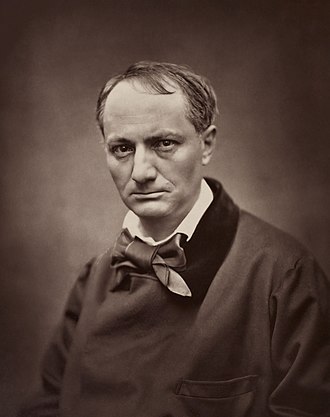
Charles Baudelaire's Les Fleurs du mal is published.
French poet and critic (1821–1867)
Charles-Pierre Baudelaire was a French poet, essayist, translator and art critic. His poems are described as exhibiting mastery of rhythm and rhyme, containing an exoticism inherited from the Romantics, and are based on observations of real life.
1857
The Revolution of the Ganhadores begins in Salvador, Bahia, Brazil.
1857 strike in Salvador, Bahia, Brazil
The Revolution of the Ganhadores was a labor strike that involved African porters, known as ganhadores, in the Brazilian city of Salvador, Bahia. The strike began following the passage of a city ordinance that changed the way the ganhadores operated in the city. The strike ended in a partial victory for the strikers, as the city council replaced the ordinance with another one that did away with some of the more unpopular provisions.
1857
American_Civil_War
American Civil War: The Battle of Fairfax Court House is fought.
1861–1865 conflict in the United States
The American Civil War was a civil war in the United States between the Union and the Confederacy, which was formed in 1861 by states that had seceded from the Union to preserve slavery in the United States. The South saw slavery as threatened because of the election of Abraham Lincoln and the growing abolitionist movement in the North. The war ended with Union victory, the dissolution of the Confederacy and the abolition of slavery, freeing four million African Americans.
1861
Peninsula_campaign
American Civil War: Peninsula Campaign: The Battle of Seven Pines (or the Battle of Fair Oaks) ends inconclusively, with both sides claiming victory.
1862 Union offensive in southeast Virginia during the American Civil War
The Peninsula campaign of the American Civil War was a major Union operation launched in southeastern Virginia from March to July 1862, the first large-scale offensive in the Eastern Theater. The operation, commanded by Major General George B. McClellan, was an amphibious turning movement against the Confederate States Army in Northern Virginia, intended to capture the Confederate capital of Richmond. Despite the fact that Confederate spy Thomas Nelson Conrad had obtained documents describing McClellan's battle plans from a double agent in the War Department, McClellan was initially successful against the equally cautious General Joseph E. Johnston, but the emergence of the more aggressive General Robert E. Lee turned the subsequent Seven Days Battles into a humiliating Union defeat.
1862
Treaty_of_Bosque_Redondo
The Treaty of Bosque Redondo is signed, allowing the Navajo to return to their lands in Arizona and New Mexico.
1868 US treaty ending the Navajo Wars
The Treaty of Bosque Redondo also the Navajo Treaty of 1868 or Treaty of Fort Sumner, Navajo Naal Tsoos Sani or Naaltsoos Sání) was an agreement between the Navajo and the US Federal Government signed on June 1, 1868. It ended the Navajo Wars and allowed for the return of those held in internment camps at Fort Sumner following the Long Walk of 1864. The treaty effectively established the Navajo as a sovereign nation.
1868
Louis-Napoléon,_Prince_Imperial
Napoléon Eugène, the last dynastic Bonaparte, is killed in the Anglo-Zulu War.
Son of Napoleon III (1856–1879)
Louis-Napoléon, Prince Imperial, also known as Louis-Napoléon, was the only child of Napoleon III, Emperor of the French, and Empress Eugénie. After his father was dethroned in 1870, he moved to England with his family. On his father's death in January 1873, he was proclaimed by the Bonapartist faction as Napoléon IV.
1879
United_States_Census_Bureau
The United States Census Bureau begins using Herman Hollerith's tabulating machine to count census returns.
U.S. agency responsible for the census related statistics
The United States Census Bureau, officially the Bureau of the Census, is a federal statistical agency responsible for producing data about the American people and economy, under the United States Department of Commerce. The bureau's director is appointed by the president of the United States.
1890
Greek–Serbian_Alliance_of_1913
The Greek–Serbian Treaty of Alliance is signed, paving the way for the Second Balkan War.
Military alliance between the kingdoms of Greece and Serbia from 1913 to 1924
The Greek–Serbian Alliance of 1913 was signed at Thessaloniki on 1 June 1913, in the aftermath of the First Balkan War, when both countries wanted to preserve their gains in Macedonia from Bulgarian expansionism. The treaty formed the cornerstone of Greek–Serbian relations for a decade, remaining in force through World War I until 1924.
1913
United_States_Senate
The United States Senate confirms the appointment of Louis Brandeis to the United States Supreme Court, making him the first Jew to be an Associate Justice.
Upper house of the US Congress
The United States Senate is a chamber of the bicameral United States Congress; it is the upper house, and the U.S. House of Representatives is the lower house. Together, the Senate and House have the authority under Article One of the Constitution to make and pass or defeat federal legislation.
1916
World_War_I
World War I: Western Front: Battle of Belleau Wood: Allied Forces under John J.
Pershing and James Harbord engage Imperial German Forces under Wilhelm, German Crown Prince.
World War I, or the First World War, also known as the Great War, was a global conflict between two coalitions: the Allies and the Central Powers. Major theatres of war included Europe and the Middle East, and well as parts of Africa and the Asia-Pacific. One of the deadliest conflicts in history, World War I resulted in an estimated 15 to 22 million deaths, including in mass war crimes against civilians and genocides. The conflict saw important developments in weaponry, including the first large-scale use of machine guns, artillery, aircraft, chemical weapons, and tanks, and was a major factor in the deadly Spanish flu pandemic.
1918
Prohibition
Prohibition comes into force in Finland.
Outlawing of alcohol
Prohibition is the act or practice of forbidding something by law; when used by itself the term refers to the banning of the manufacture, storage, transportation, sale, possession, and consumption of alcoholic beverages. The word is also used to refer to a period of time during which such bans are enforced.
1919
Royal_Ulster_Constabulary
The Royal Ulster Constabulary is founded.
Police force of Northern Ireland (1922–2001)
The Royal Ulster Constabulary (RUC) was the police force of Northern Ireland from 1922 to 2001. It was founded on 1 June 1922 as a successor to the Royal Irish Constabulary (RIC) following the partition of Ireland. At its peak, the force had around 8,500 officers, with a further 4,500 who were members of the RUC Reserve.
1922
The 1st Conference of the Communist Parties of Latin America is held in Buenos Aires.
1929 meeting of Latin American communist parties in Buenos Aires, Argentina
The First Conference of the Communist Parties of Latin America was in Buenos Aires, Argentina, June 1–12, 1929. Thirty-eight delegates, representing Argentina, Brazil, Bolivia, El Salvador, Guatemala, Cuba, Colombia, Ecuador, Mexico, Panama, Paraguay, Peru, Uruguay, and Venezuela, took part in the meeting. The only established communist party in the region that did not participate was the Communist Party of Chile, which at time suffered a period of harsh repression under the government of Carlos Ibáñez del Campo.
1929
Focke-Wulf_Fw_190
First flight of the German Focke-Wulf Fw 190 fighter aircraft.
1939 fighter aircraft family by Focke-Wulf
The Focke-Wulf Fw 190, nicknamed Würger is a German single-seat, single-engined, fighter aircraft designed by Kurt Tank at Focke-Wulf in the late 1930s; it was widely used during World War II. Along with its well-known counterpart, the Messerschmitt Bf 109, the Fw 190 became the backbone of the Jagdwaffe of the Luftwaffe. The twin-row BMW 801 radial engine that powered most operational versions enabled the Fw 190 to lift larger loads than the Bf 109, allowing its use as a day fighter, fighter-bomber, ground-attack aircraft, or to a lesser degree, night fighter.
1939
World_War_II
World War II: The Battle of Crete ends as Crete capitulates to Germany.
Global conflict (1939–1945)
World War II, or the Second World War, was a global conflict between two coalitions: the Allies and the Axis powers. Nearly all of the world's countries participated, with many engaging in total war on an unprecedented scale. World War II was the deadliest conflict in history, causing the deaths of 60 to 75 million people, a majority of whom were civilians. Millions died as a result of massacres, starvation, disease, and genocides including the Holocaust. After the Allied victory, Germany, Austria, Japan, and Korea were occupied, and German and Japanese leaders were tried for war crimes.
1941
Farhud
The Farhud, a massive pogrom in Iraq, starts and as a result, many Iraqi Jews are forced to leave their homes.
1941 anti-Jewish massacre in Baghdad, Iraq
The Farhud was a pogrom carried out against the Jewish population of Baghdad, Iraq, on 1–2 June 1941, immediately following the British victory in the Anglo-Iraqi War. The riots occurred in a power vacuum that followed the collapse of the pro-Fascist and pro-Nazi government of Rashid Ali al-Gaylani while the city was in a state of instability. The violence came immediately after the rapid defeat of Rashid Ali by British forces, whose earlier coup had generated a short period of national euphoria, and was fueled by allegations that Iraqi Jews had aided the British. More than 180 Jews were killed, with some reports that as many as 600 Jewish victims were buried in a mass grave. A thousand Jews were injured, Jewish property was looted and 900 Jewish homes were destroyed. Some non-Jewish rioters were killed in the attempt to quell the violence.
1941
BOAC_Flight_777
BOAC Flight 777 is shot down over the Bay of Biscay by German Junkers Ju 88s, killing British actor Leslie Howard and leading to speculation that it was actually an attempt to kill British Prime Minister Winston Churchill.
1943 airliner shootdown incident
BOAC Flight 777 was a KLM flight scheduled as a British Overseas Airways Corporation civilian airline flight from Portela Airport in Lisbon, Portugal, to Whitchurch Airport near Bristol, England. On 1 June 1943, the Douglas DC-3 serving the flight was attacked by eight German Junkers Ju 88 heavy fighter planes and crashed into the Bay of Biscay, killing all 17 on board. There were several notable passengers, among them actor Leslie Howard.
1943
Ion_Antonescu
Ion Antonescu, "Conducator" ("Leader") of Romania during World War II, is executed.
Dictator of Romania from 1940 to 1944
Ion Antonescu was a Romanian military officer and marshal who presided over two successive wartime dictatorships as Prime Minister and Conducător during most of World War II. Having been responsible for facilitating the Holocaust in Romania, he was overthrown in 1944, before being tried for war crimes and executed two years later in 1946.
1946
Declaration_of_Conscience
The Declaration of Conscience speech, by U.S.
Senator from Maine, Margaret Chase Smith, is delivered in response to Joseph R. McCarthy's speech at Wheeling, West Virginia.
"Declaration of Conscience" was a Cold War speech made by U.S. Senator from Maine, Margaret Chase Smith on June 1, 1950, less than four months after Senator Joseph McCarthy's "Wheeling Speech" on February 9.
1950
The Chinchaga fire ignites.
By September, it would become the largest single fire on record in North America.
The Chinchaga fire, also known as the Wisp fire, Chinchaga River fire and Fire 19, was a forest fire that burned in northern British Columbia and Alberta in the summer and early fall of 1950. With a final size of between 1,400,000 and 1,700,000 hectares, it is the single largest recorded fire in North American history. The authorities allowed the fire to burn freely, following local forest management policy considering the lack of settlements in the region. The Chinchaga fire produced large amounts of smoke, creating the "1950 Great Smoke Pall", observed across eastern North America and Europe. As the existence of the massive fire was not well-publicized, and the smoke was mostly in the upper atmosphere and could not be smelled, there was much speculation about the atmospheric haze and its provenance. The Chinchaga firestorm's "historic smoke pall" caused "observations of blue suns and moons in the United States and Europe". It was the biggest firestorm documented in North America, and created the world's largest smoke layer in the atmosphere.
1950
Washington_State_Ferries
Washington State Ferries, the largest ferry system in the United States, begins operation under state ownership after a buyout of the Puget Sound Navigation Company.
Public ferry service in Washington, US
Washington State Ferries (WSF) is a public ferry system in the U.S. state of Washington that carries passengers and vehicles. A division of the Washington State Department of Transportation (WSDOT), it operates 8 routes serving 20 terminals within Puget Sound and in the San Juan Islands. The routes are designated as part of the state highway system and also comprise a major public transit network in the Seattle metropolitan area. WSF is the largest ferry system in the United States and carried 20.1 million total riders in 2025, of which 10.7 million were passengers and 9.4 million were driving vehicles. The agency carried an average of 42,500 per weekday in the first quarter of 2026.
1951
Charles_de_Gaulle
Charles de Gaulle comes out of retirement to lead France by decree for six months.
French general and statesman (1890–1970)
Charles André Joseph Marie de Gaulle was a French general and statesman who led the Free French Forces against Nazi Germany and Vichy France in World War II and chaired the Provisional Government of the French Republic from 1944 to 1946 to restore democracy in France. Following the 1958 Algiers putsch, he came out of retirement at the request of President René Coty, who appointed him Prime Minister. He commissioned a new constitution which was approved by voters in a referendum, establishing the Fifth Republic. He was subsequently elected President of France later that year, a position he held until his resignation in 1969.
1958
Canadian_Bank_of_Commerce
The Canadian Bank of Commerce and Imperial Bank of Canada merge to form the Canadian Imperial Bank of Commerce, the largest bank merger in Canadian history.
Canadian bank (1867–1961)
The Canadian Bank of Commerce was a Canadian bank that operated from 1867 to 1961. It merged in 1961 with the Imperial Bank of Canada to form the Canadian Imperial Bank of Commerce, which today is one of Canada's Big Five banks.
1961
Adolf_Eichmann
Adolf Eichmann, former SS officer in Nazi Germany, is hanged in Israel for having committed crimes against humanity, war crimes, and other offenses.
German SS officer and war criminal (1906–1962)
Otto Adolf Eichmann was a German-Austrian official of the Nazi Party, an officer of the Schutzstaffel (SS), a convicted war criminal, and one of the major organizers of the Holocaust. He participated in the January 1942 Wannsee Conference, at which the implementation of the genocidal Final Solution to the Jewish Question was planned. Following this, he was tasked by SS-Obergruppenführer Reinhard Heydrich with facilitating and managing the logistics involved in the mass deportation of millions of Jews to Nazi ghettos and Nazi extermination camps across German-occupied Europe. He was captured and detained by the Allies in 1945, but he escaped and eventually settled in Argentina. In May 1960, he was tracked down and abducted by Israel's Mossad intelligence agency and put on trial before the Supreme Court of Israel. The highly publicised Eichmann trial resulted in his conviction in Jerusalem, following which he was executed by hanging in 1962.
1962
Heimlich_maneuver
The Heimlich maneuver for rescuing choking victims is published in the journal Emergency Medicine.
First aid procedure
The Heimlich maneuver, also known as an abdominal thrust, is a first-aid procedure used to treat upper-airway obstructions by foreign objects. American doctor Henry Heimlich is often credited for its development. To perform a Heimlich maneuver, a rescuer stands behind a choking victim and uses their hands to apply pressure to the bottom of the victim's diaphragm. This compresses the lungs and exerts pressure on the object lodged in the trachea in an effort to expel it.
1974
Patriotic_Union_of_Kurdistan
The Patriotic Union of Kurdistan was founded by Jalal Talabani, Nawshirwan Mustafa, Fuad Masum and others.
Political party in the Kurdistan Region
The Patriotic Union of Kurdistan is a centre-left regionalist political party active in Kurdistan Region and the disputed territories in Iraq. The PUK describes its goals as self-determination, human rights, democracy and peace for the Kurdish people of Kurdistan and Iraq. The PUK is currently under the leadership of Bafel Talabani. The PUK was founded in 1975 by Adel Murad, Jalal Talabani, Nawshirwan Mustafa, Fuad Masum, Ali Askari and Abdul Razaq Feyli Dawood Mohammed Ali. All presidents of Iraq under the 2005 constitution have been from this party. originally kurds got the position of president due to the power-sharing iraqi muhasasa system. in which Kurds got president, shia arabs got prime minister and sunni arabs got speaker of parliament. early on Kurdish unity decided who becomes president. by agreements made by The PUK and The Kurdistan Democratic Party, puk used to get president in iraq and the pdk used to get major positions in the Kurdistan Regional Government. following the death of Jalal Talabani kurdish unity was weakened and the PUK continued to get president due to agreements and political relations with other sanctions in iraq.
1975
Aeroflot_Flight_418
Aeroflot Flight 418 crashes in Bioko, Equatorial Guinea, killing 46.
1976 aviation accident
Aeroflot Flight 418 was an international passenger flight from Luanda to Moscow Sheremetyevo with three intermediate stops. On 1 June 1976, the Tupolev Tu-154A (CCCP-85102) operating the first leg of the flight, collided with Mount San Carlos of Bioko Island while en route. All 46 occupants on board were killed as a result of the crash.
1976
The first international applications under the Patent Cooperation Treaty are filed.
International patent law treaty
The Patent Cooperation Treaty (PCT) is an international patent law treaty, concluded in 1970. It provides a unified procedure for filing patent applications to protect inventions in each of its contracting states. A patent application filed under the PCT is called an international application, or PCT application.
1978
Rhodesia
The first black-led government of Rhodesia (now Zimbabwe) in 90 years takes power.
Former unrecognised state in Southern Africa (1965–1979)
Rhodesia, officially the Republic of Rhodesia from 1970 onwards, was an unrecognised state in Southern Africa that existed from 1965 to 1979. Rhodesia was the de facto successor to the self-governing colony of Southern Rhodesia following its unilateral declaration of independence (UDI) from the United Kingdom in 1965. Throughout this fourteen-year period, Rhodesia faced internal conflict and political unrest. Following the Lancaster House Agreement in 1979 and general elections held under a universal suffrage in 1980, the territory finally gained de jure independence and international recognition as the Republic of Zimbabwe.
1979
CNN
Cable News Network (CNN) begins broadcasting.
American news channel
Cable News Network, Inc. (CNN) is an American multinational news media company and the flagship namesake property of CNN Worldwide, a division of Warner Bros. Discovery (WBD). Founded on June 1, 1980, by American media proprietor Ted Turner and Reese Schonfeld as a 24-hour cable news channel and headquartered in Atlanta, Georgia, CNN is the first television channel to provide 24-hour news coverage and the first all-news television channel in the United States.
1980
Intermediate-Range_Nuclear_Forces_Treaty
The Intermediate-Range Nuclear Forces Treaty comes into effect.
US-Soviet/Russian treaty (1987–2019)
The Intermediate-Range Nuclear Forces Treaty was an arms control treaty between the United States and the Soviet Union. US President Ronald Reagan and Soviet General Secretary Mikhail Gorbachev signed the treaty on 8 December 1987. The US Senate approved the treaty on 27 May 1988, and Reagan and Gorbachev ratified it on 1 June 1988.
1988
Dobrinja mortar attack: Thirteen are killed and 133 wounded when Serb mortar shells are fired at a soccer game in Dobrinja, west of Sarajevo.
1993 massacre of Bosnian civilians in Sarajevo
The Dobrinja mortar attack was a massacre which occurred at 10:20 a.m. on 1 June 1993, in Dobrinja, a suburb west of Sarajevo in Bosnia and Herzegovina. Two mortar rounds were fired from Serb-held positions, hitting a football pitch where youths put on an impromptu game on the first day of the Muslim holiday Kurban Bajram. Approximately 200 people were in attendance to watch the game. The United Nations placed the official death toll stemming from the mortar attack at 13, with 133 wounded. At the time it was the deadliest event involving civilians since the imposition of sanctions against the Federal Republic of Yugoslavia by the United Nations one year prior.
1993
South_Africa
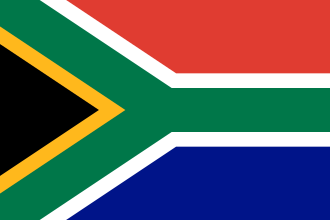
Republic of South Africa becomes a republic in the Commonwealth of Nations.
Country in Southern Africa
South Africa, officially the Republic of South Africa (RSA), is the southernmost country in Africa. Its nine provinces are bounded to the south by 2,798 kilometres of coastline that stretches along the South Atlantic, and Indian Ocean; to the north by the neighbouring countries of Namibia, Botswana, and Zimbabwe to the east and northeast by Mozambique, and Eswatini, and it encloses Lesotho. Covering an area of 1,221,037 square kilometres, the country has a population of over 63 million people, making it the sixth-most populated country in Africa. Pretoria is the administrative capital, while Cape Town, as the seat of Parliament, is the legislative capital, and Bloemfontein is regarded as the judicial capital. The largest and most populous city is Johannesburg, followed by Cape Town and Durban.
1994
American_Airlines_Flight_1420
American Airlines Flight 1420 slides and crashes while landing at Little Rock National Airport, killing 11 people on a flight from Dallas to Little Rock.
1999 aviation accident in Arkansas
American Airlines Flight 1420 was a scheduled domestic passenger flight from Dallas Fort Worth International Airport (DFW) to Little Rock National Airport in the United States. On Tuesday, June 1st, 1999, the McDonnell Douglas MD-82 operating as Flight 1420 overran the runway upon landing in Little Rock and crashed. 9 of the 145 people aboard were immediately killed—the captain and eight passengers—and 2 more passengers died in the hospital in the following weeks.
1999
Nepalese_royal_massacre
Nepalese royal massacre: Crown Prince Dipendra of Nepal shoots and kills several members of his family including his father and mother.
2001 mass shooting in Kathmandu
The Nepalese royal massacre was a mass shooting which occurred on 1 June 2001 at the Narayanhiti Palace, the then-residence of the Nepali monarchy, resulting in the deaths of nine members of the royal family, including King Birendra and Queen Aishwarya. A government-appointed inquiry team named Crown Prince Dipendra as the perpetrator of the massacre. Dipendra was declared king following the death of his parents but was comatose after shooting himself at the scene; he died in a hospital three days later without regaining consciousness. Birendra's paternal uncle Gyanendra then became king.
2001
Dolphinarium_discotheque_bombing
Dolphinarium discotheque massacre: A Hamas suicide bomber kills 21 at a disco in Tel Aviv.
2001 nightclub bombing in Tel Aviv, Israel
On 1 June 2001, Palestinian militant Saeed Hotari performed a suicide bombing outside the Dolphinarium discotheque on the beachfront in Tel Aviv, Israel, killing himself and 21 Israelis, 16 of whom were teenagers. The majority of the victims were Israeli teenage girls whose families had recently emigrated from the former Soviet Union. The death toll was the highest inflicted on Israel in five years.
2001
Oklahoma_City_bombing
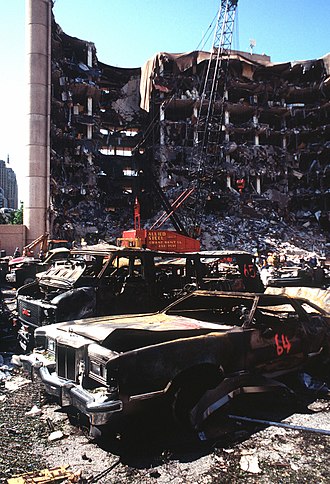
Oklahoma City bombing co-conspirator Terry Nichols is sentenced to 161 consecutive life terms without the possibility of parole.
1995 domestic terrorism bombing in Oklahoma City
On April 19, 1995, American anti-government extremist Timothy McVeigh, assisted by Terry Nichols, detonated a makeshift bomb stored in a rental truck parked in front of the Alfred P. Murrah Federal Building in Oklahoma City, Oklahoma, in an act of domestic terrorism. The explosion killed 167 people, injured 684, and destroyed more than a third of the building. The attack also destroyed or damaged 324 other buildings, destroyed 86 vehicles and caused an estimated $652 million in damage. During rescue operations after the bombing, a rescue worker was killed after being struck on the head by falling debris, bringing the total death toll to 168.
2004
Cyclone_Gonu
Cyclone Gonu develops from an area of convection in the Arabian Sea, becoming the worst recorded natural disaster in Oman.
North Indian Ocean super cyclonic storm in 2007
Super Cyclonic Storm Gonu was an extremely powerful tropical cyclone that became the strongest cyclone on record in the Arabian Sea. The second named tropical cyclone of the 2007 North Indian Ocean cyclone season, Gonu developed from a persistent area of convection in the eastern Arabian Sea on June 1, 2007. With a favorable upper-level environment and warm sea surface temperatures, it rapidly intensified to attain peak winds of 240 km/h (150 mph) on June 4, according to the India Meteorological Department. Gonu weakened after encountering dry air and cooler waters, and early on June 6, it made landfall on the easternmost tip of Oman, becoming the strongest tropical cyclone to hit the Arabian Peninsula. It then turned northward into the Gulf of Oman, and dissipated on June 7, after making landfall in southern Iran, the first cyclonic landfall in that country since 1898.
2007
2008_Universal_Studios_fire
A fire on the back lot of Universal Studios breaks out, destroying the attraction King Kong Encounter and a large archive of master tapes for music and film, the full extent of which was not revealed until 2019.
Fire in Los Angeles County, California, U.S.
On June 1, 2008, a fire broke out on the backlot of Universal Studios Hollywood, an American film studio and theme park in the San Fernando Valley area of Los Angeles County, California. The fire began when a worker used a blowtorch to warm asphalt shingles that were being applied to a facade. The worker left before checking that all spots had cooled, and as a result, a three-alarm fire broke out. Nine firefighters and a Los Angeles County sheriff's deputy sustained minor injuries. The fire was extinguished after 24 hours.
2008
Air_France_Flight_447
Air France Flight 447 crashes into the Atlantic Ocean off the coast of Brazil on a flight from Rio de Janeiro to Paris.
All 228 passengers and crew are killed.
Air France Flight 447 was a scheduled international transatlantic passenger flight from Rio de Janeiro, Brazil, to Paris Charles de Gaulle Airport, France, that crashed into the mid-Atlantic Ocean on 1 June 2009 killing all 228 passengers and crew on board. The incident, which occurred on an Airbus A330, happened because inconsistent airspeed indications and resulting miscommunication between the pilots led to an unrecoverable stall. The Brazilian Navy recovered the first major wreckage and two bodies from the sea within five days of the crash. The aircraft's flight recorders were not recovered from the ocean floor until May 2011, nearly two years after the accident.
2009
General_Motors
General Motors files for Chapter 11 bankruptcy.
It is the fourth largest United States bankruptcy in history.
General Motors Company (GM) is an American multinational automotive manufacturing company headquartered in Detroit, Michigan, United States. The company is most known for owning and manufacturing four automobile brands: Chevrolet, Buick, GMC, and Cadillac, each a separate division of GM. By total sales, it has continuously been the largest automaker in the United States, and was the largest in the world for 77 years before losing the title to Toyota in 2008.
2009
2011_Springfield_tornado
A rare tornado outbreak occurs in New England; a strong EF3 tornado strikes Springfield, Massachusetts, during the event, killing four people.
EF3 tornado in Massachusetts, U.S.
On the afternoon of June 1, 2011, an unusually long-tracked and powerful tornado caused significant damage in Hampden and Worcester Counties in Western and Central Massachusetts, including the city of Springfield, resulting in three fatalities, at least 200 injuries, and over 500 families being left homeless. The tornado, which was part of a severe weather event that occurred in portions of New England that day, received a final rating of EF3 on the Enhanced Fujita scale, with peak winds being estimated at 160 mph (260 km/h).
2011
Space_Shuttle_Endeavour
Space Shuttle Endeavour makes its final landing after 25 flights.
Space Shuttle orbiter (1992–2011)
Space Shuttle Endeavour is a retired orbiter from NASA's Space Shuttle program and the fifth and final operational Shuttle built. It embarked on its first mission, STS-49, in May 1992 and its 25th and final mission, STS-134, in May 2011. STS-134 was expected to be the final mission of the Space Shuttle program, but with the authorization of STS-135 by the United States Congress, Atlantis became the last shuttle to fly.
2011
A ship carrying 458 people capsizes in the Yangtze river in China's Hubei province, killing 442 people.
2015 Chinese river cruise ship capsize
MV Dongfang zhi Xing was a river cruise ship that operated in the Three Gorges region of inland China. On the night of 1 June 2015, the ship was traveling on the Yangtze River when it capsized during a thunderstorm in Jianli, Hubei Province, with 454 people on board. On 13 June, 442 deaths were confirmed, with 12 survivors. The passengers were mostly in their 60s and 70s, and mostly from Nanjing, where the ship started its cruise.
2015

History runs on facts, and this project runs on coffee!

Your support is incredibly helpful and genuinely appreciated.

Support with a coffee ☕