May 31 in History

Israeli Shayetet 13 commandos board the Gaza Freedom Flotilla while still in int

2010 — Israeli Shayetet 13 commandos board the Gaza Freedom Flotilla while still in international waters trying to break the ongoing blockade of the Gaza Strip; nine Turkish citizens on the flotilla were killed in the ensuing violent affray

May 31 spans 58 recorded events across recorded history, from 455 to 2026. Below is a curated digest of the most significant moments tied to this date.

By · Wikipedia

Historical Events 58 events 455 – 2026

More major events on May 31

The featured story and these ranked highlights form a quick summary. Every recorded event remains available in the chronology below.

  1. 1947 Ferenc Nagy, the democratically elected Prime Minister of Hungary, resigns from office after blackmail from the Hungarian Communist Party accusing him of being part of a plot against the state. This grants the Communists effective control of the Hungarian government. Source
  2. 1902 Second Boer War: The Treaty of Vereeniging ends the war and ensures British control of South Africa. Source
  3. 1955 The U.S. Supreme Court expands on its Brown v. Board of Education decision by ordering district courts and school districts to enforce educational desegregation "at all deliberate speed." Source

Did you know

In 2010, Israeli Shayetet 13 commandos board the Gaza Freedom Flotilla while still in international waters trying to break the ongoing blockade of the Gaza Strip; nine Turkish citizens on the flotilla were killed in the ensuing violent affray. This featured entry focuses on the immediate decision and its direct historical impact.

Did you know

The 2010 Gaza Freedom Flotilla was a small fleet of ships by the Free Gaza Movement and the Turkish Foundation for Human Rights and Freedoms and Humanitarian Relief (İHH). This helps explain why the event mattered beyond the initial announcement.

Did you know

The Flotilla mission to Gaza had the explicit goal of carrying humanitarian aid and construction materials with the intention of breaking the Israeli blockade of the Gaza Strip. This clarifies the institutional and public response around the event.

Did you know

In typical circumstances, aid is first brought to Israel to be inspected and then transferred to Gaza. This shows how the event shaped policy and public communication in the same period.

Did you know

In 2010, Israeli Shayetet 13 commandos board the Gaza Freedom Flotilla while still in international waters trying to break the ongoing blockade of the Gaza Strip; nine Turkish citizens on the flotilla were killed in the ensuing violent affray had consequences that extended beyond the first headline. The key context is the institutions involved, the policy shift, and how the public response evolved afterward.


Petronius_Maximus
Emperor Petronius Maximus is stoned to death by an angry mob while fleeing Rome.
Western Roman emperor in 455
Petronius Maximus was Roman emperor of the West for two and a half months in 455. A wealthy senator and a prominent aristocrat, he was instrumental in the murders of the Western Roman magister militum, Aëtius, and the Western Roman emperor, Valentinian III.
455
Zhongdu
Zhongdu (now Beijing), then under the control of the Jurchen ruler Emperor Xuanzong of Jin, is captured by the Mongols under Genghis Khan, ending the Battle of Zhongdu.
Capital of the Jin dynasty (1153–1214)
Zhongdu, also called Daxing City, was a capital city of the Jurchen-led Jin dynasty (1115–1234) of China, located in modern-day Beijing, in the southwestern part of Xicheng District. It served as the Jin capital from 1153 to 1214.
1215
Battle_of_the_Kalka_River
Mongol invasion of the Cumans: Battle of the Kalka River: Mongol armies of Genghis Khan led by Subutai defeat Kievan Rus' and Cumans.
1223 battle where the Mongols fought against Rus' princes and Cumans
The Battle of the Kalka River was fought between the Mongol Empire, whose armies were led by Jebe and Subutai, and a coalition of several Rus' principalities, including Kiev and Galicia-Volhynia, and the Cumans under Köten. They were under the joint command of Mstislav the Bold and Mstislav III of Kiev. The battle was fought on May 31, 1223 on the banks of the Kalka River in present-day Donetsk Oblast, Ukraine, and ended in a decisive Mongol victory.
1223
Mongols
Mongols depart Java after the failed Mongol invasion against King Kertanegara of Singhasari.
East Asian ethnic group
The Mongols are an East Asian ethnic group native to Mongolia and China, as well as the republics of Buryatia and Kalmykia in Russia. The Mongols are the principal member of the large family of Mongolic peoples. The Oirats and the Buryats are classified either as distinct ethno-linguistic groups or as subgroups of Mongols.
1293
Henry_III_of_France
King Henry III lays the first stone of the Pont Neuf (New Bridge), the oldest bridge of Paris, France.
King of France from 1574 to 1589
Henry III of France was King of France from 1574 until his assassination in 1589 and, as Henry of Valois, King of Poland and Grand Duke of Lithuania from 1573 to 1575. Before he came to these thrones, he was known as the Duke of Angoulême and Duke of Orléans from 1560, then as Duke of Anjou from 1566.
1578
London's_Love_to_Prince_Henry
The pageant London's Love to Prince Henry on the River Thames celebrates the creation of Prince Henry as Prince of Wales.
1610 pageant
London's Love to Prince Henry, was a pageant on the River Thames organised by the city of London for the investiture of Prince Henry as Prince of Wales.
1610
Samuel_Pepys
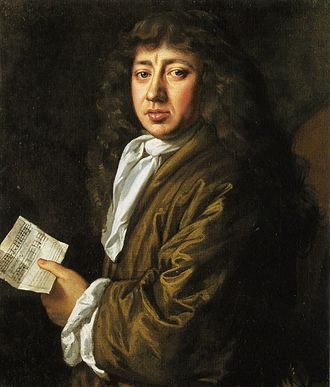
Citing poor eyesight as a reason, Samuel Pepys records the last event in his diary.
English writer and politician (1633–1703)
Samuel Pepys was an English writer and Tory politician. He served as an official in the Navy Board and Member of Parliament, but is now most renowned for the diary he kept for almost a decade, first published in the 19th century and one of the most important primary sources of the Stuart Restoration.
1669
American_Revolution
American Revolution: The Mecklenburg Resolves are adopted in the Province of North Carolina.
Founding of the United States
The American Revolution (1765–1789) was a political movement in the Thirteen Colonies of Great Britain. It began as a rebellion and turned into a revolution eventually creating the sovereign United States, which was the outcome of the associated American Revolutionary War (1775-1783). The Second Continental Congress, as the provisional government, established the Continental Army and appointed George Washington as its commander-in-chief in 1775. The following year, the Congress passed the Lee Resolution on July 2nd and unanimously adopted the Declaration of Independence on July 4th. Throughout most of the war, the outcome appeared uncertain, but a 1781 victory by Washington and the Continental Army in the Siege of Yorktown led King George III and the Fox–North coalition in government to negotiate the cessation of colonial rule and the acknowledgment of American sovereignty, which was formalized in the Treaty of Paris, signed on September 3, 1783. The Constitution took effect in 1789 and the Bill of Rights was ratified in 1791.
1775
Manuel_Quimper
Manuel Quimper explores the Strait of Juan de Fuca.
Peruvian explorer (circa 1757–1844)
Manuel Quimper Benítez del Pino was a Spanish Peruvian explorer, cartographer, naval officer, and colonial official. He participated in charting the Strait of Juan de Fuca and the Hawaiian Islands in the late 18th century. He was later appointed a colonial governor in his native Peru at the beginning of the fight for independence there. He retired to Spain, but was able to return to Peru where he served as a naval officer in the new republic and pursued a literary career, publishing over 20 books about his experiences before his death there in Lima.
1790
French_Revolution
French Revolution: The Revolutionary Tribunal is suppressed.
1789–1799 sociopolitical change in France
The French Revolution was a period of political and societal change in France that began with the Estates General of 1789 and ended with the Coup of 18 Brumaire on 9 November 1799. Many of the revolution's ideas are considered fundamental principles of liberal democracy, and its values remain central to modern French political discourse. It was caused by a combination of social, political, and economic factors which the existing regime proved unable to manage.
1795
Battle_of_Diamond_Rock
French and Spanish forces begin the assault against British forces occupying Diamond Rock, Martinique.
1805 battle of the War of the Third Coalition
The Battle of Diamond Rock took place between 31 May and 2 June 1805 during the War of the Third Coalition, when a Franco-Spanish force dispatched under Captain Julien Cosmao was able to retake Diamond Rock, on the approach to Fort-de-France, from the British forces that had occupied it over a year before.
1805
William_Lawson_(explorer)
In Australia, William Lawson, Gregory Blaxland and William Wentworth reach Mount Blaxland, effectively marking the end of a route across the Blue Mountains.
English born Australian explorer and politician (1774–1850)
William Lawson, MLC was a British soldier, explorer, land owner, grazier and politician. In 1800, he migrated to Sydney, New South Wales, and from 1819, he served as the commandant of the Bathurst, New South Wales region, and from 1843, he served as a member of the New South Wales Parliament.
1813
Qajar_Iran
Qajar Iran and the Ottoman Empire determine their international boundary in the second treaty of Erzurum.
Iran under the Qajar dynasty from 1789 to 1925
The Guarded Domains of Iran, commonly known as Qajar Iran, was the Iranian state under the rule of the Qajar dynasty, which lasted from 1789 to 1925. It was founded by Agha Mohammad Khan, a chieftain of the Qajar tribe, a Turkic tribe based in northern Iran. In the power struggle following the death of Karim Khan Zand in 1779, Agha Mohammad defeated all competitors from the preceding Zand and Afsharid dynasties, unifying Iran. He re-asserted Iranian sovereignty over large parts of the Caucasus and was formally crowned as Shah in 1796. Although he was murdered the next year, he was succeeded by his nephew Fath-Ali Shah, and the Qajars maintained control over the country until their deposal in 1925.
1847
Big_Ben
The Great Clock at the Houses of Parliament (now known as the Elizabeth Tower) starts keeping time.
Clock tower in London, England
Big Ben is the nickname for the Great Bell of the Great Clock of Westminster, and, by extension, for the clock tower that stands at the north end of the Palace of Westminster in London, England. Originally named the Clock Tower, the structure was renamed the Elizabeth Tower in 2012 to mark the Diamond Jubilee of Queen Elizabeth II. The clock is a striking clock with five bells.
1859
American_Civil_War
American Civil War: Peninsula Campaign: Confederate forces under Joseph E.
Johnston and G.W. Smith engage Union forces under George B. McClellan outside the Confederate capital of Richmond, Virginia.
The American Civil War was a civil war in the United States between the Union and the Confederacy, which was formed in 1861 by states that had seceded from the Union to preserve slavery in the United States. The South saw slavery as threatened because of the election of Abraham Lincoln and the growing abolitionist movement in the North. The war ended with Union victory, the dissolution of the Confederacy and the abolition of slavery, freeing four million African Americans.
1862
Overland_Campaign
American Civil War: Overland Campaign: Battle of Cold Harbor: The Army of Northern Virginia engages the Army of the Potomac.
1864 series of battles in Virginia during the American Civil War
The Overland Campaign, also known as Grant's Overland Campaign, the Virginia Campaign, and the Wilderness Campaign, was a series of battles fought in Virginia during May and June 1864, towards the end of the American Civil War. Lt. Gen. Ulysses S. Grant, general-in-chief of all Union armies, directed the actions of the Army of the Potomac, commanded by Maj. Gen. George G. Meade, and other forces against Confederate Gen. Robert E. Lee's Army of Northern Virginia. Although Grant suffered severe losses during the campaign, it was a strategic Union victory. It inflicted proportionately higher losses on Lee's army and maneuvered it into a siege at Richmond and Petersburg, Virginia, in just over eight weeks.
1864
Madison_Square_Garden_(1879)
Gilmore's Garden in New York City is renamed Madison Square Garden by William Henry Vanderbilt and is opened to the public at 26th Street and Madison Avenue.
Former arena in Manhattan, New York
Madison Square Garden (1879–1890) was an arena in New York City at the northeast corner of East 26th Street and Madison Avenue in Manhattan. The first venue to use that name, it seated 10,000 spectators. It was replaced with a new building on the same site.
1879
Plymouth
The arrival at Plymouth of Tāwhiao, King of Maoris, to claim the protection of Queen Victoria.
City and unitary authority in Devon, England
Plymouth is a port city and unitary authority in Devon, England. It is located on the county's south coast between the rivers Plym and Tamar, about 36 miles (58 km) south-west of Exeter and 193 miles (311 km) south-west of London. It is the most populous settlement in Devon.
1884
Johnstown_Flood
Johnstown Flood: Over 2,200 people die after a dam fails and sends a 60-foot (18-meter) wall of water over the town of Johnstown, Pennsylvania.
1889 disaster in Pennsylvania
The Johnstown Flood, sometimes referred to locally as the Great Flood of 1889, occurred on Friday, May 31, 1889, after the catastrophic failure of the South Fork Dam, located on the south fork of the Little Conemaugh River, 14 miles (23 km) upstream of the town of Johnstown, Pennsylvania, United States. The dam ruptured after several days of extremely heavy rainfall, releasing 14.55 million cubic meters of water. With a volumetric flow rate that temporarily equaled the average flow rate of the Mississippi River, the flood killed 2,208 people and accounted for US$17 million in damage. By loss of life it was by far the worst flash flood in U.S. history.
1889
Second_Boer_War
Second Boer War: The Treaty of Vereeniging ends the war and ensures British control of South Africa.
1899–1902 war in South Africa
The Second Boer War was a conflict fought between the British Empire and the Boer republics over Britain's influence in Southern Africa.
1902
Morral_affair
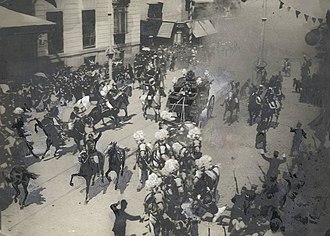
The attempted regicide of Spanish King Alfonso XIII and Queen Victoria Eugenie on their wedding day instead kills 24.
1906 attempted murder of King Alfonso XIII and Victoria Eugenie
The Morral affair was the attempted regicide of Spanish King Alfonso XIII and his bride, Queen Victoria Eugenie, on their wedding day, 31 May 1906, and its subsequent effects. The attacker, Mateu Morral, acting on a desire to spur revolution, threw a bomb concealed in a floral bouquet from a Madrid hotel window as the King's procession passed, killing 24 bystanders and soldiers and wounding over 100 others, while leaving the royals unscathed. Morral sought refuge from republican journalist José Nakens but fled in the night to Torrejón de Ardoz, whose villagers reported the interloper. Two days after the attack, militiamen accosted Morral, who killed one before killing himself. Morral was likely involved in a similar attack on the king a year earlier.
1906
The National Negro Committee, forerunner to the National Association for the Advancement of Colored People (NAACP), convenes for the first time.
African-American civil rights group (1909–10); predecessor to the NAACP
The National Negro Committee was created in response to the Springfield race riot of 1908 against the black community in Springfield, Illinois. Prominent black activists and white progressives called for a national conference to discuss African-American civil rights. They met to address the social, economic, and political rights of African Americans. This gathering served as the predecessor to the National Association for the Advancement of Colored People (NAACP), which was formally named during the second meeting in May 1910.
1909
South_Africa_Act_1909
The South Africa Act comes into force, establishing the Union of South Africa.
Constitution of the Union of South Africa (1910–1961)
The South Africa Act 1909 was an act of the Parliament of the United Kingdom that created the Union of South Africa out of the former Cape, Natal, Orange River, and Transvaal colonies, and served as the constitution of the Union from 1910 until 1961. The act also allowed for potential admission of Rhodesia into the Union, a proposal rejected by Rhodesian colonists in a 1922 referendum. The draft proposal was supported by the four colonial parliaments, but was opposed by Cape Colony premier W. P. Schreiner, who raised concerns that it would strip rights from non-white South Africans.
1910
Titanic
The RMS Titanic is launched in Belfast, Northern Ireland.
British passenger liner that sank in 1912
RMS Titanic was a British ocean liner that sank in the early hours of 15 April 1912 as a result of striking an iceberg on her maiden voyage from Southampton, England, to New York City. Of the 2,208 passengers and crew aboard, approximately 1,500 died, making the incident one of the deadliest peacetime sinkings of a single ship. Titanic, operated by White Star Line, carried some of the wealthiest people in the world, as well as hundreds of emigrants from the British Isles, Scandinavia, and elsewhere in Europe who were seeking a new life in the United States and Canada. The disaster drew public attention, spurred major changes in maritime safety regulations, and inspired a lasting legacy in popular culture. It was the second time White Star Line had lost a ship on her maiden voyage, the first being RMS Tayleur in 1854.
1911
President_of_Mexico
The President of Mexico Porfirio Díaz flees the country during the Mexican Revolution.
Head of state and government
The president of Mexico, officially the president of the United Mexican States, is the head of state and head of government of Mexico. Under the Constitution of Mexico, the president heads the executive branch of the federal government and is the commander in chief of the Mexican Armed Forces.
1911
World_War_I
World War I: Battle of Jutland: The British Grand Fleet engages the High Seas Fleet in the largest naval battle of the war, which proves indecisive.
Global conflict from 1914 to 1918
World War I, or the First World War, also known as the Great War, was a global conflict between two coalitions: the Allies and the Central Powers. Major theatres of war included Europe and the Middle East, and well as parts of Africa and the Asia-Pacific. One of the deadliest conflicts in history, World War I resulted in an estimated 15 to 22 million deaths, including in mass war crimes against civilians and genocides. The conflict saw important developments in weaponry, including the first large-scale use of machine guns, artillery, aircraft, chemical weapons, and tanks, and was a major factor in the deadly Spanish flu pandemic.
1916
Tulsa_race_massacre
The Tulsa race massacre kills at least 39, but other estimates of black fatalities vary from 55 to about 300.
1921 mass violence in Oklahoma, US
The Tulsa race massacre was a two-day-long terrorist massacre perpetrated by white supremacists that took place in the Greenwood District of Tulsa, Oklahoma, United States, between May 31 and June 1, 1921. Mobs of white residents, some of whom had been armed and appointed as deputies by city government officials, attacked black residents and their homes and businesses. The attackers burned and destroyed more than 35 square blocks of the neighborhood—at the time, one of the wealthiest black communities in the United States, colloquially known as "Black Wall Street." The event is considered one of the worst incidents of racial violence in American history.
1921
Hope_Development_School_fire
Hope Development School fire kills 24 people, mostly disabled children.
1924 multi-fatality building fire in California
The Hope Development School fire started about 9 p.m. on the evening of May 31, 1924 in Playa Del Rey, Los Angeles, California. The fire at the Hope Development School for Deficient Girls killed 24 people, primarily the mentally disabled or behaviorally challenged girls who were residents of the home, as well as the matron and her eight-year-old son.
1924
A 7.7 Mw earthquake destroys Quetta in modern-day Pakistan killing 40,000.
Magnitude 7.7 earthquake in Baluchistan Agency
An earthquake occurred on 31 May 1935 between 2:30 am and 3:40 am at Quetta, Baluchistan Agency, close to the border with southern Afghanistan. The earthquake had a magnitude of 7.7 Mw and anywhere between 30,000 and 60,000 people died from the impact. It was recorded as the deadliest earthquake to strike South Asia until 2005. The quake was centred 4 km south-west of Ali Jaan, Balochistan, British India.
1935
Anglo-Iraqi_War
Anglo-Iraqi War: The United Kingdom completes the re-occupation of Iraq and returns 'Abd al-Ilah to power as regent for Faisal II.
1941 campaign during World War II
The Anglo-Iraqi War was a British-led Allied military campaign during the Second World War against the Kingdom of Iraq, then ruled by Rashid Ali al-Gaylani who had seized power in the 1941 Iraqi coup d'état with assistance from Germany and Italy. The campaign resulted in the downfall of Gaylani's government, the re-occupation of Iraq by the British, and the return to power of the Regent of Iraq, Prince 'Abd al-Ilah, a British ally.
1941
World_War_II
World War II: Imperial Japanese Navy midget submarines begin a series of attacks on Sydney, Australia.
Global conflict (1939–1945)
World War II, or the Second World War, was a global conflict between two coalitions: the Allies and the Axis powers. Nearly all of the world's countries participated, with many engaging in total war on an unprecedented scale. World War II was the deadliest conflict in history, causing the deaths of 60 to 75 million people, a majority of whom were civilians. Millions died as a result of massacres, starvation, disease, and genocides including the Holocaust. After the Allied victory, Germany, Austria, Japan, and Korea were occupied, and German and Japanese leaders were tried for war crimes.
1942
Ferenc_Nagy
Ferenc Nagy, the democratically elected Prime Minister of Hungary, resigns from office after blackmail from the Hungarian Communist Party accusing him of being part of a plot against the state.
This grants the Communists effective control of the Hungarian government.
Ferenc Nagy was a Hungarian politician of the Smallholders Party who served as Prime Minister of Hungary from 1946 until his forced resignation in 1947. He was also a Speaker of the National Assembly of Hungary and a member of the High National Council from 1945 to 1946. Nagy was the second democratically elected prime minister of Hungary, and would be the last until 1990 not to be a Communist or fellow traveler. The subsequent Hungarian prime minister Imre Nagy was unrelated to him.
1947
The Uniform Code of Military Justice takes effect as the legal system of the United States Armed Forces.
United States military law
The Uniform Code of Military Justice (UCMJ) is the foundation of the system of military justice of the armed forces of the United States. The UCMJ was established by the United States Congress in accordance with their constitutional authority, per Article I Section 8 of the U.S. Constitution, which provides that "The Congress shall have Power. .. to make Rules for the Government and Regulation of the land and naval forces" of the United States.
1951
Supreme_Court_of_the_United_States
The U.S.
Supreme Court expands on its Brown v. Board of Education decision by ordering district courts and school districts to enforce educational desegregation "at all deliberate speed."
The Supreme Court of the United States (SCOTUS) is the highest court in the federal judiciary of the United States. It has ultimate appellate jurisdiction over all U.S. federal court cases, and over state court cases that turn on questions of U.S. constitutional or federal law. It also has original jurisdiction over a narrow range of cases, specifically "all Cases affecting Ambassadors, other public Ministers and Consuls, and those in which a State shall be Party". In 1803, the court asserted the power of judicial review, the ability to invalidate a statute for violating a provision of the Constitution. It is also able to strike down presidential directives for violating either the Constitution or statutory law.
1955
South_African_Constitution_of_1961
The South African Constitution of 1961 becomes effective, thus creating the Republic of South Africa, which remains outside the Commonwealth of Nations until 1 June 1994, when South Africa is returned to Commonwealth membership.
Fundamental law of South Africa from 1961 to 1986
The Constitution of 1961 was the fundamental law of South Africa for two decades. Under the terms of the constitution South Africa ceased to be a Commonwealth realm and became a republic, until rejoining the Commonwealth of Nations in 1994.
1961
Moscow_City_Court
In Moscow City Court, the Rokotov–Faibishenko show trial begins, despite the Khrushchev Thaw to reverse Stalinist elements in Soviet society.
Russian judicial body
The Moscow City Court is the highest judicial body of the city of Moscow on civil, criminal, administrative and other cases.
1961
West_Indies_Federation
The West Indies Federation dissolves.
1958–1962 political union of British island colonies in the Caribbean
The West Indies Federation, also known as the West Indies, the Federation of the West Indies or the West Indian Federation, was a short-lived political union that existed from 3 January 1958 to 31 May 1962. Various islands in the Caribbean that were part of the British Empire, including Trinidad and Tobago, Barbados, Jamaica, and those on the Leeward and Windward Islands, came together to form the Federation, with its capital in Port of Spain, Trinidad and Tobago. The expressed intention of the Federation was to create a political unit that would become independent from Britain as a single state – possibly similar to Australia, Canada, or Rhodesia and Nyasaland. Before that could happen, the Federation collapsed due to internal political conflicts over how it would be governed or function viably following the results of the Jamaican political referendum on participation. The formation of a West Indian Federation was encouraged by the United Kingdom, but also requested by pan-Caribbean nationalists.
1962
1970_Ancash_earthquake
The 7.9 Mw Ancash earthquake shakes Peru with a maximum Mercalli intensity of VIII (Severe) and a landslide buries the town of Yungay, Peru.
Between 66,794 and 70,000 were killed and 50,000 were injured.
The 1970 Ancash earthquake occurred on 31 May off the coast of Peru in the Pacific Ocean at 15:23:29 local time. Combined with a resultant landslide, it is the most catastrophic natural disaster in the history of Peru. Due to the large amounts of snow and ice included in the landslide that caused an estimated 66,794–70,000 fatalities, it is also considered to be the world's deadliest avalanche.
1970
Uniform_Monday_Holiday_Act
In accordance with the Uniform Monday Holiday Act passed by the U.S.
Congress in 1968, observation of Memorial Day occurs on the last Monday in May for the first time, rather than on the traditional Memorial Day of May 30.
The Uniform Monday Holiday Act is an Act of Congress that permanently moved two federal holidays in the United States to a Monday, being Washington's Birthday and Memorial Day, and further made Columbus Day a federal holiday, also permanently on a Monday. This created long weekends with three days off ending with the holidays, such as Memorial Day Weekend.
1971
United_States_Senate
The United States Senate votes to cut off funding for the bombing of Khmer Rouge targets within Cambodia, hastening the end of the Cambodian Civil War.
Upper house of the US Congress
The United States Senate is a chamber of the bicameral United States Congress; it is the upper house, and the U.S. House of Representatives is the lower house. Together, the Senate and House have the authority under Article One of the Constitution to make and pass or defeat federal legislation.
1973
Indian_Airlines_Flight_440
Indian Airlines Flight 440 crashes near Palam Airport in Delhi, killing 48.
1973 plane crash in India
Indian Airlines Flight 440 was a flight on 31 May 1973 operated by a Boeing 737-200 that crashed while on approach to Palam Airport killing 48 of the 65 passengers and crew on board.
1973
Trans-Alaska_Pipeline_System
The Trans-Alaska Pipeline System is completed.
Alaskan oil pipeline system
The Trans-Alaska Pipeline System (TAPS) is an oil transportation system spanning Alaska, including the trans-Alaska crude-oil pipeline, 12 pump stations, several hundred miles of feeder pipelines, and the Valdez Marine Terminal. TAPS is one of the world's largest pipeline systems. The core pipeline itself, which is commonly called the Alaska pipeline, trans-Alaska pipeline, or Alyeska pipeline,, is an 800-mile (1,287 km) long, 48-inch (1.22 m) diameter pipeline that conveys oil from Prudhoe Bay, on Alaska's North Slope, south to Valdez, on the shores of Prince William Sound in southcentral Alaska. The crude oil pipeline is privately owned by the Alyeska Pipeline Service Company.
1977
1985_United_States–Canada_tornado_outbreak
United States–Canada tornado outbreak: Forty-one tornadoes hit Ohio, Pennsylvania, New York, and Ontario, leaving 76 dead.
Record-breaking tornado outbreak
The 1985 United States–Canada tornado outbreak, referred to as the Barrie tornado outbreak in Canada, was a major tornado outbreak that occurred in Ohio, Pennsylvania, New York, and Ontario, on May 31, 1985. In all, 44 tornadoes were counted including 14 in Ontario, Canada. Ninety people were killed, with 14 deaths occurring in Canada, and 76 occurring in the United States. It remains the largest and most intense tornado outbreak ever to hit this region, and the worst tornado outbreak in Pennsylvania history in terms of deaths and destruction.
1985
The Ariane 2 rocket is launched on its maiden flight, carrying Intelsat VA F-14, but the mission ends in failure.
European medium-lift space launch vehicle (1986–1989)
Ariane 2 was a European expendable space launch vehicle, operated by the European Space Agency (ESA) between 1986 and 1989 as part of Ariane family of rockets. The principal manufacturer for the Ariane 2 was Aérospatiale, while the lead agency for its development was the Centre National d'Etudes Spatiales (CNES), the French government's space agency.
1986
Bicesse Accords in Angola lay out a transition to multi-party democracy under the supervision of the United Nations' UNAVEM II peacekeeping mission.
1991 agreement to transition to democracy in Angola
The Bicesse Accords, also known as the Estoril Accords, laid out a transition to multi-party democracy in Angola under the supervision of the United Nations' UNAVEM II mission. President José Eduardo dos Santos of the MPLA and Jonas Savimbi of UNITA signed the accord in Lisbon, Portugal on May 31, 1991. UNITA rejected the official results of the 1992 presidential election and renewed their guerrilla war.
1991
Confederation_Bridge
The Confederation Bridge opens, linking Prince Edward Island with mainland New Brunswick.
Canadian bridge from Prince Edward Island to the mainland
The Confederation Bridge is a box girder bridge carrying the Trans-Canada Highway across the Abegweit Passage of the Northumberland Strait, linking the province of Prince Edward Island with the mainland province of New Brunswick. Opened on May 31, 1997, the 12.9-kilometre bridge is Canada's longest bridge and the world's longest bridge over ice-covered water.
1997
Air_France
Air France retires its fleet of Concorde aircraft.
National airline of France
Air France, stylised as AIRFRANCE, is the flag carrier of France, and is headquartered in Tremblay-en-France. The airline is a subsidiary of the Air France–KLM Group and is one of the founding members of the SkyTeam airline alliance. As of 2013, Air France served 29 destinations in France and operates worldwide scheduled passenger and cargo services to 201 destinations in 78 countries and also carried 46,803,000 passengers in 2019. The airline maintains its global and domestic hub at Charles de Gaulle Airport. Air France's corporate headquarters, previously in Montparnasse, Paris, are located at the Roissypôle complex on the grounds of Charles de Gaulle Airport, north of Paris.
2003
Vanity_Fair_(magazine)
Vanity Fair reveals that Mark Felt was "Deep Throat".
American monthly periodical
Vanity Fair is an American monthly magazine of popular culture, fashion, and current affairs published by Condé Nast in the United States.
2005
Usain_Bolt
Usain Bolt breaks the world record in the 100m sprint, with a wind-legal (+1.7 m/s) 9.72 seconds.
Jamaican sprinter (born 1986)
Usain St. Leo Bolt is a Jamaican retired sprinter. Widely regarded as the greatest sprinter of all time, he is an eight-time Olympic gold medalist and the world record holder in the 100 metres, 200 metres, and 4 × 100 metres relay.
2008
Space_Shuttle_Discovery
Space Shuttle Discovery launches on STS-124 carrying the second portion of the Japanese Kibō module to the International Space Station.
Space Shuttle orbiter (1984–2011)
Space Shuttle Discovery is a retired American Space Shuttle orbiter. The spaceplane was one of the orbiters from NASA's Space Shuttle program and the third of five fully operational orbiters to be built. Its first mission, STS-41-D, flew from August 30 to September 5, 1984. Over 27 years of service it launched and landed 39 times, aggregating more spaceflights than any other spacecraft as of December 2024. The Space Shuttle launch vehicle had three main components: the Space Shuttle orbiter, a single-use central fuel tank, and two reusable solid rocket boosters. Nearly 25,000 heat-resistant tiles cover the orbiter to protect it from high temperatures on re-entry.
2008
Asteroid
The asteroid 1998 QE2 and its moon make their closest approach to Earth for the next two centuries.
Minor planet found within the inner Solar System
An asteroid is a minor planet—an object larger than a meteoroid that is neither a planet nor an identified comet—that orbits within the inner Solar System or is co-orbital with Jupiter. Asteroids are rocky, metallic, or icy bodies with no atmosphere, and are broadly classified into C-type (carbonaceous), M-type (metallic), or S-type (silicaceous). The size and shape of asteroids vary significantly, ranging from small rubble piles under a kilometer across to Ceres, a dwarf planet almost 1000 km in diameter. A body is classified as a comet, not an asteroid, if it shows a coma (tail) when warmed by solar radiation, although recent observations suggest a continuum between these types of bodies.
2013
2013_El_Reno_tornado
A record breaking 2.6 mile wide tornado strikes near El Reno, Oklahoma, United States, causing eight fatalities (including three storm chasers) and over 150 injuries.
2013 EF3 tornado in Oklahoma, U.S.
The 2013 El Reno tornado was an extremely large, intense, and erratic tornado that occurred and hit a rural part of Central Oklahoma during the early evening of May 31, 2013. This rain-wrapped, multiple-vortex tornado was the widest tornado ever recorded, peaking at 2.6 miles across. It was part of a larger weather system that produced dozens of tornadoes over the preceding days. The tornado initially formed at 6:03 p.m. CDT (23:03 UTC) about 8.3 miles (13.4 km) west-southwest of El Reno, rapidly growing in size and becoming more violent as it tracked through central Canadian County. Remaining over mostly open terrain, the tornado did not impact many structures; however, measurements from mobile weather radars revealed extreme instantaneous winds in excess of 313 mph (504 km/h) within sub-vortices. These are among the highest observed wind speeds on Earth, just slightly lower than the wind speeds of the 1999 Bridge Creek–Moore tornado. As it crossed U.S. 81, it had grown to a record-breaking width of 2.6 miles (4.2 km), beating the previous width record set in 2004. Turning northeastward, the tornado soon weakened. Upon crossing Interstate 40, the tornado dissipated around 6:43 p.m. CDT (23:43 UTC), after tracking for 16.2 miles (26.1 km). It avoided affecting more densely populated areas near and within the Oklahoma City metropolitan area.
2013
Syrian_civil_war
Syrian civil war: The Syrian Democratic Forces (SDF) launch the Manbij offensive, in order to capture the city of Manbij from the Islamic State of Iraq and the Levant (ISIL).
2011–2024 armed conflict in Syria
The Syrian civil war was an armed conflict that began with the Syrian revolution in March 2011, when popular discontent with the Ba'athist regime ruled by Bashar al-Assad triggered large-scale protests and pro-democracy rallies across Syria, as part of the wider Arab Spring. The Assad regime responded to the protests with lethal force, which led to a series of defections, the emergence of armed opposition groups, and the civilian uprising descending into a civil war. The war lasted almost 14 years and culminated in the fall of the Assad regime in December 2024. Many sources regard this as the end of the civil war even though clashes have continued into 2026.
2016
A car bomb explodes in a crowded intersection in Kabul near the German embassy during rush hour, killing over 90 and injuring 463.
Car bomb explosion in the centre of Afghanistan, killing 100+ people
On 31 May 2017, a truck bomb exploded at a crowded intersection in Kabul, Afghanistan, near the German embassy at about 08:25 local time during rush hour, killing over 150 and injuring 413, mostly civilians, and damaging several buildings in the embassy. The attack was the deadliest terror attack to take place in Kabul. The diplomatic quarter—in which the attack took place—is one of the most heavily fortified areas in the city, with three-meter-high (10 ft) blast walls, and access requiring passing through several checkpoints. The explosion created a crater about 4.5 meters (15 ft) wide and 3 meters deep. Afghanistan's intelligence agency NDS claimed that the blast was planned by the Haqqani Network. Although no group has claimed responsibility, the Afghan Taliban were also a suspect but they denied involvement and condemned the attack. It was the single largest attack on the city up till that point.
2017
A shooting occurs inside a municipal building at Virginia Beach, Virginia, leaving 13 people dead, including the shooter, and four others injured.
Mass shooting in Virginia, U.S.
On May 31, 2019, a mass shooting occurred at a municipal building in the Princess Anne area of Virginia Beach, Virginia, United States. The gunman, 40-year-old DeWayne Craddock, a disgruntled city employee, fatally shot 12 people and wounded four others before he was killed by responding police officers during an exchange of gunfire. It is the second-deadliest workplace shooting in U.S. history after the 1986 Edmond post office shooting and the deadliest mass shooting in Virginia since the 2007 Virginia Tech shooting.
2019
An explosion at a Ta'ang National Liberation Army base kills 46 people.
Explosion in Myanmar
On 31 May 2026, a major explosion occurred at a building storing explosives used for mining in Namhkam Township, Shan State, Myanmar. The explosion occurred in territory controlled by the Ta'ang National Liberation Army (TNLA), one of the rebel groups fighting in the country's ongoing civil war. The explosion largely leveled Kaung Tat village, killing more than 46 people and injuring more than 112 people.
2026

History runs on facts, and this project runs on coffee!

Your support is incredibly helpful and genuinely appreciated.

Support with a coffee ☕