June 30 in History

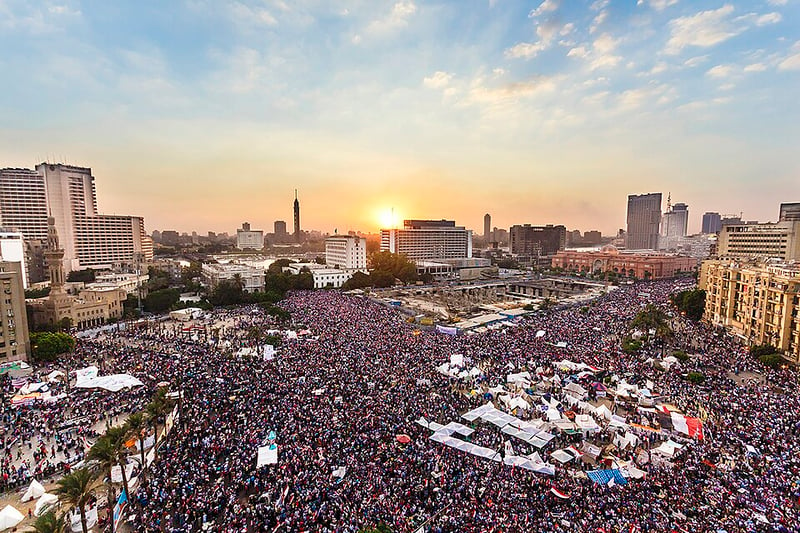
Protests begin around Egypt against President Mohamed Morsi and the ruling Freed

2013 — Protests begin around Egypt against President Mohamed Morsi and the ruling Freedom and Justice Party, leading to their overthrow during the 2013 Egyptian coup d'état

June 30 spans 62 recorded events across recorded history, from 296 to 2023. Below is a curated digest of the most significant moments tied to this date.

By · Wikipedia

Historical Events 62 events 296 – 2023

More major events on June 30

The featured story and these ranked highlights form a quick summary. Every recorded event remains available in the chronology below.

  1. 1989 A coup d'état in Sudan deposes the democratically elected government of Prime Minister Sadiq al-Mahdi and President Ahmed al-Mirghani. Read story Source
  2. 1966 The National Organization for Women, the United States' largest feminist organization, is founded. Source
  3. 1876 Serbia declares war on the Ottoman Empire, leading to the Serbian Wars for Independence. Source

Did you know

The Freedom and Justice Party was founded in 2011 by the Muslim Brotherhood of Egypt.
Did you know

Mohamed Morsi, the ex-president of the party, served as the fifth president of Egypt from 2012 to 2013.

Did you know

The party won 47.2% of the seats in the 2011-2012 parliamentary election, making it the largest party in the People's Assembly.

Did you know

The Freedom and Justice Party was officially dissolved by an Egyptian court in August 2014.

Did you know

The party's ban was upheld by the Egyptian Court of Cassation in 2015, effectively ending its official existence.


Pope_Marcellinus
Pope Marcellinus begins his papacy.
Head of the Catholic Church from 296 to 304
Pope Marcellinus was the bishop of Rome from 30 June 296 to his death in 304.
296
Byzantine_Empire
The Byzantine army of emperor Constantine V defeats the Bulgarian forces in the Battle of Anchialus.
Continuation of the Roman Empire (330–1453)
The Byzantine Empire, also known as the Eastern Roman Empire, was the continuation of the Roman Empire centred on Constantinople during late antiquity and the Middle Ages. Having survived the fall of the Western Roman Empire in the 5th century AD, it endured until the fall of Constantinople to the Ottoman Empire in 1453. The term 'Byzantine Empire' was coined only after its demise; its citizens used the term 'Roman Empire' and called themselves 'Romans'.
763
Ming_dynasty
Zhu Yunwen ascended the throne to the Ming dynasty to become the Jianwen Emperor.
Imperial dynasty of China (1368–1644)
The Ming dynasty, officially the Great Ming, was an imperial dynasty of China that ruled from 1368 to 1644, following the collapse of the Mongol-led Yuan dynasty. The Ming was the last imperial dynasty of China ruled by the Han people, the majority ethnic group in China. Although the primary capital of Beijing fell in 1644 to a rebellion led by Li Zicheng, numerous rump regimes ruled by remnants of the Ming imperial family, collectively called the Southern Ming, survived until 1662.
1398
Battle_of_Arbedo
Battle of Arbedo between the duke of Milan and the Swiss cantons.
1422 battle during the Transalpine campaigns of the Old Swiss Confederacy
The Battle of Arbedo was fought on 30 June 1422 between the Duchy of Milan and the Swiss Confederation, and ended with a Milanese victory.
1422
Kingdom_of_France
Spanish forces defeat a combined French and Navarrese army at the Battle of Noáin during the Spanish conquest of Iberian Navarre.
Country in Western Europe (843–1792; 1815–1848)
The Kingdom of France is the historiographical name or umbrella term given to various political entities of France in the medieval and early modern period. It was one of the most powerful states in Europe from the High Middle Ages to 1848 during its dissolution. It was also an early colonial power, with colonies in Asia and Africa, and the largest being New France in North America geographically centred on the Great Lakes. In the 16th to the 18th centuries, the French colonial empire stretched from a total area at its peak in 1680 to over 10 million square kilometres, the second-largest empire in the world at the time behind the Spanish Empire.
1521
Henry_II_of_France
King Henry II of France is mortally wounded in a jousting match against Gabriel, comte de Montgomery.
King of France from 1547 to 1559
Henry II was King of France from 1547 until his death in 1559. The second son of Francis I and Claude, Duchess of Brittany, he became Dauphin of France upon the death of his elder brother Francis in 1536.
1559
Castillo_San_Felipe_del_Morro
The Spanish-held Castillo San Felipe del Morro in San Juan, Puerto Rico having been besieged for fifteen days, surrenders to an English force under Sir George Clifford, Earl of Cumberland.
16th-century fortress and citadel in Puerto Rico
Castillo San Felipe del Morro, most commonly known as El Morro, is a large fortress and citadel in the Old San Juan historic quarter of San Juan, the capital city and municipality of Puerto Rico. Commissioned by King Charles I of Spain in 1539, it was first built as a fortified tower in honor of King Philip II, who oversaw its expansion into a hornwork bastion fort by 1595. Over the next 200 years, especially in the reign of King Charles III, El Morro continued to be developed to reach its current form in 1787. Rising 43 metres (140 ft) from the Atlantic shoreline with 5.5 to 7.6 metres thick walls, the six-leveled edifice stands on a steep, rocky headland promontory on San Juan Islet guarding the entry to San Juan Bay, the harbor of Old San Juan. El Morro, alongside La Fortaleza, San Cristóbal, El Cañuelo, and other forts part of the Walls of Old San Juan, protected strategically and militarily important Puerto Rico, or La Llave de las Indias, from invasion by competing world powers during the Age of Discovery and Sail. It was designated a World Heritage Site by UNESCO in 1983.
1598
University_of_Tartu
The University of Tartu is founded.
Public university in Tartu, Estonia
The University of Tartu is a public research university in Tartu, Estonia. It is the national university of Estonia, as well as the largest and oldest university in the country.
1632
Charles_I_of_England
Royalists loyal to King Charles I led by the Earl of Newcastle defeat Parliamentarian troops commanded by Lord Fairfax in the battle of Adwalton Moor, allowing them to capture Bradford and Leeds.
King of England, Scotland and Ireland from 1625 to 1649
Charles I was King of England, Scotland, and Ireland from 27 March 1625 until his execution in 1649.
1643
Deluge_(history)
The Deluge: Khmelnytsky Uprising: The Battle of Berestechko ends with a Polish victory.
1648–1666 invasions of Poland–Lithuania
The Deluge was a series of mid-17th-century military campaigns in the Polish–Lithuanian Commonwealth. In a stricter sense, the term refers to the Swedish invasion and occupation of the Commonwealth as a theatre of the Second Northern War (1655–1660) only; in Poland and Lithuania this period is called the Swedish Deluge, or less commonly the Russo–Swedish Deluge due to the simultaneous Russo-Polish War. In a wider sense, it applies to the period between the Khmelnytsky Uprising of 1648 and the Truce of Andrusovo in 1667, comprising the Polish theatres of the Russo-Polish and Second Northern Wars. The term "deluge" was popularized by Henryk Sienkiewicz in his novel The Deluge (1886).
1651
Invitation_to_William
The Immortal Seven issue the Invitation to William, which would culminate in the Glorious Revolution.
Letter to William III
The Invitation to William was a letter sent by seven Englishmen, later referred to as "the Immortal Seven", to stadtholder William III, Prince of Orange, dated 30 June 1688. In England, the heir apparent to the throne, James Francis Edward Stuart, had just been born to the unpopular King James II of England, and baptised a Catholic. The letter asked William, who was a nephew and son-in-law of James II, to use military intervention to force the King to make his eldest daughter, Mary, William's Protestant wife, his heir. The letter alleged that the newborn prince was an impostor.
1688
Godert_de_Ginkel,_1st_Earl_of_Athlone
A Williamite army under Godert de Ginkell takes the city of Athlone from the Jacobites after a short siege.
Dutch States Army officer (1644–1703)
Godard van Reede, 1st Earl of Athlone was a Dutch States Army officer who rose to prominence during the Williamite War in Ireland. During the Franco-Dutch War, his bravery and meticulous execution of duties as a cavalry officer caught William of Orange's attention. Rapid promotions followed, and in 1691, he was entrusted with command of the war in Ireland. Alongside Waldeck and Schomberg, Athlone became one of the few senior officers to whom William granted independent command over the Anglo-Dutch forces during his wars.
1691
Battle_of_Ekeren
The Battle of Ekeren between a Dutch force and a French force.
1703 battle of the War of the Spanish Succession
The Battle of Ekeren, which took place on 30 June 1703, was a battle of the War of the Spanish Succession. A Bourbon army of around 24,000 men, consisting of troops from France, Spain and Cologne, surrounded a smaller Dutch force of 12,000 men, which however managed to break out and retire to safety.
1703
Seven_Years'_War
Seven Years' War: Habsburg Austrian forces destroy a Prussian reinforcement and supply convoy in the Battle of Domstadtl, helping to expel Prussian King Frederick the Great from Moravia.
Global war among European powers (1756–1763)
The Seven Years' War, 1756 to 1763, was a global war fought by numerous great powers, primarily in Europe, with significant subsidiary campaigns in North America and the Indian subcontinent. The primary warring states were Great Britain and Prussia fighting against France and Austria, with other countries joining these coalitions: Portugal, Spain, Sweden, and Russia, plus Saxony and many other minor states of the Holy Roman Empire. Related conflicts include the Third Silesian War, French and Indian War, Third Carnatic War, Anglo-Spanish War (1762–1763), and Spanish–Portuguese War.
1758
Northwest_Indian_War
Northwest Indian War: Native American forces under Blue Jacket attack Fort Recovery.
Part of the American Indian Wars (1786–1795)
The Northwest Indian War was an armed conflict for control of the Northwest Territory between the United States and a loose confederation of Native American peoples who called themselves the United Indian Nations but are better known today as the Northwestern Confederacy. The United States Army considers the conflict to be the first of the American Indian Wars.
1794
United_States_Congress
Under An act to divide the Indiana Territory into two separate governments, adopted by the U.S.
Congress on January 11, 1805, the Michigan Territory is organized.
The United States Congress is the legislative branch of the federal government of the United States. It is a bicameral legislature, including a lower body, the U.S. House of Representatives, and an upper body, the U.S. Senate. They both meet in the United States Capitol in Washington, D.C.
1805
Acrobatics
French acrobat Charles Blondin crosses Niagara Falls on a tightrope.
Feats of balance and agility
Acrobatics is the performance of human feats of balance, agility, and motor coordination. Acrobatic skills are used in performing arts, sporting events, and martial arts. Extensive use of acrobatic skills are most often performed in acro dance, circus, gymnastics, and freerunning and to a lesser extent in other athletic activities including ballet, slacklining and diving. Although acrobatics is most commonly associated with human body performance, the term is used to describe other types of performance, such as aerobatics.
1859
1860_Oxford_evolution_debate
The 1860 Oxford evolution debate at the Oxford University Museum of Natural History takes place.
Discussion about evolution in Oxford, England
The 1860 Oxford evolution debate took place at the Oxford University Museum in Oxford, England, on 7 July 1860, seven months after the publication of Charles Darwin's On the Origin of Species. Several prominent British scientists and philosophers participated, including Thomas Henry Huxley, Bishop Samuel Wilberforce, Benjamin Brodie, Joseph Dalton Hooker and Robert FitzRoy.
1860
President_of_the_United_States
U.S.
President Abraham Lincoln grants Yosemite Valley to California for "public use, resort and recreation".
The president of the United States (POTUS) is the head of state and head of government of the United States. The president directs the executive branch of the federal government and is the commander-in-chief of the United States Armed Forces.
1864
Principality_of_Serbia
Serbia declares war on the Ottoman Empire, leading to the Serbian Wars for Independence.
Principality in southeast Europe between 1815 and 1882
The Principality of Serbia was an autonomous, later sovereign state in the Balkans that came into existence as a result of the Serbian Revolution. Its creation was negotiated first through an unwritten agreement between Miloš Obrenović, leader of the Second Serbian Uprising, and Ottoman official Marashli Pasha, followed by a series of decrees of the Sublime Porte in 1828–1833. Its de facto independence ensued in 1867, following the evacuation of the remaining Ottoman troops from the Belgrade Fortress and the country; its independence was recognized internationally in 1878 by the Treaty of Berlin. In 1882 the country was elevated to the status of kingdom.
1876
Charles_J._Guiteau
Charles J.
Guiteau is hanged in Washington, D.C. for the assassination of U.S. President James Garfield.
Charles Julius Guiteau was an American office seeker who assassinated the 20th President of the United States, James A. Garfield, in 1881. A failed lawyer suffering from mental illness, Guiteau delusionally believed he had played a major role in Garfield's election victory, for which he should have been rewarded with a consulship. Guiteau felt frustrated and offended by the Garfield administration's rejections of his applications to serve in Vienna or Paris to such a degree that he shot Garfield in Washington, D.C., on July 2, 1881. Garfield died on September 19 from infections related to the wounds. Caught immediately after shooting Garfield, Guiteau was tried, convicted, and publicly executed by hanging on June 30, 1882.
1882
Montreal
The first transcontinental train trip across Canada departs from Montreal, Quebec.
It arrives in Port Moody, British Columbia on July 4.
Montreal is the largest city in the province of Quebec, the second-largest in Canada, and the eighth-largest in North America. Founded in 1642 as Ville-Marie, or "City of Mary", it now takes its name from Mount Royal, the triple-peaked mountain around which the early settlement was built. The city is centred on the Island of Montreal and a few, much smaller, peripheral islands, the largest of which is Île Bizard. It lies 196 kilometres (122 mi) east of the national capital, Ottawa, and 258 kilometres (160 mi) southwest of the provincial capital, Quebec City.
1886
Homestead_strike
The Homestead Strike begins near Pittsburgh, Pennsylvania.
1892 labor strike
The Homestead strike, also known as the Homestead steel strike, Homestead massacre, or Battle of Homestead, was an industrial lockout and strike that occurred in Pennsylvania in the United States, in 1892. It began on July 1, 1892, culminating in a battle in which strikers defeated private security agents on July 6, 1892. The governor responded by sending in the National Guard to protect strikebreakers. The dispute occurred at the Homestead Steel Works in the Pittsburgh-area town of Homestead, Pennsylvania, between the Amalgamated Association of Iron and Steel Workers and the Carnegie Steel Company. The final result was a major defeat for the union strikers and a setback for their efforts to unionize steelworkers. The battle was a pivotal event in U.S. labor history.
1892
1900_Hoboken_Docks_fire
A savage fire wrecked three steamships docked at a pier in Hoboken, New Jersey.
Over 200 crew members and passengers are killed, and hundreds injured.
The 1900 Hoboken Docks fire occurred on June 30, 1900, and killed at least 326 people in and around the Hoboken, New Jersey piers of the Norddeutscher Lloyd (NDL) shipping company. The piers were in New York Harbor, at the foot of 3rd and 4th Streets in Hoboken, across the North River from Manhattan in New York City. The area, a few blocks north of Hoboken Terminal, is now mostly part of the Hudson River, without docks: a waterfront bicycle path lines it.
1900
Albert_Einstein
Albert Einstein sends the article On the Electrodynamics of Moving Bodies, in which he introduces special relativity, for publication in Annalen der Physik.
German-born theoretical physicist (1879–1955)
Albert Einstein was a German-born theoretical physicist best known for developing the theory of relativity. Einstein also made important contributions to quantum theory. His mass–energy equivalence formula E = mc2, which arises from special relativity, has been called "the world's most famous equation". He received the 1921 Nobel Prize in Physics for "his services to theoretical physics, and especially for his discovery of the law of the photoelectric effect".
1905
Federal_Meat_Inspection_Act
The United States Congress passes the Meat Inspection Act and Pure Food and Drug Act.
1906 U.S. law regulating the meat industry
The Federal Meat Inspection Act of 1906 (FMIA) is a U.S. law that makes it illegal to adulterate or misbrand meat and meat products being sold as food, and ensures that meat and meat products are slaughtered and processed under strictly regulated sanitary conditions. These requirements also apply to imported meat products, which must be inspected under equivalent foreign standards. United States Department of Agriculture (USDA) inspection of poultry was added by the Poultry Products Inspection Act of 1957 (PPIA). The Food, Drug, and Cosmetic Act authorizes the Food and Drug Administration (FDA) to provide inspection services for all livestock and poultry species not listed in the FMIA or PPIA, including venison and buffalo. The Agricultural Marketing Act authorizes the USDA to offer voluntary, fee-for-service inspection services for these same species.
1906
Tunguska_event
The Tunguska Event, the largest impact event on Earth in human recorded history, resulting in a massive explosion over Eastern Siberia.
1908 air burst explosion in Siberia, Russia
The Tunguska event was a large explosion of between 3 and 50 megatons TNT equivalent that occurred near the Podkamennaya Tunguska River in Yeniseysk Governorate, Russia, on the morning of 30 June [O.S. 17 June] 1908.
1908
Regina_Cyclone
The Regina Cyclone, Canada's deadliest tornado event, kills 28 people in Regina, Saskatchewan.
1912 tornado in Saskatchewan, Canada
On Sunday, June 30, 1912, a violent and deadly tornado devastated the city of Regina, Saskatchewan, Canada. The tornado, also known as the Regina Cyclone or the Regina tornado of 1912, remains the deadliest tornado in Canadian history with a total of 28 fatalities and about 300 people injured. At about 4:50 p.m., green funnel clouds formed and touched down south of the city, tearing through the residential area between Wascana Lake and Victoria Avenue, and continuing through the downtown business district, rail yards, warehouse district, and northern residential area.
1912
World_War_I
World War I: In "the day Sussex died", elements of the Royal Sussex Regiment take heavy casualties in the Battle of the Boar's Head at Richebourg-l'Avoué in France.
Global conflict from 1914 to 1918
World War I, or the First World War, also known as the Great War, was a global conflict between two coalitions: the Allies and the Central Powers. Major theatres of war included Europe and the Middle East, and well as parts of Africa and the Asia-Pacific. One of the deadliest conflicts in history, World War I resulted in an estimated 15 to 22 million deaths, including in mass war crimes against civilians and genocides. The conflict saw important developments in weaponry, including the first large-scale use of machine guns, artillery, aircraft, chemical weapons, and tanks, and was a major factor in the deadly Spanish flu pandemic.
1916
Warren_G._Harding
U.S.
President Warren G. Harding appoints former President William Howard Taft as Chief Justice of the United States.
Warren Gamaliel Harding was the 29th president of the United States, serving from 1921 until his death in 1923. A member of the Republican Party, he was one of the most popular presidents at the time of his death. After that, a number of scandals were exposed that greatly damaged his reputation.
1921
Charles_Evans_Hughes
In Washington D.C., U.S.
Secretary of State Charles Evans Hughes and Dominican Ambassador Francisco J. Peynado sign the Hughes–Peynado agreement, which ends the United States occupation of the Dominican Republic.
Charles Evans Hughes was an American politician, academic, and jurist who served as the 11th chief justice of the United States from 1930 to 1941. A member of the Republican Party, he previously was the 36th governor of New York (1907–1910), an associate justice of the Supreme Court (1910–1916), and 44th U.S. secretary of state (1921–1925). He was the Republican nominee in the 1916 presidential election, narrowly losing to incumbent president Woodrow Wilson.
1922
Night_of_the_Long_Knives
The Night of the Long Knives, Adolf Hitler's violent purge of his political rivals in Germany, takes place.
1934 purge in Germany
The Night of the Long Knives, also called the Röhm purge or Operation Hummingbird, was a purge that took place in Nazi Germany from 30 June to 2 July 1934. Chancellor Adolf Hitler, urged on by Hermann Göring and Heinrich Himmler, ordered a series of extrajudicial executions intended to consolidate his power and alleviate the German military's concerns about the role of Ernst Röhm and the Sturmabteilung (SA), the Nazis' paramilitary organization, known colloquially as "Brownshirts". Nazi propaganda presented the murders as a preventive measure against an alleged imminent coup by the SA under Röhm – the so-called Röhm Putsch.
1934
Haile_Selassie
Emperor Haile Selassie of Abyssinia appeals for aid to the League of Nations against Italy's invasion of his country.
Emperor of Ethiopia from 1930 to 1974
Haile Selassie I was Emperor of Ethiopia from 1930 to 1974. He rose to power as the Regent Plenipotentiary of Ethiopia under Empress Zewditu between 1916 and 1930.
1936
Emergency_telephone_number
The world's first emergency telephone number, 999, is introduced in London.
Number for local emergency services
An emergency telephone number is a number that allows a caller to contact local emergency services for assistance. The emergency number differs from country to country; it is typically a three-digit number so that it can be easily remembered and dialed quickly. Some countries have a different emergency number for each of the different emergency services; these often differ only by the last digit.
1937
World_War_II
World War II: The Battle of Cherbourg ends with the fall of the strategically valuable port to American forces.
Global conflict (1939–1945)
World War II, or the Second World War, was a global conflict between two coalitions: the Allies and the Axis powers. Nearly all of the world's countries participated, with many engaging in total war on an unprecedented scale. World War II was the deadliest conflict in history, causing the deaths of 60 to 75 million people, a majority of whom were civilians. Millions died as a result of massacres, starvation, disease, and genocides including the Holocaust. After the Allied victory, Germany, Austria, Japan, and Korea were occupied, and German and Japanese leaders were tried for war crimes.
1944
Chevrolet_Corvette
The first Chevrolet Corvette rolls off the assembly line in Flint, Michigan.
American sports car by the Chevrolet division of General Motors (GM)
The Chevrolet Corvette is a line of American two-door, two-seater sports cars manufactured and marketed by General Motors under the Chevrolet marque since 1953. Throughout eight generations, indicated sequentially as C1 to C8, the Corvette is noted for its performance, distinctive styling, lightweight fiberglass or composite bodywork, and competitive pricing. The Corvette has had domestic mass-produced two-seater competitors fielded by American Motors, Ford, and Chrysler; it is the only one continuously produced by a United States auto manufacturer. It serves as Chevrolet's halo car.
1953
Trans_World_Airlines
A TWA Super Constellation and a United Airlines DC-7 collide above the Grand Canyon in Arizona and crash, killing all 128 on board both airliners.
Airline of the United States (1930–2001)
Trans World Airlines (TWA) was a trunk carrier, a scheduled airline in the United States that operated from 1930 until it was acquired by American Airlines in 2001. It was formed as Transcontinental & Western Air to operate a route from New York City to Los Angeles via St. Louis, Kansas City, and other stops, with Ford Trimotors. With American, United, and Eastern, it was one of the "Big Four" domestic airlines in the United States formed by the Spoils Conference of 1930.
1956
North_American_F-100_Super_Sabre
A United States Air Force F-100 Super Sabre from Kadena Air Base, Okinawa, crashes into a nearby elementary school, killing 11 students plus six residents from the local neighborhood.
1953 fighter aircraft family
The North American F-100 Super Sabre is an American supersonic jet fighter aircraft designed and produced by the aircraft manufacturer North American Aviation. The first of the Century Series of American jet fighters, it was the first United States Air Force (USAF) fighter capable of supersonic speed in level flight.
1959
Belgian_Congo
Belgian Congo gains independence as Republic of the Congo (Léopoldville).
1908–1960 Belgian colony in Central Africa
The Belgian Congo was a Belgian colony in Central Africa from 1908 until independence in 1960. It is today the Democratic Republic of the Congo (DRC).
1960
Ciaculli bombing: a car bomb, intended for Mafia boss Salvatore Greco, kills seven police officers and military personnel near Palermo.
1963 assassination attempt of Sicilian mafia boss Salvatore "Ciaschiteddu" Greco
The Ciaculli massacre on 30 June 1963 was caused by a car bomb that exploded in Ciaculli, an outlying suburb of Palermo, killing seven police and military officers sent to defuse it after an anonymous phone call. The bomb was intended for Salvatore "Ciaschiteddu" Greco, head of the Sicilian Mafia Commission and the boss of the Ciaculli Mafia family. At first, mafia boss Pietro Torretta was considered to be the instigator behind the bomb attack, but it was eventually found to be Michele Cavataio.
1963
National_Organization_for_Women
The National Organization for Women, the United States' largest feminist organization, is founded.
American feminist organization
The National Organization for Women (NOW) is an American progressive-left feminist organization. Founded in 1966, it is legally a 501(c)(4) social welfare organization. The organization consists of 550 chapters in all 50 U.S. states and in Washington, D.C. It is the largest feminist organization in the United States with around 500,000 members. NOW is regarded as one of the main liberal feminist organizations in the US, and primarily lobbies for gender equality within the existing political system. NOW campaigns for constitutional equality, economic justice, reproductive rights, LGBTQIA+ rights and racial justice, and against violence against women.
1966
Pope_Paul_VI
Pope Paul VI issues the Credo of the People of God.
Head of the Catholic Church from 1963 to 1978
Pope Paul VI was head of the Catholic Church and sovereign of Vatican City from 21 June 1963 until his death on 6 August 1978. Succeeding John XXIII, he continued the Second Vatican Council, which he closed in 1965, implementing its numerous reforms. He fostered improved ecumenical relations with Eastern Orthodox and Protestant churches, which resulted in many historic meetings and agreements.
1968
Soviet_Union
The crew of the Soviet Soyuz 11 spacecraft are killed when their air supply escapes through a faulty valve.
Country in Eurasia from 1922 to 1991
The Soviet Union, officially the Union of Soviet Socialist Republics (USSR), was a transcontinental country that spanned much of Eurasia from its formation in 1922 until its dissolution in 1991. It was the world's third-most populous country, the largest by area, and bordered twelve other countries. A diverse multinational state, it was organized as a federal union of national republics, with the largest and most populous being the Russian Soviet Federative Socialist Republic (SFSR). The world's flagship communist state, it was governed by the Communist Party under Marxism–Leninism, through soviet councils. The Soviet economy was also centrally planned. Its capital and largest city was Moscow.
1971
Leap_second
The first leap second is added to the UTC time system.
Intermittent adjustment to UTC
A leap second is a one-second adjustment occasionally applied to Coordinated Universal Time (UTC), to accommodate the difference between International Atomic Time (TAI), as measured precisely by atomic clocks, and observed solar time (UT1), which varies due to irregularities and long-term slowdown in the Earth's rotation.
1972
Concorde 001 intercepts the path of a total solar eclipse and follows the moon's shadow, experiencing the longest total eclipse observation.
Longest total solar eclipse observation
On 30 June 1973, the supersonic jet Concorde 001 intercepted the path of a total solar eclipse and followed the path of totality as it crossed Africa. This feat allowed the passengers to experience a total solar eclipse for 74 minutes, the longest-ever total eclipse observation. Five experiments were carried out during the flight, but they have had limited scientific impact.
1973
The Baltimore municipal strike of 1974 begins.
Strikes and protests by public workers
The 1974 Baltimore municipal strike was a strike action undertaken by different groups of municipal workers in Baltimore, Maryland, United States. It was initiated by waste collectors seeking higher wages and better conditions. They were joined by sewer workers, zookeepers, prison guards, highway workers, recreation & parks workers, animal control workers, abandoned vehicles workers, and eventually by police officers. Trash piled up during the strike, and, especially with diminished police enforcement, many trash piles were set on fire. City jails were also a major site for unrest.
1974
Southeast_Asia_Treaty_Organization
The Southeast Asia Treaty Organization disbands.
Collective defense organization (1955–1977)
The Southeast Asia Treaty Organization (SEATO) was an international organization for collective defense in Southeast Asia created by the Southeast Asia Collective Defense Treaty signed in September 1954 in Manila, Philippines. The formal institution of SEATO was established on 19 February 1955 at a meeting of treaty partners in Bangkok, Thailand. The organization's headquarters was also in Bangkok. A total of eight members joined the organization in its lifetime.
1977
TWA_Flight_847
Thirty-nine American hostages from the hijacked TWA Flight 847 are freed in Beirut after being held for 17 days.
1985 aircraft hijacking
TWA Flight 847 was a regularly scheduled Trans World Airlines flight from Cairo to San Diego with en route stops in Athens, Rome, Boston, and Los Angeles. On the morning of June 14, 1985, Flight 847 was hijacked soon after takeoff from Athens. The Hezbollah hijackers demanded the release of a total of 766 Shia Muslims from Israeli custody and took the plane repeatedly to Beirut and Algiers. As of 2023, Hezbollah continues to deny involvement.
1985
Supreme_Court_of_the_United_States
The U.S.
Supreme Court rules in Bowers v. Hardwick that states can outlaw homosexual acts between consenting adults.
The Supreme Court of the United States (SCOTUS) is the highest court in the federal judiciary of the United States. It has ultimate appellate jurisdiction over all U.S. federal court cases, and over state court cases that turn on questions of U.S. constitutional or federal law. It also has original jurisdiction over a narrow range of cases, specifically "all Cases affecting Ambassadors, other public Ministers and Consuls, and those in which a State shall be Party". In 1803, the court asserted the power of judicial review, the ability to invalidate a statute for violating a provision of the Constitution. It is also able to strike down presidential directives for violating either the Constitution or statutory law.
1986
1989_Sudanese_coup_d'état
A coup d'état in Sudan deposes the democratically elected government of Prime Minister Sadiq al-Mahdi and President Ahmed al-Mirghani.
Military overthrow of Prime Minister Sadiq al-Mahdi
A bloodless coup d'état in Sudan overthrew the democratically elected government of Prime Minister Sadiq al-Mahdi and President Ahmed al-Mirghani on 30 June 1989, ending Sudan's third democratic era. Carried out by a faction of the Sudanese Armed Forces heavily infiltrated and directed by the National Islamic Front (NIF), the coup was led by Brigadier General Omar al-Bashir and architected by Islamist ideologue Hassan al-Turabi, establishing a totalitarian military-religious regime that ruled the country for the next 30 years until its overthrow in 2019.
1989
German_reunification
East and West Germany merge their economies.
1989–1991 unification process of Germany
German reunification, also known as the expansion of the Federal Republic of Germany (BRD), was the process of re-establishing Germany as a single sovereign state, which began on 9 November 1989 and culminated on 3 October 1990 with the dissolution of the German Democratic Republic and the integration of its re-established constituent federated states into the Federal Republic of Germany to form present-day Germany. This date was chosen as the customary German Unity Day, and has thereafter been celebrated each year as a national holiday. On the same date, East and West Berlin were also reunified into a single city, which eventually became the capital of Germany.
1990
Local_councils_of_Malta
Malta is officially subdivided into 68 local councils by the Local Councils Act.
Since June 30, 1993, Malta has been subdivided into 68 localities, governed by local councils, Maltese: kunsilli lokali, meaning municipalities or boroughs, and considered by the Maltese as the equivalent to basic villages or towns, where appropriate. These form the most basic type of local government and are subdivisions of the country's first-level regions.
1993
Airbus_A330
An Airbus A330-300 crashes during a test flight at Toulouse–Blagnac Airport, killing all seven people on board.
Twin-aisle airliner family
The Airbus A330 is a wide-body airliner developed and produced by Airbus. Airbus began developing larger A300 derivatives in the mid–1970s, giving rise to the A330 twinjet as well as the Airbus A340 quadjet, and launched both designs along with their first orders in June 1987. The A330-300, the first variant, took its maiden flight in November 1992 and entered service with Air Inter in January 1994. The A330-200, a shortened longer-range variant, followed in 1998 with Canada 3000 as the launch operator.
1994
Jeep_Cherokee
A Jeep Cherokee filled with propane canisters drives into the entrance of Glasgow Airport, Scotland in a failed terrorist attack.
This was linked to the 2007 London car bombs that had taken place the day before.
The Jeep Cherokee is a line of sport utility vehicles (SUV) manufactured and marketed by Jeep over six generations. Marketed initially as a variant of the Jeep Wagoneer (SJ), the Cherokee has evolved from a full-size station wagon to one of the first compact SUVs and into its latest generation as a crossover SUV.
2007
Yemenia_Flight_626
Yemenia Flight 626, an Airbus A310-300, crashes into the Indian Ocean near Comoros, killing 152 of the 153 people on board.
A 14-year-old girl named Bahia Bakari survives the crash.
Yemenia Flight 626 was a scheduled flight on an Airbus A310-324 twin-engine jet airliner operated by Yemenia that was flying a scheduled international service, from Sanaa in Yemen to Moroni in Comoros, when it crashed on 30 June 2009 at around 1:50 am local time while on approach to Prince Said Ibrahim International Airport, killing all but one of the 153 passengers and crew on board. The sole survivor, 12-year-old girl Bahia Bakari, was found clinging to wreckage after floating in the ocean. Bakari was discharged from the hospital on 23 July 2009.
2009
Yarnell_Hill_Fire
Nineteen firefighters die controlling a wildfire near Yarnell, Arizona.
2013 wildfire in Arizona, USA
The Yarnell Hill Fire was a wildfire near Yarnell, Arizona, ignited by dry lightning on June 28, 2013. Two days later; on June 30, it overran and killed 19 members of the Granite Mountain Hotshots, a group of firefighters within the Prescott Fire Department. Just one of the hotshots on the crew survived — he was posted as a lookout on the fire and was not with the others when the fire overtook them. The Yarnell Hill Fire was one of the deadliest U.S. wildfires since the 1991 Oakland Hills fire, which killed 25 people, and the deadliest wildland fire for U.S. firefighters since the 1933 Griffith Park fire, which killed 29 "impromptu" civilian firefighters drafted on short notice to help battle the Los Angeles area fire.
2013
Lockheed_C-130_Hercules
A Hercules C-130 military aircraft with 113 people on board crashes in a residential area in Medan, Indonesia, resulting in at least 116 deaths.
American military transport aircraft
The Lockheed C-130 Hercules is an American four-engine turboprop military transport aircraft designed and built by Lockheed. Capable of using unprepared runways for takeoffs and landings, the C-130 was designed as a troop, medevac, and cargo transport aircraft. The versatile airframe has found uses in other roles, including as a gunship (AC-130), for airborne assault, search and rescue, scientific research support, weather reconnaissance, aerial refueling, maritime patrol, and aerial firefighting. It is the main tactical airlifter for many military forces worldwide. More than 40 variants of the Hercules, including civilian versions marketed as the Lockheed L-100, operate in more than 60 nations.
2015
Donald_Trump
Donald Trump becomes the first sitting US President to visit the Democratic People's Republic of Korea (North Korea).
President of the United States (2017–2021; since 2025)
Donald John Trump is an American politician, media personality, and businessman who is the 47th president of the United States. A member of the Republican Party, he served as the 45th president from 2017 to 2021.
2019
2020_Hong_Kong_national_security_law
The Hong Kong National Security Law is passed by the Standing Committee of the National People's Congress and immediately comes into effect after gazettal.
The Law of the People's Republic of China on Safeguarding National Security in the Hong Kong Special Administrative Region is a national law of China on Hong Kong national security passed on 30 June 2020. It is implemented in Hong Kong in accordance with Hong Kong Basic Law Article 18, which allows for China's national laws to be valid in Hong Kong if they are included in Annex III. It was formulated under the authorization of the National People's Congress decision on Hong Kong national security legislation. The law was passed on 30 June 2020 by the Standing Committee of the National People's Congress as a means of resolving the anti-extradition bill protests instigated by a Hong Kong local bill proposed in 2019 to enable extradition to other territories including the mainland, and came into force the same day.
2020
Tiger_Fire
The Tiger Fire ignites near Black Canyon City, Arizona, and goes on to burn 16,278 acres (6,587 ha) of land before being fully contained on July 30.
2021 wildfire in Arizona, USA
The Tiger Fire was a wildfire that burned 16,278 acres (6,587 ha) in the U.S. state of Arizona from June to July 2021. The fire was caused by a dry lightning strike in the Prescott National Forest. Although Horsethief Basin Lake was evacuated and both the community of Crown King and the census-designated place of Black Canyon City were threatened, no injuries or deaths were reported, and no buildings were damaged or destroyed. Over 300 fire personnel were assigned to contain the blaze.
2021
Tajikistan
A Tajik citizen with ISIS connections, wanted in Tajikistan for murder and kidnapping, kills two people at Chișinău International Airport in Moldova, after being denied entry to the country.
Landlocked country in Central Asia
Tajikistan, officially the Republic of Tajikistan, is a landlocked country located in Central Asia. Dushanbe is the capital and largest city of the country, with a population of over 1.2 million. Tajikistan borders Afghanistan to the south, Uzbekistan to the west, Kyrgyzstan to the north, and China to the east; it is narrowly separated from Pakistan by Afghanistan's Wakhan Corridor. Its total population exceeds 11 million.
2023

History runs on facts, and this project runs on coffee!

Your support is incredibly helpful and genuinely appreciated.

Support with a coffee ☕