June 5 in History

Denmark amends its constitution to allow women's suffrage.

1915 — Denmark amends its constitution to allow women's suffrage

June 5 spans 72 recorded events across recorded history, from 830 to 2025. Below is a curated digest of the most significant moments tied to this date.

By · Wikipedia

Historical Events 72 events 830 – 2025

More major events on June 5

The featured story and these ranked highlights form a quick summary. Every recorded event remains available in the chronology below.

  1. 1873 Sultan Barghash bin Said of Zanzibar closes the great slave market under the terms of a treaty with Great Britain. Source
  2. 2024 The Boeing Starliner is launched on its first crewed flight, carrying astronauts Barry Wilmore and Sunita Williams to the International Space Station. Source
  3. 1949 Thailand elects Orapin Chaiyakan, the first female member of Thailand's Parliament. Source

Did you know

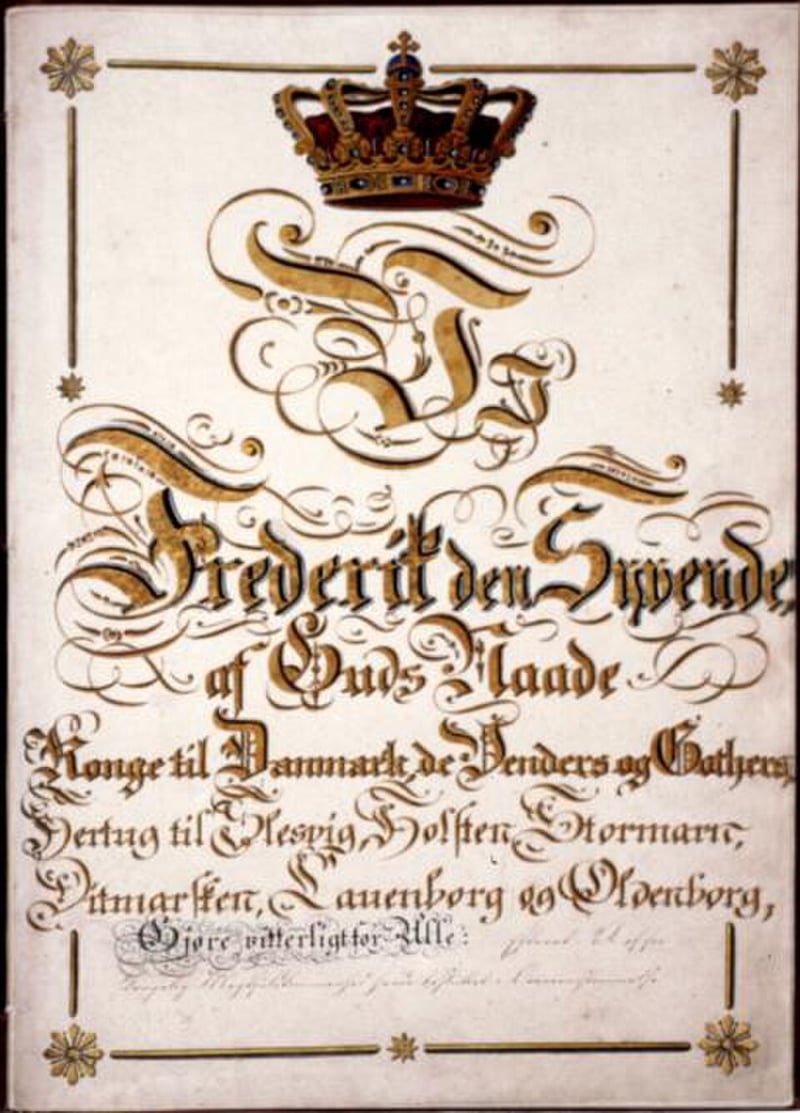
In 1915, Denmark amends its constitution to allow women's suffrage. This featured entry focuses on the immediate decision and its direct historical impact.
Did you know

The Constitutional Act of the Realm of Denmark, also known as the Constitutional Act of the Kingdom of Denmark, or simply the Constitution, is the constitution of the Kingdom of Denmark, applying equally in the Realm of Denmark: Denmark proper, Greenland and the Faroe Islands. This helps explain why the event mattered beyond the initial announcement.

Did you know

The first democratic constitution was adopted in 1849, replacing the 1665 absolutist constitution. This clarifies the institutional and public response around the event.

Did you know

The Constitutional Act has been changed a few times. This shows how the event shaped policy and public communication in the same period.

Did you know

The wording is general enough to still apply today. This helps explain why the event mattered beyond the initial announcement.


Theodora_(wife_of_Theophilos)
Theodora is crowned Byzantine empress and marries then emperor Theophilos in the Hagia Sophia.
She is credited with restoring Christian orthodoxy and icons.
Theodora, sometimes called Theodora the Armenian or Theodora the Blessed, was Byzantine empress as the wife of Byzantine emperor Theophilos from 830 to 842. Following Theophilos's death, the widowed Theodora acted as regent for the couple's young son, Michael III, until her son deposed her in 856.
830
Tutush, brother of Seljuk sultan Malik Shah, defeats Suleiman ibn Qutalmish, the Turkish ruler of Anatolia in the battle of Ain Salm.
Sultan of Damascus from 1092 to 1094
Abu Sa'id Taj al-Dawla Tutush or Tutush I, was the Seljuk emir of Damascus from 1078 to 1092, and sultan of Damascus from 1092 to 1094.
1086
Kraków
Kraków, in Poland, receives city rights.
City in Poland
Kraków, officially the Royal Capital City of Kraków, is the second-largest and one of the oldest cities in Poland. Situated on the Vistula River in Lesser Poland Voivodeship, the city has a population of 816,614 (2025), with 1,428,363 people living in the Kraków metropolitan area. Kraków was the official capital of Poland until 1596 and has traditionally been one of the leading centres of Polish economic, academic, cultural, and artistic life. Its Old Town was declared a UNESCO World Heritage Site in 1978, one of the world's first sites granted the status.
1257
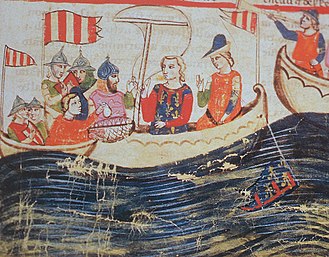
Battle_of_the_Gulf_of_Naples
Battle of the Gulf of Naples: Roger of Lauria, admiral to King Peter III of Aragon, destroys the Neapolitan fleet and captures Charles of Salerno.
1284 naval battle during the War of the Sicilian Vespers
The Battle of the Gulf of Naples was a naval engagement during the War of the Sicilian Vespers. Fought on 5 June 1284 in the south of the Gulf of Naples, the battle saw an Aragonese–Sicilian fleet commanded by Roger of Lauria defeat a Angevin fleet commanded by Prince Charles of Salerno. Charles was captured during the battle, and the Aragonese victory helped secure Aragonese control of the sea around Sicily.
1284
Battle_of_Worringen
The Battle of Worringen ends the War of the Limburg Succession, with John I, Duke of Brabant, being one of the more important victors.
Part of the War of the Limburg Succession
The Battle of Worringen was fought on 5 June 1288 near the town of Worringen, which is now part of Chorweiler, the northernmost borough (Stadtbezirk) of Cologne. It was the decisive battle of the War of the Limburg Succession, fought for the possession of the Duchy of Limburg between on one side the Archbishop Siegfried II of Cologne and Count Henry VI of Luxembourg, and on the other side, Duke John I of Brabant.
1288
1304–1305_conclave
Election of Pope Clement V following the death of Pope Benedict XI in the previous year.
The 1304–1305 papal conclave was initiated after the death of Pope Benedict XI in July 1304. It took place in Perugia, the city in which Benedict XI had died, and proved to be a protracted affair. It ran from 10 or 17 July 1304 to 5 June 1305, and ultimately elected the non-cardinal Raymond de Got as Pope Clement V. At the time of his election, de Got was the archbishop of Bordeaux and thus a subject of King Edward I of England, although he was a childhood friend of King Philip IV of France. Pope Clement V's decision to relocate the papacy to France was one of the most contested issues in the conclave following his 1314 death, during which the minority of Italian cardinals were unable to engineer the return of the papacy to Rome. This immediately preceded the beginning of the Avignon Papacy.
1305
Tethys'_Festival
The masque Tethys' Festival is performed at Whitehall Palace to celebrate the investiture of Henry Frederick, Prince of Wales.
17th century English Masque
Tethys' Festival was a masque produced on 5 June 1610 to celebrate the investiture of Prince Henry (1594–1612) as Prince of Wales.
1610
Qing_dynasty
The Qing dynasty's Manchu forces led by the Shunzhi Emperor take Beijing during the collapse of the Ming dynasty.
Manchu-led dynasty of China (1644–1912)
The Qing dynasty, officially the Great Qing, also known as the Qing Empire or Qing China, was a Manchu-led imperial dynasty of China and an early modern empire in East Asia which existed from 1636/1644 to 1912. The last imperial dynasty in Chinese history, the Qing dynasty was preceded by the Ming dynasty and succeeded by the Republic of China. At the height of its power, the empire stretched from the Sea of Japan in the east to the Pamir Mountains in the west, and from the Mongolian Plateau in the north to the South China Sea in the south. Originally emerging from the Later Jin dynasty founded in 1616 and proclaimed in Shenyang in 1636, the dynasty seized control of the Ming capital Beijing and North China in 1644, traditionally considered the start of the dynasty's rule. The dynasty lasted until the Xinhai Revolution of October 1911 led to the abdication of the last emperor in February 1912. The multi-ethnic Qing dynasty assembled the territorial base for modern China. The Qing controlled the most territory of any dynasty in Chinese history, and in 1790 was the fourth-largest empire in world history to that point. It was also the most populous state at the time, with over 426 million citizens in 1907.
1644
Haitian_Revolution
Haitian Revolution: Battle of Port-Républicain: British troops capture the capital of Saint-Domingue.
1791–1804 slave revolt in Hispanola
The Haitian Revolution, also known as the Haitian War of Independence, was a successful insurrection by enslaved Africans against French colonial rule in Saint-Domingue, now the sovereign state of Haiti. The revolution was one of the only known slave rebellions in human history that led to the founding of a state which was both free from slavery and ruled by former captives.
1794
Battle_of_New_Ross_(1798)
Battle of New Ross: The attempt to spread the United Irish Rebellion into Munster is defeated.
Battle of the Irish Rebellion of 1798
The Battle of New Ross was a military engagement which took place in New Ross, County Wexford during the Irish Rebellion of 1798. It was fought between the Society of United Irishmen rebels and government forces garrisoning the town. The attack on the town of New Ross on the River Barrow, was an attempt by the recently victorious rebels to break out of county Wexford across the river Barrow and to spread the rebellion into county Kilkenny and the nearby province of Munster.
1798
Great_Lakes
The first Great Lakes steamer, the Frontenac, is launched.
Group of lakes in North America
The Great Lakes, also called the Great Lakes of North America, are a series of large interconnected freshwater lakes spanning the Canada–United States border. The five lakes are Superior, Michigan, Huron, Erie, and Ontario. The Great Lakes Waterway enables modern travel and shipping by water among the lakes. The lakes connect ultimately to the Atlantic Ocean via the Saint Lawrence River as their primary drainage outflow. The lakes are also connected to the Mississippi River basin through the Illinois Waterway.
1817
HMS Pickle captures the armed slave ship Voladora off the coast of Cuba.
List of ships with the same or similar names
Eight ships of the Royal Navy have been named HMS Pickle:The first HMS Pickle (1800) was a 10-gun topsail schooner purchased in 1800, originally named Sting, and renamed in 1802. She was present at the Battle of Trafalgar in 1805, under the command of John Richards Lapenotiere, who was entrusted with conveying the message about the victory and the death of Lord Nelson to England. She landed in Falmouth, Cornwall, setting Lapenotiere on his historic 36-hour journey by post chaise to the Admiralty in London. The route he took was inaugurated as The Trafalgar Way in 2005. She was wrecked in 1808 off Cádiz. The second Pickle was the 12-gun schooner Eclair, originally French, that Garland, a tender to Daphne, captured in 1801. Eclair was renamed Pickle in 1809 and sold in 1818. The third Pickle was a schooner of 5 guns, launched in 1827. She was involved in the suppression of the slave trade, and achieved fame for capturing the armed slave ship Voladora off the coast of Cuba on 5 June 1829. She was broken up in 1847. The fourth Pickle was originally the slave-trading brig Eolo, captured in 1852 by HMS Orestes. The fifth Pickle was a mortar vessel launched in 1855 and broken up in 1865. The sixth Pickle was an Albacore-class wooden screw gunboat launched in 1856 and broken up in 1864. The seventh Pickle was an Ant-class iron screw gunboat launched in 1872. The eighth HMS Pickle (J293) was an Algerine-class minesweeper launched in 1943. She was transferred to the navy of Ceylon in 1959 and renamed Parakarama.
1829
June_Rebellion
The June Rebellion breaks out in Paris in an attempt to overthrow the monarchy of Louis Philippe.
1832 insurrection against the French monarchy
The June Rebellion, also called the Paris Uprising of 1832, was an anti-monarchist insurrection of Parisian republicans on 5 and 6 June 1832.
1832
Houston
Houston is incorporated by the Republic of Texas.
Largest city in Texas, United States
Houston is the most populous city in the U.S. state of Texas and the Southern United States. It is the fourth-most populous city in the United States, with a population of 2.3 million at the 2020 census. The Greater Houston metropolitan area, at 7.8 million residents, is the fifth-most populous metropolitan area in the nation and second-most populous in Texas. Located in Southeast Texas near Galveston Bay and the Gulf of Mexico, Houston is the county seat of Harris County. Covering a total area of 640.4 square miles (1,659 km2), it is the ninth largest city in the country and the largest whose municipal government is not consolidated with a county, parish, or borough. Although primarily located within Harris County, portions of the city extend into Fort Bend and Montgomery counties. Houston also functions as the southeastern anchor of the Texas Triangle megaregion.
1837
Denmark
Denmark becomes a constitutional monarchy by the signing of a new constitution.
Country in northern Europe
Denmark is a Nordic country in Northern Europe. It is the metropole and most populous constituent of the Kingdom of Denmark, also known as the Danish Realm, a constitutionally unitary state that includes the autonomous territories of the Faroe Islands and Greenland in the north Atlantic Ocean. Metropolitan Denmark, also called "continental Denmark" or "Denmark proper", consists of the northern Jutland peninsula and an archipelago of 406 islands. It is the southernmost of the Scandinavian countries, lying southwest of Sweden, south of Norway, and north of Germany, with which it shares a short border. Metropolitan Denmark is situated between the North Sea to the west and the Baltic Sea to the east.
1849
Harriet_Beecher_Stowe
Harriet Beecher Stowe's anti-slavery serial, Uncle Tom's Cabin, or Life Among the Lowly, starts a ten-month run in the National Era abolitionist newspaper.
American abolitionist and author (1811-1896)
Harriet Elisabeth Beecher Stowe was an American author and abolitionist. She came from the Beecher family and wrote a popular novel called Uncle Tom's Cabin (1852), which depicts the harsh conditions experienced by enslaved African Americans. The book reached an audience of millions as a novel and play and was influential in the United States and in Great Britain, energizing anti-slavery forces in the American North, while provoking widespread anger in the South. Stowe wrote over 30 books, including novels, three travel memoirs, and collections of articles and letters. She was influential both for her writings and for her public stances and debates on social issues of the day.
1851
Treaty_of_Saigon_(1862)
As the Treaty of Saigon is signed, ceding parts of southern Vietnam to France, the guerrilla leader Trương Định decides to defy Emperor Tự Đức of Vietnam and fight on against the Europeans.
1862 treaty between Vietnam and France
The Treaty of Saigon was signed on 5 June 1862 between representatives of the colonial powers, France and Spain, and the last precolonial emperor of the Nguyễn dynasty, Emperor Tự Đức after the coalition's invasion during the Cochinchina campaign. The signatories were Louis Adolphe Bonard (France), Carlos Palanca Gutiérrez (Spain) and Phan Thanh Giản (Vietnam). Based on the terms of the accord, Tự Đức ceded Saigon, the island of Poulo Condor and three southern provinces of what was to become known as Cochinchina to the French. The treaty was confirmed by the Treaty of Huế signed on 14 April 1863.
1862
American_Civil_War
American Civil War: Battle of Piedmont: Union forces under General David Hunter defeat a Confederate army at Piedmont, Virginia, taking nearly 1,000 prisoners.
1861–1865 conflict in the United States
The American Civil War was a civil war in the United States between the Union and the Confederacy, which was formed in 1861 by states that had seceded from the Union to preserve slavery in the United States. The South saw slavery as threatened because of the election of Abraham Lincoln and the growing abolitionist movement in the North. The war ended with Union victory, the dissolution of the Confederacy and the abolition of slavery, freeing four million African Americans.
1864
Barghash_bin_Said_of_Zanzibar
Sultan Barghash bin Said of Zanzibar closes the great slave market under the terms of a treaty with Great Britain.
2nd Sultan of Zanzibar (r. 1870–88)
Sayyid Barghash bin Said al-Busaidi, an Afro-Omani Sultan and the son of Said bin Sultan, was the second Sultan of Zanzibar. He ruled Zanzibar from 7 October 1870 to 26 March 1888.
1873
Zungeni_Mountain_skirmish
The Zungeni Mountain skirmish takes place between British and Zulu forces during the second invasion of the Zulu Kingdom.
1879 skirmish between British and Zulu forces
The Zungeni Mountain skirmish took place on 5 June 1879 between British and Zulu forces during the second invasion of Zululand, in what is now South Africa, in the later stages of the Anglo-Zulu War. British irregular horse commanded by Colonel Redvers Buller discovered a force of 300 Zulus at the settlement of eZulaneni near Zungeni Mountain. The horsemen charged towards and scattered the Zulus before burning the settlement. Buller's men withdrew after coming under fire from Zulus who threatened to surround them.
1879
Orient_Express
The first regularly scheduled Orient Express departs Paris.
Luxury passenger train service in Europe
The Orient Express was a long-distance passenger luxury train service created in 1883 by the Belgian company Compagnie Internationale des Wagons-Lits (CIWL) that operated until 2009. The train traveled the length of continental Europe, with terminal stations in Paris in the northwest and Istanbul in the southeast, and branches extending service to Athens, Brussels, and London.
1883
The Rio de la Plata earthquake takes place.
Earthquake between Argentina and Uruguay
The 1888 Río de la Plata earthquake occurred on 5 June measuring 5.5 on the Richter scale, and shook the upper Río de la Plata at 3:20 UTC-3. The epicentre was located 15 kilometres (9 mi) southwest of Colonia del Sacramento (Uruguay) and 42 kilometres (26 mi) east of Buenos Aires (Argentina), with a hypocentre at a depth of 30 kilometres (19 mi).
1888
Lizzie_Borden
The trial of Lizzie Borden for the murder of her father and step-mother begins in New Bedford, Massachusetts.
American acquitted murder suspect (1860–1927)
Lizzie Andrew Borden was an American woman who was tried and acquitted of the August 4, 1892, axe murders of her father and stepmother in Fall River, Massachusetts. No one else was charged in the murders, and Borden spent the remainder of her life in Fall River. She died of pneumonia at age 66, nine days before the death of her older sister Emma.
1893
Second_Boer_War
Second Boer War: British soldiers take Pretoria.
1899–1902 war in South Africa
The Second Boer War was a conflict fought between the British Empire and the Boer republics over Britain's influence in Southern Africa.
1900
Louis_Brandeis
Louis Brandeis is sworn in as a Justice of the United States Supreme Court; he is the first American Jew to hold such a position.
US Supreme Court justice from 1916 to 1939 (1856–1941)
Louis Dembitz Brandeis was an American lawyer who served as an associate justice of the U.S. Supreme Court from 1916 to 1939. Brandeis was a leading figure in the antitrust movement at the turn of the 20th century, particularly in his resistance to the monopolization of the New England railroad. His anti-monopolistic jurisprudence laid the intellectual foundation for the New Brandeis movement, a contemporary revival of antitrust thought spearheaded by figures such as Lina Khan and Tim Wu.
1916
World_War_I
World War I: The Arab Revolt against the Ottoman Empire breaks out.
Global conflict from 1914 to 1918
World War I, or the First World War, also known as the Great War, was a global conflict between two coalitions: the Allies and the Central Powers. Major theatres of war included Europe and the Middle East, and well as parts of Africa and the Asia-Pacific. One of the deadliest conflicts in history, World War I resulted in an estimated 15 to 22 million deaths, including in mass war crimes against civilians and genocides. The conflict saw important developments in weaponry, including the first large-scale use of machine guns, artillery, aircraft, chemical weapons, and tanks, and was a major factor in the deadly Spanish flu pandemic.
1916
Selective_Service_Act_of_1917
World War I: Conscription begins in the United States as "Army registration day".
Former United States conscription law
The Selective Service Act of 1917 or Selective Draft Act authorized the United States federal government to raise a national army for service in World War I through conscription. It was envisioned in December 1916 and brought to President Woodrow Wilson's attention shortly after the break in relations with Germany in February 1917. The Act itself was drafted by then-Captain Hugh S. Johnson after the United States entered World War I when it declared war on Germany. The Act was canceled with the end of the war on November 11, 1918. The United States Supreme Court upheld the Act as constitutional in 1918.
1917
World_War_II
World War II: After a brief lull in the Battle of France, the Germans renew the offensive against the remaining French divisions south of the River Somme in Operation Fall Rot ("Case Red").
Global conflict (1939–1945)
World War II, or the Second World War, was a global conflict between two coalitions: the Allies and the Axis powers. Nearly all of the world's countries participated, with many engaging in total war on an unprecedented scale. World War II was the deadliest conflict in history, causing the deaths of 60 to 75 million people, a majority of whom were civilians. Millions died as a result of massacres, starvation, disease, and genocides including the Holocaust. After the Allied victory, Germany, Austria, Japan, and Korea were occupied, and German and Japanese leaders were tried for war crimes.
1940
Chongqing
World War II: Four thousand Chongqing residents are asphyxiated in a bomb shelter during the Bombing of Chongqing.
Municipality in Southwestern China
Chongqing is a provincial-level direct-administered municipality in Southwestern China. It is one of the four direct-administered municipalities of China and the only one located inland.
1941
Kingdom_of_Bulgaria
World War II: The United States declares war on Bulgaria, Hungary, and Romania.
State in southeastern Europe from 1908 to 1946
The Tsardom of Bulgaria, also known as the Third Bulgarian Tsardom, commonly known in English as the Kingdom of Bulgaria, or simply Bulgaria, was a constitutional monarchy in Southeastern Europe, which was established on 5 October [O.S. 22 September] 1908, when the Bulgarian state was raised from a principality to a tsardom.
1942
Nazi_Germany
World War II: More than 1,000 British bombers drop 5,000 tons of bombs on German gun batteries on the Normandy coast in preparation for D-Day.
German state from 1933 to 1945
Nazi Germany, officially the German Reich and later the Greater German Reich, was the German state between 1933 and 1945, when Adolf Hitler and the Nazi Party controlled the country, transforming it into a totalitarian dictatorship. The Third Reich, meaning "Third Realm" or "Third Empire", referred to the Nazi claim that Nazi Germany was the successor to the Holy Roman Empire (800–1806) and the German Empire (1871–1918). The Third Reich, which the Nazis referred to as the Thousand-Year Reich, ended in May 1945, after 12 years, when the Allies defeated Germany and entered the capital, Berlin, ending World War II in Europe.
1944
Allied_Control_Council
The Allied Control Council, the military occupation governing body of Germany, formally takes power.
1945–1991 military governing body
The Allied Control Council (ACC) or Allied Control Authority, also referred to as the Four Powers, was the governing body of the Allied occupation zones in Germany (1945–1949/1991) and Austria (1945–1955) following the end of World War II in Europe. Its members were the Soviet Union, the United Kingdom, the United States, and France. Following the defeat of the Nazis, Germany and Austria were occupied as two different areas, both by the same four Allies. Both were later divided into four zones by the 1 August 1945 Potsdam Agreement. The organisation was based in Schöneberg, West Berlin.
1945
La_Salle_Hotel
A fire in the La Salle Hotel in Chicago, Illinois, kills 61 people.
Former hotel in Chicago
The La Salle Hotel was a historic hotel located on the northwest corner of La Salle Street and Madison Street in the Chicago Loop community area of Chicago, Illinois, United States. It was designed by Holabird & Roche and opened in 1909. After a major fire in 1946, the hotel was refurbished and reopened in 1947. It closed in 1976 and was demolished for construction of an office building.
1946
Cold_War
Cold War: Marshall Plan: In a speech at Harvard University, the United States Secretary of State George Marshall calls for economic aid to war-torn Europe.
1947–1991 geopolitical rivalry between US and USSR
The Cold War was a period of international geopolitical rivalry between the United States (US) and the Soviet Union (USSR) and their respective allies, the capitalist Western Bloc and communist Eastern Bloc. It began in the aftermath of the Second World War and ended with the dissolution of the Soviet Union in 1991. The term cold war is used because there was no direct fighting between the two superpowers, though each supported opposing sides in regional conflicts known as proxy wars. In addition to the struggle for ideological and economic influence and an arms race in both conventional and nuclear weapons, the Cold War was expressed through technological rivalries such as the Space Race, espionage, propaganda campaigns, embargoes, and sports diplomacy.
1947
Thailand
Thailand elects Orapin Chaiyakan, the first female member of Thailand's Parliament.
Country in Southeast Asia
Thailand, officially the Kingdom of Thailand, and formerly known as Siam, is a country located in Mainland Southeast Asia. It shares land borders with Myanmar to the west and northwest, Laos to the east and northeast, Cambodia to the southeast, and Malaysia to the south. Its maritime boundaries include the Gulf of Thailand and the Andaman Sea and shares maritime borders with Vietnam, Indonesia, and India. Thailand has a population of nearly 66 million people and covers an area of approximately 513,115 km2. The capital and largest city is Bangkok.
1949
Elvis_Presley
Elvis Presley introduces his new single, "Hound Dog", on The Milton Berle Show, scandalizing the audience with his suggestive hip movements.
American singer and actor (1935–1977)
Elvis Aaron Presley was an American singer and actor. Referred to as the "King of Rock and Roll", he is widely regarded as one of the most culturally significant figures of the 20th century. Presley's energetic and sexually provocative performance style, combined with a mixture of influences across color lines during a transformative era in race relations, brought both great success and initial controversy.
1956
Singapore
The first government of Singapore is sworn in.
Island country in Southeast Asia
Singapore, officially the Republic of Singapore, is an island country in Southeast Asia. Its territory comprises a main island, over 60 satellite islands and islets, and one outlying islet. The country is about one degree of latitude north of the equator, off the southern tip of the Malay Peninsula, bordering the Strait of Malacca to the west, the Singapore Strait to the south along with the Riau Islands in Indonesia, the South China Sea to the east and the Straits of Johor along with the State of Johor in Malaysia to the north.
1959
Lake_Bodom_murders
The Lake Bodom murders occur in Finland.
1960 unsolved homicide in Espoo, Finland
The Lake Bodom murders is an unsolved 1960 homicide case in which three teenage campers were killed and another seriously injured in Finland. The case is one of the most notorious crimes in modern Finnish history.
1960
Secretary_of_State_for_War
The British Secretary of State for War, John Profumo, resigns in a sex scandal known as the "Profumo affair".
Former position in the government of the United Kingdom (1794–1801, 1854–1964)
The Secretary of State for War, commonly called the War Secretary, was a secretary of state in the Government of the United Kingdom. The position existed from 1794 to 1801 and again from 1854 to 1964. The Secretary of State for War headed the War Office and was assisted by an under-secretary, a parliamentary private secretary who was also a member of parliament (MP), and a military secretary, who was a general.
1963
1963_demonstrations_in_Iran
Movement of 15 Khordad: Protests against the arrest of Ayatollah Ruhollah Khomeini by the Shah of Iran, Mohammad Reza Pahlavi.
In several cities, masses of angry demonstrators are confronted by tanks and paratroopers.
The demonstrations of 5 and 6 June, also called the events of June 1963 or the 15 Khordad protests, were protests in Iran against the arrest of Ruhollah Khomeini after his denouncement of the Shah, Mohammad Reza Pahlavi, and Israel. Although the protests were crushed within days by the police and military, the events established the importance and power of (Shia) religious opposition to the Shah, and Ayatollah Khomeini as a major political and religious leader. Fifteen years later, Khomeini led the Iranian Revolution which overthrew the Shah and the Imperial State of Iran and established the Islamic Republic of Iran.
1963
DSV_Alvin
DSV Alvin is commissioned.
Crewed deep-ocean research submersible
Alvin (DSV-2) is a crewed deep-ocean research submersible owned by the United States Navy and operated by the Woods Hole Oceanographic Institution (WHOI) of Woods Hole, Massachusetts. The original vehicle was built by General Mills' Electronics Group in Minneapolis, Minnesota. Named to honor the prime mover and creative inspiration for the vehicle, Allyn Vine, Alvin was commissioned on June 5, 1964.
1964
Six-Day_War
The Six-Day War begins: Israel launches surprise strikes against Egyptian air-fields in response to the mobilisation of Egyptian forces on the Israeli border.
1967 war between Israel and Arab states
The Six-Day War, or the 1967 Arab–Israeli war, was fought between Israel and a coalition of Arab states, primarily Egypt, Syria, and Jordan, in the context of the Arab–Israeli conflict. In the war, Israel captured and occupied the West Bank from Jordan, the Gaza Strip and the Sinai Peninsula from Egypt, and the Golan Heights from Syria.
1967
Robert_F._Kennedy
Presidential candidate Robert F.
Kennedy is assassinated by Sirhan Sirhan.
Robert Francis Kennedy, also known by his initials RFK, was an American politician and lawyer. A member of the Democratic Party, Kennedy served as the 64th United States attorney general from 1961 to 1964, and as a U.S. senator from New York from 1965 until his assassination in 1968. Like his brothers John F. Kennedy and Ted Kennedy, he is considered an icon of modern American liberalism in the 21st century.
1968
Suez_Canal
The Suez Canal opens for the first time since the Six-Day War.
Artificial sea-level waterway in Egypt
The Suez Canal is an artificial sea-level waterway in Egypt, connecting the Mediterranean Sea to the Red Sea through the Isthmus of Suez and dividing Africa and Asia. It is the border between Africa and Asia. The 193.30-kilometre-long (120.11 mi) canal is a key trade route between Europe and Asia.
1975
1975_United_Kingdom_European_Communities_membership_referendum
The United Kingdom holds its first country-wide referendum on membership of the European Economic Community (EEC).
British referendum of 1975
The 1975 United Kingdom European Communities membership referendum, also known variously as the Referendum on the European Community (Common Market), the Common Market referendum and EEC membership referendum, was a non-binding referendum that took place on 5 June 1975 in the United Kingdom (UK) under the provisions of the Referendum Act 1975 to ask the electorate whether the country should continue to remain a member of, or leave, the European Communities (EC) also known at the time as the Common Market — which it had joined as a member state two-and-a-half years earlier on 1 January 1973 under the Conservative government of Edward Heath. The Labour Party's manifesto for the October 1974 general election had promised that the people would decide through the ballot box whether to remain in the EC.
1975
Teton_Dam
The Teton Dam in Idaho, United States, collapses.
Eleven people are killed as a result of flooding.
The Teton Dam was an earthen dam in the western United States, on the Teton River in eastern Idaho. It was built by the U.S. Bureau of Reclamation, one of eight federal agencies authorized to construct dams. Located between Fremont and Madison counties, it suffered a catastrophic failure on June 5, 1976, as it was filling for the first time.
1976
Morbidity_and_Mortality_Weekly_Report
The Morbidity and Mortality Weekly Report of the Centers for Disease Control and Prevention reports that five people in Los Angeles, California, have a rare form of pneumonia seen only in patients with weakened immune systems, in what turns out to be the first recognized cases of AIDS.
Weekly epidemiological report published by the U.S. Centers for Disease Control (CDC)
The Morbidity and Mortality Weekly Report (MMWR) is a series of epidemiological science periodicals published by the United States Centers for Disease Control and Prevention (CDC). The MMWR series comprises 4 publications: the Weekly Report, published weekly on Thursdays, and 3 titles presenting longer-form reports published on an ad hoc basis: MMWR Recommendations and Reports, MMWR Surveillance Summaries, and MMWR Supplements. MMWR was originally established as Weekly Health Index in 1930, changing its title to Weekly Mortality Index in 1941 and Morbidity and Mortality in 1952. It acquired its current name in 1976. It is the main vehicle for publishing public health information and recommendations that have been received by the CDC from state health departments. Material published in the report is in the public domain and may be reprinted without permission. As of 2026, the journal’s acting editor-in-chief is Leonard Jack, who also serves as editor-in-chief of the CDC's peer-reviewed journal Preventing Chronic Disease.
1981
Aleksandr_Suvorov_(ship)
More than 100 people are killed when the Russian river cruise ship Aleksandr Suvorov collides with a girder of the Ulyanovsk Railway Bridge.
The collision caused a freight train to derail, further damaging the vessel, yet the ship remained afloat and was eventually restored and returned to service.
Aleksandr Suvorov is a Valerian Kuybyshev-class (92-016, OL400) Soviet/Russian river cruise ship, cruising in the Volga–Don basin. On 5 June 1983 Aleksandr Suvorov crashed into a girder of the Ulyanovsk railway bridge. The catastrophe led to 176 deaths yet the ship stayed afloat, was restored and still navigates. Her home port is currently Nizhny Novgorod.
1983
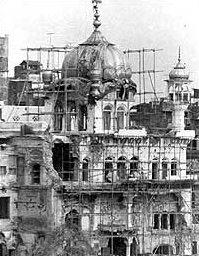
Operation_Blue_Star
Operation Blue Star: Under orders from India's prime minister, Indira Gandhi, the Indian Army begins an invasion of the Golden Temple, the holiest site of the Sikh religion.
1984 Indian military operation
Operation Blue Star was a military operation by the Indian Armed Forces conducted between 1 and 10 June 1984, with the stated objective of removing Damdami Taksal leader Jarnail Singh Bhindranwale and militants from the buildings of the Golden Temple, the holiest site of Sikhism, in Amritsar. The Akali Dal political party and other Sikh factions had been based there during the course of the Dharam Yudh Morcha. The operation would mark the beginning of the Insurgency in Punjab, India.
1984
Tank_Man
The Tank Man halts the progress of a column of advancing tanks for over half an hour after the Tiananmen Square protests of 1989.
Unknown Tiananmen Square protester
Tank Man is an unidentified individual, presumed to be a Chinese man, who stood in front of a column of Type 59 tanks on Chang'an Avenue near Tiananmen Square in Beijing on June 5, 1989. The confrontation occurred one day after the government of China forcibly cleared the square following six weeks of pro-democracy demonstrations, resulting in the deaths of hundreds of people, primarily in areas surrounding the square.
1989
Space_Shuttle_Columbia
Space Shuttle Columbia is launched on STS-40, the fifth spacelab mission.
Space Shuttle orbiter (1981–2003)
Space Shuttle Columbia (OV-102) was a Space Shuttle orbiter manufactured by Rockwell International and operated by NASA. Named after the first American ship to circumnavigate the globe, and the female personification of the United States, Columbia was the first of five Space Shuttle orbiters to fly in space, debuting the Space Shuttle launch vehicle on its maiden flight on April 12, 1981 and becoming the first spacecraft to be re-used after its first flight when it launched on STS-2 on November 12, 1981. As only the second full-scale orbiter to be manufactured after the Approach and Landing Test vehicle Enterprise, Columbia retained unique external and internal features compared with later orbiters, such as test instrumentation and distinctive black chines. In addition to a heavier aft fuselage and the retention of an internal airlock throughout its lifetime, these made Columbia the heaviest of the five spacefaring orbiters: around 1,000 kilograms heavier than Challenger and 3,600 kilograms heavier than Endeavour when originally constructed. Columbia also carried ejection seats based on those from the SR-71 during its first six flights until 1983, and from 1986 onwards carried an imaging pod on its vertical stabilizer.
1991
Holbeck_Hall_Hotel
Portions of the Holbeck Hall Hotel in Scarborough, North Yorkshire, UK, fall into the sea following a landslide.
Hotel in Scarborough, North Yorkshire, England; destroyed by 1993 landslide
The Holbeck Hall Hotel was a clifftop hotel in Scarborough, North Yorkshire, England, owned by the Turner family. It was built in 1879 by George Alderson Smith as a private residence, and was later converted to a hotel.
1993
Bose–Einstein_condensate
The Bose–Einstein condensate is first created.
State of matter
In condensed matter physics, a Bose–Einstein condensate (BEC) is a state of matter that is typically formed when a gas of bosons at very low densities is cooled to temperatures very close to absolute zero, i.e. 0 K. Under such conditions, a large fraction of bosons occupy the lowest quantum state, at which microscopic quantum-mechanical phenomena, particularly wavefunction interference, become apparent macroscopically. More generally, condensation refers to the appearance of macroscopic occupation of one or several states: for example, in BCS theory, a superconductor is a condensate of Cooper pairs. As such, condensation can be associated with phase transition, and the macroscopic occupation of the state is the order parameter.
1995
Republic_of_the_Congo_Civil_War_(1997–1999)
The Second Republic of the Congo Civil War begins.
Ethno-political conflict in the Republic of the Congo
The Second Republic of the Congo Civil War, also known as the Second Brazzaville-Congolese Civil War, was the second of two ethnopolitical civil conflicts in the Republic of the Congo which lasted from 5 June 1997 to 29 December 1999. The war served as the continuation of the civil war of 1993–1994 and involved militias representing three political candidates. The conflict ended following the intervention of the Angolan military, which reinstated former president Denis Sassou Nguesso to power.
1997
Strike_action
A strike begins at the General Motors parts factory in Flint, Michigan, that quickly spreads to five other assembly plants.
The strike lasts seven weeks.
Strike action, also called labor strike, labour strike in British English, or simply strike, is a form of direct action in which employees collectively refuse to work. It is usually a response to employee grievances. Generally, strikes are intended to bring an employer to accede to employees' demands for improved working conditions or unionisation, particularly when other avenues of change, such as negotiations or legal redress, have been exhausted. Strike actions can be called by trade unions or be instigated by rank-and-file activists.
1998
Six-Day_War_(2000)
The Six-Day War in Kisangani begins in Kisangani, in the Democratic Republic of the Congo, between Ugandan and Rwandan forces.
A large part of the city is destroyed.
The Six-Day War was a series of armed confrontations between Ugandan and Rwandan forces around the city of Kisangani in the Democratic Republic of the Congo from 5 to 10 June 2000. The war formed part of the wider Second Congo War (1998–2003).
2000
Tropical_Storm_Allison
Tropical Storm Allison makes landfall on the upper-Texas coastline as a strong tropical storm and dumps large amounts of rain over Houston.
The storm causes $5.5 billion in damages, making Allison the second costliest tropical storm in U.S. history.
Tropical Storm Allison was a tropical cyclone that devastated southeast Texas in June 2001. It lasted unusually long for a June storm, remaining tropical and subtropical for 16 days, most of which was when the storm was over land dumping torrential rainfall. The storm developed from a tropical wave in the northern Gulf of Mexico on June 5, and struck the upper Texas coast shortly thereafter. It drifted northward through the state, turned back to the south, and re-entered the Gulf of Mexico. The storm continued to the east-northeast, made landfall on Louisiana, then moved across the southeast United States and Mid-Atlantic. Allison was the first storm since Tropical Storm Frances in 1998 to strike the northern Texas coastline.
2001
Space_Shuttle_Endeavour
Space Shuttle Endeavour launches on STS-111, carrying the Expedition 5 crew to the International Space Station to replace the Expedition 4 crew.
Astronaut Franklin Chang-Díaz becomes the second person to have flown on seven spaceflights.
Space Shuttle Endeavour is a retired orbiter from NASA's Space Shuttle program and the fifth and final operational Shuttle built. It embarked on its first mission, STS-49, in May 1992 and its 25th and final mission, STS-134, in May 2011. STS-134 was expected to be the final mission of the Space Shuttle program, but with the authorization of STS-135 by the United States Congress, Atlantis became the last shuttle to fly.
2002
Heat_wave
A severe heat wave across Pakistan and India reaches its peak, as temperatures exceed 50 °C (122 °F) in the region.
Prolonged period of excessively hot weather
A heat wave or heatwave, sometimes described as extreme heat, is a period of abnormally hot weather that lasts for multiple days. A heat wave is usually measured relative to the usual climate in the area and to normal temperatures for the season. The main difficulties with this broad definition emerge when one must quantify what the 'normal' temperature state is, and what the spatial extent of the event may or must be. Temperatures that humans from a hotter climate consider normal can be regarded as a heat wave in a cooler area. This would be the case if the warm temperatures are outside the normal climate pattern for that area.
2003
Noël_Mamère
Noël Mamère, Mayor of Bègles, celebrates marriage for two men for the first time in France.
French journalist and politician (born 1948)
Noël Mamère is a French journalist and former politician. He was the mayor of Bègles in Gironde from 1989 to 2017, as well as deputy to the French National Assembly for Gironde's 3rd constituency from 1997 to 2017. He also served as a Member of the European Parliament from 1994 to 1997.
2004
Serbia
Serbia declares independence from the State Union of Serbia and Montenegro.
Country in Southeast and Central Europe
Serbia, officially the Republic of Serbia, is a landlocked country in Southeast and Central Europe. Located in the Balkans, it is bordered by Hungary to the north, Romania to the northeast, Bulgaria to the southeast, North Macedonia to the south, Croatia to the northwest, Bosnia and Herzegovina to the west, and Montenegro to the southwest. Serbia also claims to share a border with Albania through the disputed territory of Kosovo. Serbia has about 6.5 million inhabitants, excluding Kosovo. Belgrade, Serbia's capital, is also its largest city.
2006
2009_Peruvian_political_crisis
After 65 straight days of civil disobedience, at least 31 people are killed in clashes between security forces and indigenous people near Bagua, Peru.
Indigenous-led anti–oil drilling protests
The 2009 Peruvian political crisis resulted from the ongoing opposition to oil development in the Peruvian Amazon by local Indigenous peoples; they protested Petroperú and confronted the National Police. At the forefront of the movement to resist the development was Interethnic Association for the Development of the Peruvian Rainforest, a coalition of indigenous community organizations in the region.
2009
2009_Hermosillo_daycare_center_fire
A fire at a day-care center kills 49 people in Hermosillo, Mexico.
Fire in Mexico
The ABC Day Care Center Fire in Hermosillo, Sonora, Mexico, took place on Friday, June 5, 2009 and resulted in 49 deaths. Thirty five children died that day, with the death toll subsequently rising as additional children succumbed to their injuries. By June 7, 44 toddlers and infants were reported killed as a result of the blaze. Five additional children died in the coming weeks, raising the final death toll to 49. Additionally, 40 infants and toddlers and six adults were hospitalized with burns.
2009
2012_transit_of_Venus
Last transit of Venus until the year 2117.
Transit of Venus across the Sun visible from Earth on 5–6 June 2012
The 2012 transit of Venus, when the planet Venus appeared as a small, dark spot passing across the face of the Sun, began at 22:09 UTC on 5 June 2012, and finished at 04:49 UTC on 6 June. Depending on the position of the observer, the exact times varied by up to ±7 minutes. Transits of Venus are among the rarest of predictable celestial phenomena and occur in pairs. Consecutive transits per pair are spaced 8 years apart, and consecutive pairs occur more than a century apart: The previous transit of Venus took place on 8 June 2004 ; the next pair of transits will occur on 10–11 December 2117 and December 2125 within the 22nd century.
2012
An earthquake with a moment magnitude of 6.0 strikes Ranau, Sabah, Malaysia, killing 18 people, including hikers and mountain guides on Mount Kinabalu, after mass landslides that occurred during the earthquake.
This is the strongest earthquake to strike Malaysia since 1975.
The 2015 Sabah earthquake struck Ranau, Sabah, Malaysia with a moment magnitude of 6.0 on 5 June, which lasted for 30 seconds. The earthquake was the strongest to affect Malaysia since the 1976 Sabah earthquake.
2015
2016_Aktobe_shootings
Two shootings in Aktobe, Kazakhstan, kill six people.
Terrorist attacks in Aktobe, Kazakhstan
The 2016 Aktobe shootings were a series of shootings on civilian and military targets in Aktobe, Kazakhstan, in June 2016. On 5 June, two attacks occurred at gun stores, while a third attack was aimed at a military unit. Multiple shootouts between terrorists and police occurred over the next few days. The shootings left 7 victims dead and 37 injured,Other 6 injured died at hospital and its 13 dead in total. Eighteen attackers were killed and nine were arrested.
2016
Montenegro
Montenegro becomes the 29th member of NATO.
Country in Southeast Europe
Montenegro is a country in Southeast Europe, on the Balkan Peninsula. Its 25 municipalities have a total population of 633,158 people in an area of 13,883 km2. It is bordered by Serbia to the northeast, Bosnia and Herzegovina to the northwest, Kosovo to the east, Albania to the southeast, and Croatia to the west, and has a coastline along the Adriatic Sea to the southwest. The capital and largest city is Podgorica, while Cetinje is the Old Royal Capital and cultural centre.
2017
Bahrain
Six Arab countries—Bahrain, Egypt, Libya, Saudi Arabia, Yemen, and the United Arab Emirates—cut diplomatic ties with Qatar, accusing it of destabilising the region.
Country in West Asia
Bahrain, officially the Kingdom of Bahrain, is an island country in the eastern part of Arabian Peninsula in West Asia. Situated near the western shore of the Persian Gulf, the country comprises a small archipelago of 33 natural islands and an additional 50 artificial islands, centered on Bahrain Island, which makes up around 80 percent of the country's landmass. Bahrain is situated between Qatar and the northeastern coast of Saudi Arabia, to which it is connected by the King Fahd Causeway. The population is 1,588,670 as of 2024, of whom 739,736 are Bahraini nationals, and 848,934 are expatriates. Bahrain spans some 760 square kilometres (290 sq mi) and is the third-smallest nation in Asia after Maldives and Singapore. The capital and largest city is Manama.
2017
2022_Kazakh_constitutional_referendum
A constitutional referendum is held in Kazakhstan following violent protests and civil unrest against the government.
Republican referendum in Kazakhstan
A constitutional referendum, locally called the republican referendum, was held in Kazakhstan on 5 June 2022. It was the third referendum since Kazakhstan's independence in 1991, and the first since the 1995 referendum that established the second constitution. The amendments followed violent civil unrest in early January caused by worsening economic conditions and subsequent calls for rapid political reform. The referendum changed 33 of the document's 98 articles. Political commentators assessed that amendments would lessen the influence of the executive branch, grant more powers to the Parliament, and eliminate the powers that former president Nursultan Nazarbayev had retained after resigning from office in 2019.
2022
Boeing_Starliner
The Boeing Starliner is launched on its first crewed flight, carrying astronauts Barry Wilmore and Sunita Williams to the International Space Station.
Class of partially reusable crew capsules
The Boeing CST-100 Starliner is a spacecraft designed to transport crew to and from the International Space Station (ISS) and other low-Earth-orbit destinations. Under development by Boeing under NASA's Commercial Crew Program (CCP), it consists of a reusable crew capsule and an expendable service module.
2024
Nintendo_Switch_2
The Nintendo Switch 2 video game console is released worldwide.
Hybrid video game console
The Nintendo Switch 2 is a video game console developed by Nintendo and released in most regions on June 5, 2025. Like the original Nintendo Switch, it can be used as a handheld, as a tablet, or connected via the dock to an external display. The Joy-Con 2 controllers can be used while magnetically attached or detached from the console. Compared to the original Switch, the Switch 2 has a larger liquid-crystal display (LCD), more internal storage, and updated graphics, controllers, and social features. It supports 1080p resolution and a 120 Hz refresh rate in handheld or tabletop mode, and 4K resolution with a 60 Hz refresh rate when docked, as well as HDR support on both the tablet and compatible external displays.
2025

History runs on facts, and this project runs on coffee!

Your support is incredibly helpful and genuinely appreciated.

Support with a coffee ☕