October 26 in History

World War I: Erich Ludendorff, quartermaster-general of the Imperial German Army

1918 — World War I: Erich Ludendorff, quartermaster-general of the Imperial German Army, is dismissed by Kaiser Wilhelm II for refusing to cooperate in peace negotiations

October 26 spans 49 recorded events across recorded history, from 1185 to 2015. Below is a curated digest of the most significant moments tied to this date.

By · Wikipedia

Historical Events 49 events 1185 – 2015

More major events on October 26

The featured story and these ranked highlights form a quick summary. Every recorded event remains available in the chronology below.

  1. 2000 A wave of protests forces Robert Guéï to step down as president after the Ivorian presidential election. Source
  2. 1892 Ida B. Wells publishes Southern Horrors: Lynch Law in All Its Phases. Source
  3. 1890 Malleco Viaduct in Chile, at the time "the highest railroad bridge in the world", is inaugurated by President José Manuel Balmaceda. Source

Did you know

In 1918, World War I: Erich Ludendorff, quartermaster-general of the Imperial German Army, is dismissed by Kaiser Wilhelm II for refusing to cooperate in peace negotiations. This featured entry focuses on the immediate decision and its direct historical impact.
Did you know

The Imperial German Army (1871–1919), officially referred to as the German Army, was the unified ground and air force of the German Empire. This helps explain why the event mattered beyond the initial announcement.

Did you know

It was established in 1871 with the political unification of Germany under the leadership of Prussia, and was dissolved in 1919, after the defeat of the German Empire in World War I (1914–1918). This clarifies the institutional and public response around the event.

Did you know

In the Federal Republic of Germany, the term Deutsches Heer refers to the German Army, the land component of the Bundeswehr. This shows how the event shaped policy and public communication in the same period.

Did you know

In 1918, World War I: Erich Ludendorff, quartermaster-general of the Imperial German Army, is dismissed by Kaiser Wilhelm II for refusing to cooperate in peace negotiations had consequences that extended beyond the first headline. The key context is the institutions involved, the policy shift, and how the public response evolved afterward.


Uprising_of_Asen_and_Peter
The Uprising of Asen and Peter begins on the feast day of St.
Demetrius of Thessaloniki and ends with the creation of the Second Bulgarian Empire.
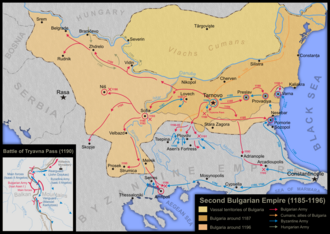
The Uprising of Asen and Peter was a revolt of Bulgarians and Vlachs living in Moesia and the Balkan Mountains, then the theme of Paristrion of the Byzantine Empire, caused by a tax increase. It began on 26 October 1185, the feast day of St. Demetrius of Thessaloniki, and ended with the restoration of Bulgaria and the creation of the Second Bulgarian Empire, ruled by the Asen dynasty.
1185
Byzantine_civil_war_of_1341–1347
The Byzantine civil war of 1341–1347 formally begins with the proclamation of John VI Kantakouzenos as Byzantine Emperor.
The Byzantine civil war of 1341–1347, sometimes referred to as the Second Palaiologan Civil War, was a conflict that broke out in the Byzantine Empire after the death of Andronikos III Palaiologos over the guardianship of his nine-year-old son and heir, John V Palaiologos. It pitted on the one hand Andronikos III's chief minister, John VI Kantakouzenos, and on the other a regency headed by the Empress-Dowager Anna of Savoy, the Patriarch of Constantinople John XIV Kalekas, and the megas doux Alexios Apokaukos. The war polarized Byzantine society along class lines, with the aristocracy backing Kantakouzenos and the lower and middle classes supporting the regency. To a lesser extent, the conflict acquired religious overtones; Byzantium was embroiled in the Hesychast controversy, and adherence to the mystical doctrine of Hesychasm was often equated with support for Kantakouzenos.
1341
Tvrtko_I_of_Bosnia
Tvrtko I is crowned the first king of Bosnia.
First king of Bosnia from 1377 to 1391
Stephen Tvrtko I was the first king of Bosnia. A member of the House of Kotromanić, he succeeded his uncle Stephen II as the ban of Bosnia in 1353. As he was a minor at the time, Tvrtko's father, Vladislav, briefly ruled as regent, followed by Tvrtko's mother, Jelena. Early in his personal rule, Tvrtko quarrelled with his country's Roman Catholic clergy but later enjoyed cordial relations with all the religious communities in his realm. After initial difficulties—the loss of large parts of Bosnia to his overlord, King Louis I of Hungary, and being briefly deposed by his magnates—Tvrtko's power grew considerably. He conquered some remnants of the neighbouring Serbian Empire in 1373, after the death of its last ruler and his distant relative, Uroš the Weak. In 1377, he had himself crowned king of Bosnia and Serbia, claiming to be the heir of Serbia's extinct Nemanjić dynasty.
1377
Charles_V,_Holy_Roman_Emperor
Charles V is crowned as Holy Roman Emperor.
Holy Roman Emperor from 1519 to 1556
Charles V was Holy Roman Emperor and Archduke of Austria from 1519 to 1556, King of Spain from 1516 to 1556, King of Sicily and Naples from 1516 to 1554, and also Lord of the Netherlands and titular Duke of Burgundy from 1506 to 1555. He was heir to and then head of the rising House of Habsburg. His dominions in Europe included the Holy Roman Empire, extending from Germany to northern Italy with rule over the Austrian hereditary lands and Burgundian Low Countries, and Spain with its possessions of the southern Italian kingdoms of Sicily, Naples, and Sardinia. In the Americas, he oversaw the continuation of Spanish colonisation and a short-lived German colonisation. The personal union of the European and American territories he ruled was the first collection of realms labelled "the empire on which the sun never sets".
1520
Imjin_War
Imjin War: Korean Admiral Yi Sun-sin routs the Japanese Navy of 300 ships with only 13 ships at the Battle of Myeongnyang.
1592–1598 Japanese invasions of Korea
The Imjin War was a series of two Japanese invasions of Korea: an initial invasion in 1592 also individually called the "Imjin War", a brief truce in 1596 between the conflicts, followed by a second invasion in 1597 called the Chŏngyu War. The conflict ended in 1598 with the withdrawal of Japanese forces from the Korean Peninsula after a military stalemate in Korea's southern provinces.
1597
Treaty_of_Ripon
The Treaty of Ripon is signed, restoring peace between Covenanter Scotland and King Charles I of England.
1640 treaty ceasing hostilities
The Treaty of Ripon was a truce between Charles I, King of England, and the Covenanters, a Scottish political movement, which brought a cessation of hostilities to the Second Bishops' War.
1640
General Enea Silvio Piccolomini of Austria burns down Skopje to prevent the spread of cholera; he dies of the disease soon afterwards.
Imperial general
Enea Silvio Piccolomini was a Sienese nobleman whose lineage included two popes, and who served in the Habsburg army of Leopold I, Holy Roman Emperor. He is known for leading a campaign against the Ottomans in Bosnia, Macedonia and Kosovo in 1689, and for setting fire to Skopje, the present day capital of the Republic of North Macedonia.
1689
American_Revolution
American Revolution: The First Continental Congress adjourns in Philadelphia.
Founding of the United States
The American Revolution (1765–1789) was a political movement in the Thirteen Colonies of Great Britain. It began as a rebellion and turned into a revolution eventually creating the sovereign United States, which was the outcome of the associated American Revolutionary War (1775-1783). The Second Continental Congress, as the provisional government, established the Continental Army and appointed George Washington as its commander-in-chief in 1775. The following year, the Congress passed the Lee Resolution on July 2nd and unanimously adopted the Declaration of Independence on July 4th. Throughout most of the war, the outcome appeared uncertain, but a 1781 victory by Washington and the Continental Army in the Siege of Yorktown led King George III and the Fox–North coalition in government to negotiate the cessation of colonial rule and the acknowledgment of American sovereignty, which was formalized in the Treaty of Paris, signed on September 3, 1783. The Constitution took effect in 1789 and the Bill of Rights was ratified in 1791.
1774
War_of_1812
War of 1812: A combined force of British regulars, Canadian militia and Mohawks defeat the United States Army in the Battle of the Chateauguay.
1812–1815 conflict in North America
The War of 1812 was a conflict initiated by the United States against the United Kingdom and its allies fought mainly in North America and at sea during the wider Napoleonic Wars. The United States declared war on Britain on 18 June 1812. Although peace terms were agreed upon in the December 1814 Treaty of Ghent, the war did not officially end until the peace treaty was ratified by the United States Senate on 17 February 1815.
1813
Erie_Canal
The Erie Canal opens, allowing direct passage from the Hudson River to Lake Erie.
Waterway in upstate New York, U.S.
The Erie Canal is a historic canal in upstate New York that runs east–west between the Hudson River and Lake Erie. Completed in 1825, the canal was the first navigable waterway connecting the Atlantic Ocean to the upper Great Lakes above Niagara Falls, vastly reducing the costs of transporting people and goods across the Appalachians. The Erie Canal accelerated the settlement of the Great Lakes region, the westward expansion of the United States, and the economic ascendancy of New York state.
1825
Royal_Charter_Storm
The Royal Charter Storm kills at least eight hundred people in the British Isles.
1859 storm in the Irish Sea
The Royal Charter Storm of 25‍–‍26 October 1859 was considered to be the most severe storm to hit the Irish Sea in the 19th century, with an estimated death toll of over 800. It takes its name from the Royal Charter ship, which was driven by the storm onto the east coast of Anglesey, Wales, with the loss of over 450 lives.
1859
Unification_of_Italy
Unification of Italy: The Expedition of the Thousand ends when Giuseppe Garibaldi presents his conquests to King Victor Emmanuel of Sardinia.
1848–1870 consolidation of Italian states
The unification of Italy, also known as the Risorgimento, was the 19th century political and social movement that in 1861 ended in the annexation of various states of the Italian peninsula and its outlying isles to the Kingdom of Sardinia, resulting in the creation of the Kingdom of Italy. Inspired by the rebellions in the 1820s and 1830s against the outcome of the Congress of Vienna, the unification process was precipitated by the Revolutions of 1848, and reached completion in 1871 with the official designation of Rome as capital of Italy, following the capture of Rome in 1870.
1860
The_Football_Association
The Football Association is founded.
Governing body of association football in England
The Football Association is the governing body of association football in England and the Crown Dependencies of Jersey, Guernsey and the Isle of Man. Formed in 1863, it is the oldest football association in the world and is responsible for overseeing all aspects of the amateur and professional game in its territory.
1863
Edward_James_Roye
Liberian President Edward James Roye is deposed in a coup d'état.
5th president of Liberia (1870–71)
Edward James Roye was a Liberian merchant and politician who served as the fifth president of Liberia from 1870 until his overthrow in the 1871 Liberian coup d'état and subsequent death. He had previously served as the fourth Chief Justice of Liberia from 1865 until 1868. He was the first member of Liberia's True Whig Party to serve as president.
1871
Wyatt_Earp
Wyatt Earp and Doc Holliday participate in the Gunfight at the O.K.
Corral in Tombstone, Arizona.
Wyatt Berry Stapp Earp was an American lawman and an assistant marshal to his brother, Virgil Earp. Earp was involved in the 1881 gunfight at the O.K. Corral, during which he and other lawmen killed three outlaws. While Earp is usually depicted as the key figure in the shootout, his brother Virgil was both the U.S. Marshal and the Tombstone city marshal and had decided to enforce a city ordinance prohibiting carrying weapons in public in an attempt to neutralize the loosely organized group of outlaws known as the Cochise County Cowboys.
1881
Malleco_Viaduct
Malleco Viaduct in Chile, at the time "the highest railroad bridge in the world", is inaugurated by President José Manuel Balmaceda.
Railway bridge over the Malleco River in Araucania Region, Chile
The Malleco Viaduct is a railway bridge located in central Chile, passing over the Malleco River valley, south of Collipulli in the Araucania Region. It was opened by President José Manuel Balmaceda on October 26, 1890. At that time, it was the highest such bridge in the world. The Panamerican Highway passes right next to the viaduct.
1890
Ida_B._Wells
Ida B.
Wells publishes Southern Horrors: Lynch Law in All Its Phases.
Ida Bell Wells-Barnett was an American investigative journalist, sociologist, educator, and early leader in the civil rights movement. She was one of the founders of the National Association for the Advancement of Colored People (NAACP). Wells dedicated her career to combating prejudice and violence, and advocating for African-American equality—especially for women.
1892
Oscar_II
King Oscar II recognizes the dissolution of the union between Norway and Sweden.
King of Sweden (1872–1907) and Norway (1872–1905)
Oscar II was King of Sweden from 1872 until his death in 1907 and King of Norway from 1872 to 1905.
1905
Korea_under_Japanese_rule
Japanese occupation of Korea: An Jung-geun assassinates Japan's Resident-General of Korea.
1910–1945 colony of the Empire of Japan
From 1910 to 1945, Korea was ruled by the Empire of Japan as a colony under the name Chōsen (朝鮮), the Japanese reading of "Joseon".
1909
First_Balkan_War
First Balkan War: The Ottomans lose the cities of Thessaloniki and Skopje.
1912–1913 war between the Balkan League and the Ottoman Empire
The First Balkan War lasted from October 1912 to May 1913 and involved actions of the Balkan League against the Ottoman Empire. The Balkan states' combined armies overcame the initially numerically inferior and strategically disadvantaged Ottoman armies, achieving rapid success.
1912
World_War_I
World War I: Brazil declares war on the Central Powers.
Global conflict from 1914 to 1918
World War I, or the First World War, also known as the Great War, was a global conflict between two coalitions: the Allies and the Central Powers. Major theatres of war included Europe and the Middle East, and well as parts of Africa and the Asia-Pacific. One of the deadliest conflicts in history, World War I resulted in an estimated 15 to 22 million deaths, including in mass war crimes against civilians and genocides. The conflict saw important developments in weaponry, including the first large-scale use of machine guns, artillery, aircraft, chemical weapons, and tanks, and was a major factor in the deadly Spanish flu pandemic.
1917
Electric_generator
The first electric generator at Hoover Dam goes into full operation.
Device that converts other energy to electrical energy
In electricity generation, a generator, also called an electric generator, electrical generator, and electromagnetic generator is an electromechanical device that converts mechanical energy to electrical energy for use in an external circuit. In most generators which are rotating machines, a source of kinetic power rotates the generator's shaft, and the generator produces an electric current at its output terminals which flows through an external circuit, powering electrical loads. Sources of mechanical energy used to drive generators include steam turbines, gas turbines, water turbines, internal combustion engines, wind turbines and even hand cranks. Generators produce nearly all of the electric power for worldwide electric power grids. The first electromagnetic generator, the Faraday disk, was invented in 1831 by British scientist Michael Faraday.
1936
Nazi_Germany
Nazi Germany begins expulsions of 18,000 Polish Jews.
German state from 1933 to 1945
Nazi Germany, officially the German Reich and later the Greater German Reich, was the German state between 1933 and 1945, when Adolf Hitler and the Nazi Party controlled the country, transforming it into a totalitarian dictatorship. The Third Reich, meaning "Third Realm" or "Third Empire", referred to the Nazi claim that Nazi Germany was the successor to the Holy Roman Empire (800–1806) and the German Empire (1871–1918). The Third Reich, which the Nazis referred to as the Thousand-Year Reich, ended in May 1945, after 12 years, when the Allies defeated Germany and entered the capital, Berlin, ending World War II in Europe.
1937
World_War_II
World War II: In the Battle of the Santa Cruz Islands during the Guadalcanal Campaign, one U.S.
aircraft carrier is sunk and another carrier is heavily damaged, while two Japanese carriers and one cruiser are heavily damaged.
World War II, or the Second World War, was a global conflict between two coalitions: the Allies and the Axis powers. Nearly all of the world's countries participated. World War II was the deadliest conflict in history, causing the death of 60 to 75 million people. Millions died as a result of massacres, starvation, disease, and genocides, including the Holocaust. After the Allied victory, Germany, Austria, Japan, and Korea were occupied, and German and Japanese leaders were tried for war crimes.
1942
Battle_of_Leyte_Gulf
World War II: The Battle of Leyte Gulf ends with an overwhelming American victory.
Largest naval battle of World War II and history
The Battle of Leyte Gulf was the largest naval battle of World War II and by some criteria the largest naval battle in history, with over 200,000 naval personnel involved.
1944
Partition_of_India
Partition of India: The Maharaja of Kashmir and Jammu signs the Instrument of Accession with India, beginning the Indo-Pakistani War of 1947–1948 and the Kashmir conflict.
1947 division of British India
The partition of India in 1947 was the division of British India into two independent dominion states, the Union of India and Dominion of Pakistan. The Union of India is today the Republic of India, and the Dominion of Pakistan is the Islamic Republic of Pakistan and the People's Republic of Bangladesh. The partition involved the division of two provinces, Bengal and the Punjab, based on district-wide non-Muslim or Muslim majorities. It also involved the division of the British Indian Army, the Royal Indian Navy, the Indian Civil Service, the railways, and the central treasury, between the two new dominions. The partition was set forth in the Indian Independence Act 1947 and resulted in the end of the British Raj, or Crown rule in India. The two self-governing countries of India and Pakistan legally came into existence at midnight on 14–15 August 1947.
1947
Austrian_State_Treaty
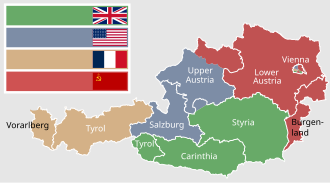
After the last Allied troops have left the country, and following the provisions of the Austrian Independence Treaty, Austria declares that it will never join a military alliance.
1955 treaty re-establishing Austria as a sovereign state
The Austrian State Treaty or Austrian Independence Treaty established Austria as a sovereign state. It was signed on 15 May 1955 in Vienna, at the Schloss Belvedere among the Allied occupying powers and the Austrian government. The neighbouring Federal People's Republic of Yugoslavia acceded to the treaty subsequently. It officially came into force on 27 July 1955.
1955
Ngo_Dinh_Diem
Ngô Đình Diệm proclaims himself as President of the newly created Republic of Vietnam.
President of South Vietnam from 1955 to 1963
Ngô Đình Diệm was a South Vietnamese politician who was the final prime minister of the State of Vietnam (1954–1955) and later the first president of South Vietnam from 1955 until his capture and assassination during the CIA-backed 1963 coup d'état.
1955
Hungarian_Revolution_of_1956
Hungarian Revolution: In the towns of Mosonmagyaróvár and Esztergom, Hungarian secret police forces massacre civilians.
As rebel strongholds in Budapest hold, fighting spreads throughout the country.
The Hungarian Revolution of 1956, also known as the Hungarian Uprising, was an attempted countrywide revolution against the government of the Hungarian People's Republic (1949–1989) and the policies caused by the government's subordination to the Union of Soviet Socialist Republics (USSR). The uprising lasted 15 days before being crushed by Soviet tanks and troops on 7 November 1956. Thousands were killed or wounded, and nearly a quarter of a million Hungarians fled the country.
1956
Pan_Am
Pan American Airways makes the first commercial flight of the Boeing 707 from New York City to Paris.
United States airline (1927–1991)
Pan American World Airways, originally founded as Pan American Airways and more commonly known as Pan Am, was an airline that was the largest international air carrier and unofficial flag carrier of the United States for much of the 20th century. The first airline to fly worldwide, it pioneered innovations such as jumbo jets and computerized reservation systems, and introduced the first American jetliner, the Boeing 707, in 1958. Until its dissolution on December 4, 1991, Pan Am "epitomized the luxury and glamour of intercontinental travel", and it remains a cultural icon of the 20th century, identified by its blue globe logo, the use of the word "Clipper" in its aircraft names and call signs, and the white uniform caps of its pilots.
1958
Mohammad_Reza_Pahlavi
Mohammad Reza Pahlavi crowns himself Emperor of Iran.
Shah of Iran from 1941 to 1979
Mohammad Reza Pahlavi was the last Shah of Iran from 1941 to 1979. He succeeded his father Reza Shah and ruled the Imperial State of Iran until he was overthrown in the Islamic Revolution led by Ruhollah Khomeini, which abolished the Iranian monarchy to establish the Islamic Republic of Iran. In 1967, he took the title Shahanshah, and held several others, including Aryamehr and Bozorg Arteshtaran. He was the second and last ruling monarch of the Pahlavi dynasty.
1967
Space_Race
Space Race: The Soyuz 3 mission achieves the first Soviet space rendezvous.
US–USSR spaceflight capability rivalry
The Space Race was a 20th-century competition between the Cold War rivals, the United States and the Soviet Union, to achieve superior spaceflight capability. It had its origins in the ballistic missile-based nuclear arms race between the two nations following World War II and the onset of the Cold War. The technological advantage demonstrated by spaceflight achievement was seen as necessary for national security, particularly in regard to intercontinental ballistic missile and satellite reconnaissance capability, but also became part of the cultural symbolism and ideology of the time. The Space Race brought pioneering launches of artificial satellites, robotic landers to the Moon, Venus, and Mars, and human spaceflight in low Earth orbit and ultimately to the Moon.
1968
Ali_Maow_Maalin
Ali Maow Maalin, the last natural case of smallpox, develops a rash in Somalia.
The WHO and the CDC consider this date to be the anniversary of the eradication of smallpox, the most spectacular success of vaccination.
Ali Maow Maalin was a Somali hospital cook and health worker from Merca who is the last person known to have been infected with naturally occurring Variola minor smallpox. The disease was diagnosed in October 1977 and Maalin made a full recovery. Although he had many contacts, none of them developed the disease, and an aggressive containment campaign was successful in preventing an outbreak. Smallpox was declared to have been eradicated globally by the World Health Organization (WHO) two years later. Maalin was subsequently involved in the successful poliomyelitis eradication campaign in Somalia, and he died of malaria while carrying out polio vaccinations after the re-emergence of the poliovirus in 2013.
1977
Park_Chung_Hee
Park Chung Hee, President of South Korea, is assassinated by Korean CIA head Kim Jae-gyu.
President of South Korea from 1963 to 1979
Park Chung Hee was a South Korean politician and army officer who served as the third president of South Korea from 1962 after he seized power in the May 16 coup of 1961 until his assassination in 1979. His regime oversaw a period of intense economic growth and transformation, making Park one of the most consequential leaders in Korean history, although his legacy as a military dictator remains a bitter subject.
1979
Uluru
The Australian government returns ownership of Uluru to the local Pitjantjatjara Aboriginals.
Sandstone monolith in the Northern Territory, Australia
Uluru, also known as Ayers Rock and officially gazetted as Uluru / Ayers Rock, is a large sandstone monolith. It crops out near the centre of Australia in the southern part of the Northern Territory, 335 km (208 mi) south-west of Alice Springs.
1985
China_Airlines_Flight_204
China Airlines Flight 204 crashes after takeoff from Hualien Airport in Taiwan, killing all 54 people on board.
1989 aviation accident
China Airlines Flight 204 (CI204/CAL204) was a Boeing 737-200 that crashed into a mountain after takeoff from Hualien Airport, Taiwan, on 26 October 1989. The crash killed all 54 passengers and crew on board the aircraft.
1989
Ten-Day_War
Three months after the end of the Ten-Day War, the last soldier of the Yugoslav People's Army leaves the territory of the Republic of Slovenia.
1991 Slovenia-Yugoslavia conflict
The Ten-Day War, or the Slovenian War of Independence, was a brief armed conflict that followed Slovenia's declaration of independence from Yugoslavia on 25 June 1991. It was fought between the Slovenian Territorial Defence and the Slovenian National Police Force on one side, and the Yugoslav People's Army (JNA) on the other. It lasted from 27 June 1991 until 7 July 1991, when the Brioni Accords were signed.
1991
Jordan
Jordan and Israel sign a peace treaty.
Country in West Asia
Jordan, officially the Hashemite Kingdom of Jordan, is a country in the Southern Levant region of West Asia. Jordan is bordered by Syria to the north, Iraq to the east, Saudi Arabia to the south, and both Israel and Palestine to the west. The Jordan River, flowing into the Dead Sea, is located along the country's western border within the Jordan Rift Valley. Jordan has a small coastline along the Red Sea in its southwest, separated by the Gulf of Aqaba from Egypt. Amman is the country's capital and largest city, as well as the most populous city in the Levant.
1994
Mossad
Mossad agents assassinate Palestinian Islamic Jihad leader Fathi Shaqaqi in his hotel in Malta.
National intelligence agency of Israel
The Institute for Intelligence and Special Operations, popularly known as Mossad, is the national intelligence agency of the State of Israel. It is one of the main organizations in the Israeli intelligence community, along with Aman and Shin Bet.
1995
Flateyri
An avalanche hits the Icelandic village of Flateyri, destroying 29 homes and burying 45 people, and killing 20.
Village in Northwest Constituency, Iceland
Flateyri is a village situated in Iceland's Westfjords. It is part of the municipality of Ísafjarðarbær and has a population of approximately 200, making it the largest settlement in Önundarfjörður.
1995
United_Kingdom
The United Kingdom's House of Lords votes to end the right of most hereditary peers to vote in Britain's upper chamber of Parliament.
Country in northwestern Europe
The United Kingdom of Great Britain and Northern Ireland, commonly known as the United Kingdom (UK) or Britain, is a country in northwestern Europe, off the coast of the continental mainland. It comprises England, Scotland, Wales and Northern Ireland, with a population of over 69 million in 2024. The UK includes the island of Great Britain, the north-eastern part of the island of Ireland, and most of the smaller islands within the British Isles, covering 94,354 square miles (244,376 km2). It shares a land border with the Republic of Ireland and is surrounded by the Atlantic Ocean, the North Sea, the English Channel, the Celtic Sea and the Irish Sea, while maintaining sovereignty over the Crown Dependencies and the British Overseas Territories. The capital and largest city of England and the UK is London; Edinburgh, Cardiff and Belfast are the national capitals of Scotland, Wales and Northern Ireland, respectively.
1999
Robert_Guéï
A wave of protests forces Robert Guéï to step down as president after the Ivorian presidential election.
1999–2000 military president of Côte d'Ivoire
Robert Guéï was an Ivorian politician who served as the third president of the Ivory Coast from 24 December 1999 to 26 October 2000. He succeeded President Henri Konan Bédié after the 1999 Ivorian coup d'état and lost to Laurent Gbagbo in the ensuing 2000 Ivorian presidential election. Guéï, his wife Rose Doudou Guéï, and his children were killed on 19 September 2002 on the first day of the First Ivorian Civil War.
2000
Patriot_Act
The United States passes the USA PATRIOT Act into law.
2001 United States anti-terrorism law
The USA PATRIOT Act is a landmark Act of the United States Congress, signed into law by President George W. Bush. The formal name of the statute is the Uniting and Strengthening America by Providing Appropriate Tools Required to Intercept and Obstruct Terrorism Act of 2001, and the commonly used short name is a backronym that is embedded in the name set forth in the statute.
2001
Moscow_theater_hostage_crisis
Approximately 50 Chechen terrorists and 150 hostages die when Russian special forces troops storm a theater building in Moscow, which had been occupied by the terrorists during a musical performance three days before.
2002 terrorist attack and hostage crisis in Moscow
The Moscow theater hostage crisis, also known as the 2002 Nord-Ost siege, was the seizure of the crowded Dubrovka Theater in Moscow by Chechen terrorists on 23 October 2002, resulting in the taking of 912 hostages. The attackers, led by Movsar Barayev, claimed allegiance to the rebel breakaway movement in Chechnya. They demanded the withdrawal of Russian forces from Chechnya and an end to the Second Chechen War. The crisis ended when Russian security services released sleeping gas into the building, and subsequently stormed it, killing all 40 hostage takers. 132 hostages died, largely due to the effects of the gas.
2002
Cedar_Fire
The Cedar Fire, the third-largest wildfire in California history, kills 15 people, consumes 250,000 acres (1,000 km2), and destroys 2,200 homes around San Diego.
2003 wildfire in Southern California
The Cedar Fire was a massive, highly-destructive wildfire, which burned 273,246 acres (1,106 km2) of land in San Diego County, California, during October and November 2003. The fire's rapid growth was driven by the Santa Ana winds, causing the fire to spread at a rate of 3,600 acres (15 km2) per hour. By the time the fire was fully contained on November 4, it had destroyed 2,820 buildings and killed 15 people, including one firefighter. Hotspots continued to burn within the Cedar Fire's perimeter until December 5, 2003, when the fire was fully brought under control.
2003
Rockstar_Games
Rockstar Games releases Grand Theft Auto: San Andreas for the PlayStation 2 in North America, which sold 12 million units for the PS2, becoming the console's best-selling video game.
American video game publisher
Rockstar Games, Inc. is an American video game publisher based in New York City. The company was established in December 1998 as a subsidiary of Take-Two Interactive, using the assets Take-Two had previously acquired from BMG Interactive. Founding members of the company were Terry Donovan, Gary Foreman, Dan and Sam Houser, and Jamie King, who worked for Take-Two at the time, and of which the Houser brothers were previously executives at BMG Interactive. Sam Houser heads the studio as president.
2004
Microsoft
Microsoft made a public release of Windows 8 and made it available on new PCs.
American multinational technology company
Microsoft Corporation is an American multinational technology company headquartered in Redmond, Washington. The company became influential in the rise of personal computers through software like Windows and has since expanded into areas such as Internet services, cloud computing, artificial intelligence, video gaming, and more. A Big Tech company, Microsoft is the largest software company by revenue, one of the most valuable public companies, and one of the most valuable brands globally.
2012
October_2015_Hindu_Kush_earthquake
A 7.5 magnitude earthquake strikes in the Hindu Kush mountain range in South Asia, killing 399 people and leaving 2,536 people injured.
Earthquake in Pakistan, Afghanistan and India
The October 2015 Hindu Kush earthquake was a magnitude 7.5 earthquake that struck South Asia on 26 October 2015, at 13:39 AFT with the epicenter 45 km north of Kuran wa Munjan, Afghanistan, at a depth of 231.0 km.
2015

History runs on facts, and this project runs on coffee!

Your support is incredibly helpful and genuinely appreciated.

Support with a coffee ☕