October 31 in History

Vietnam War October surprise: Citing progress with the Paris peace talks, US Pre

1968 — Vietnam War October surprise: Citing progress with the Paris peace talks, US President Lyndon B

Johnson announces to the nation that he has ordered a complete cessation of "all air, naval, and artillery bombardment of North Vietnam" effective November 1.

October 31 spans 48 recorded events across recorded history, from 475 to 2020. Below is a curated digest of the most significant moments tied to this date.

By · Wikipedia

Historical Events 48 events 475 – 2020

More major events on October 31

The featured story and these ranked highlights form a quick summary. Every recorded event remains available in the chronology below.

  1. 2000 Soyuz TM-31 launches, carrying the first resident crew to the International Space Station. The ISS has been crewed continuously since then. Source
  2. 1956 Hungarian Revolution of 1956: A Revolutionary Headquarters is established in Hungary. Following Imre Nagy's announcement of October 30, banned non-Communist political parties are reformed, and the MDP is replaced by the MSZMP. József Mindszenty is released from prison. The Soviet Politburo makes the decision to crush the Revolution. Source
  3. 1968 Great Drought of 1968: Amidst a collapse of hydropower President of Chile Eduardo Frei Montalva decrees the establishment of daylight saving time. Source

Did you know

In 1968, Vietnam War October surprise: Citing progress with the Paris peace talks, US President Lyndon B. Johnson announces to the nation that he has ordered a complete cessation of "all air, naval, and artillery bombardment of North Vietnam" effective November 1. This featured entry focuses on the immediate decision and its direct historical impact.

Did you know

In the politics of the United States, an October surprise is a news event that may influence the outcome of an upcoming November election, whether deliberately planned or spontaneously occurring. This helps explain why the event mattered beyond the initial announcement.

Did you know

Because the date for national elections is in early November, events that take place in October have greater potential to influence the decisions of prospective voters and allow less time to take remedial action; thus, relatively last-minute news stories could either change the course of an election or reinforce the inevitable. This clarifies the institutional and public response around the event.

Did you know

Common political events that have been referred to as an October surprise include political scandals, sudden international crises, criminal investigations, health issues involving a candidate, news leaks, natural disasters, and major policy announcements. This shows how the event shaped policy and public communication in the same period.

Did you know

In 1968, Vietnam War October surprise: Citing progress with the Paris peace talks, US President Lyndon B. Johnson announces to the nation that he has ordered a complete cessation of "all air, naval, and artillery bombardment of North Vietnam" effective November 1 had consequences that extended beyond the first headline. The key context is the institutions involved, the policy shift, and how the public response evolved afterward.


Romulus_Augustulus
Romulus Augustulus is proclaimed Western Roman Emperor.
Western Roman emperor from 475 to 476
Romulus Augustus, nicknamed Augustulus, was Roman emperor of the West from 31 October 475 until 4 September 476. Romulus was placed on the imperial throne while still a minor by his father Orestes, the magister militum, for whom he served as little more than a figurehead. After a rule of ten months, the barbarian general Odoacer defeated and killed Orestes and deposed Romulus. As Odoacer did not proclaim any successor, Romulus is typically regarded as the last Western Roman emperor, his deposition marking the end of the Western Roman Empire as a political entity. The deposition of Romulus Augustulus is also sometimes used by historians to mark the transition from antiquity to the medieval period.
475
During the Siege of Mecca, the Kaaba catches fire and is burned down.
Part of the Second Fitna
The siege of Mecca in September–November 683 was one of the early battles of the Second Fitna. The city of Mecca was a sanctuary for Abd Allah ibn al-Zubayr, who was among the most prominent challengers to the hereditary succession to the Caliphate by Yazid I of the Umayyad dynasty. After nearby Medina, the other holy city of Islam, also rebelled against Yazid, the Umayyad ruler sent an army to subdue the Hejaz. The Umayyad army defeated the Medinans and took the city, but Mecca held out in a month-long siege, during which the Kaaba was damaged by fire. The siege ended when news came of Yazid's sudden death. The Umayyad commander, Husayn ibn Numayr al-Sakuni, after failing to induce Ibn al-Zubayr to return with him to Syria and be recognized as Caliph, departed with his forces. Ibn al-Zubayr remained in Mecca throughout the civil war, but he was nevertheless soon acknowledged as Caliph across most of the Muslim world. It was not until 692 that the Umayyads were able to send another army, which again besieged and captured Mecca, ending the civil war.
683
Irene_of_Athens
Empress Irene is deposed and banished to Lesbos.
Conspirators place Nikephoros, the minister of finance, on the Byzantine throne.
Irene of Athens, surname Sarantapechaena, was Byzantine empress consort to Emperor Leo IV from 775 to 780, regent during the childhood of their son Constantine VI from 780 until 790, co-ruler from 792 until 797, and finally empress regnant and sole ruler of the Eastern Roman Empire from 797 to 802. A member of the politically prominent Sarantapechos family, she was selected as Leo IV's bride for unknown reasons in 768. Even though her husband was an iconoclast, she harbored iconophile sympathies. During her regency, in 787, she called the Second Council of Nicaea which condemned iconoclasm as heretical and brought an end to the first iconoclast period (730–787). Irene's concluding five years of sole rule were unprecedented in Roman and Byzantine history. Her public figure in this period was polarizing, due to the setbacks faced by the Empire and her iconophilic stances, often attributed to her gender and the influence of her retinue.
802
Abbasid caliph al-Muqtadir is killed while fighting against the forces of general Mu'nis al-Muzaffar.
Al-Muqtadir's brother al-Qahir is chosen to succeed him.
The Abbasid caliphs were the holders of the Islamic title of caliph who were members of the Abbasid dynasty, a branch of the Quraysh tribe descended from the uncle of the Islamic prophet Muhammad, Al-Abbas ibn Abd al-Muttalib.
932
Protestant Reformation: Martin Luther posts his 95 Theses on the door of the Castle Church in Wittenberg.
16th-century movement in Western Christianity
The Reformation, also known as the Protestant Reformation or the European Reformation, was a major theological movement in Western Christianity in 16th-century Europe that posed a religious and political challenge to the papacy and the authority of the Catholic Church hierarchy. Towards the end of the Renaissance, the Reformation marked the beginning of Protestantism. It is considered one of the events that signified the end of the Middle Ages and the beginning of the early modern period in Europe.
1517
Leiden_University_Library
Leiden University Library opens its doors after its founding in 1575.
Academic library in the Netherlands
Leiden University Libraries is the set of libraries of Leiden University, founded in 1575 in Leiden, Netherlands. Holdings include some five million volumes, one million e-books, ninety thousand e-journals, two thousand current paper journals, and three thousand cuneiform tablets. The library manages large collections on Indonesia and the Caribbean, and curates seven entries in UNESCO's international and Dutch Memory of the World Register. Joseph Justus Scaliger, who was a languages and history professor at Leiden from 1593 up to 1609, commented in Latin on the library:Est hic magna commoditas bibliothecae ut studiosi possint studere. Here [at Leiden] is the great convenience of a library so that those who want to study [students], can study.
1587
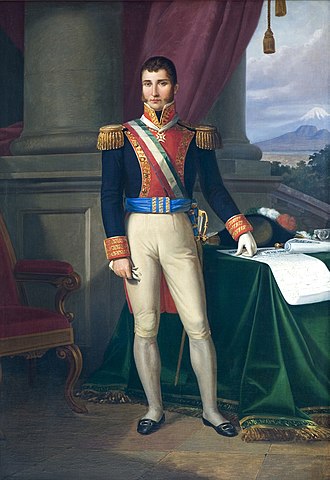
Agustín_de_Iturbide
Emperor Agustín de Iturbide attempts to dissolve the Congress of the Mexican Empire.
Mexican army officer and politician
Agustín Cosme Damián de Iturbide y Arámburu, commonly known as Agustín de Iturbide and later by his regnal name Agustín I, was the first Emperor of Mexico from 1822 until his abdication in 1823.
1822
Muscogee
Approximately 300 Muscogee die in the steamboat Monmouth disaster on the Trail of Tears in the United States.
Indigenous people from Southeastern Woodlands
The Muscogee, Mvskoke or Mvskokvlke, also known as Muscogee Creek or just Creek, are a group of related Indigenous peoples of the Southeastern Woodlands in the United States. Their historical homelands are in what now comprises southern Tennessee, much of Alabama, western Georgia and parts of northern Florida.
1837
New_Zealand_Wars
The New Zealand Wars resume as British forces in New Zealand led by General Duncan Cameron begin their Invasion of the Waikato.
1845–1872 armed conflicts in New Zealand
The New Zealand Wars took place from 1845 to 1872 between the New Zealand colonial government and allied Māori on one side, and Māori and Māori-allied settlers on the other.
1863
Nevada
Nevada is admitted as the 36th U.S.
state.
Nevada is a landlocked state in the Western United States. It is also sometimes placed in the Mountain West and Southwestern United States. It borders Idaho to the northeast, Oregon to the northwest, California to the west, Arizona to the southeast, and Utah to the east. Nevada is the seventh-most extensive and the 31st-most populous U.S. state. Nearly three-quarters of Nevada's population live in Clark County, which contains the Las Vegas–Paradise metropolitan area. Nevada's capital is Carson City. Las Vegas is the largest city in the state.
1864
The strongest earthquake in the Midwestern United States since 1812 strikes near Charleston, Missouri, causing damage and killing at least two.
Earthquake affecting the Midwestern United States
The 1895 Charleston earthquake, also known as the Halloween earthquake, occurred on October 31, at 05:07 CST near Charleston, Missouri. It had an estimated moment magnitude of 5.8–6.6 and evaluated Modified Mercalli intensity of VIII (Severe). The earthquake caused substantial property damage in the states of Missouri, Illinois, Ohio, Alabama, Iowa, Kentucky, Indiana, and Tennessee. Shaking was widespread, being felt across 23 states and even in Canada. At least two people died and seven were injured.
1895
Purdue_wreck
The Purdue Wreck, a railroad train collision in Indianapolis, kills 17 people, including 14 players of the Purdue University football team.
1903 train collision
The Purdue wreck was a railroad train collision in Indianapolis, Indiana, on Saturday, October 31, 1903, between two special trains that killed 17 people, including 14 players of the 1903 Purdue University football team. Team captain and future Indiana governor Harry G. Leslie was initially thought to have died in the accident, but was later revived.
1903
Parliament_of_Finland
The Parliament of Finland approved the Prohibition Act, but the law was not implemented because it was not ratified by Tsar Nicholas II of Russia.
Supreme unicameral legislature of Finland
The Parliament of Finland is the unicameral and supreme legislature of Finland, founded on 9 May 1906. In accordance with the Constitution of Finland, sovereignty belongs to the people, and that power is vested in the Parliament. The Parliament consists of 200 members, 199 of whom are elected every four years from 13 multi-member districts electing 6 to 37 members using the proportional D'Hondt method. In addition, there is one member from Åland.
1907
Lincoln_Highway
Dedication of the Lincoln Highway, the first automobile highway across United States.
Historic long-distance highway in the United States
The Lincoln Highway is one of the first transcontinental highways in the United States and one of the first highways designed expressly for automobiles. Conceived in 1912 by Indiana entrepreneur Carl G. Fisher, and formally dedicated October 31, 1913, the Lincoln Highway runs coast-to-coast from Times Square in New York City west to Lincoln Park in San Francisco. The full route originally ran through 13 states: New York, New Jersey, Pennsylvania, Ohio, Indiana, Illinois, Iowa, Nebraska, Colorado, Wyoming, Utah, Nevada, and California. In 1915, the "Colorado Loop" was removed, and in 1928, a realignment routed the Lincoln Highway through the northern tip of West Virginia. Thus, there are 14 states, 128 counties, and more than 700 cities, towns, and villages through which the highway passed at some time in its history.
1913
Indianapolis_streetcar_strike_of_1913
The Indianapolis Streetcar Strike and subsequent riot begins.
Streetcar strike
The Indianapolis streetcar strike of 1913 and the subsequent police mutiny and riots was a civil conflict in Indianapolis, Indiana. The events began as a workers strike by the union employees of the Indianapolis Traction and Terminal Company and their allies on Halloween night, October 31, 1913. The company was responsible for public transportation in Indianapolis, the capital city and transportation hub of the U.S. state of Indiana. The unionization effort was being organized by the Amalgamated Street Railway Employees of America who had successfully enforced strikes in other major United States cities. Company management suppressed the initial attempt by some of its employees to unionize and rejected an offer of mediation by the United States Department of Labor, which led to a rapid rise in tensions, and ultimately the strike. Government response to the strike was politically charged, as the strike began during the week leading up to public elections. The strike effectively shut down mass transit in the city and caused severe interruptions of statewide rail transportation and the 1913 city elections.
1913
World_War_I
World War I: Battle of Beersheba: The "last successful cavalry charge in history".
Global conflict from 1914 to 1918
World War I, or the First World War, also known as the Great War, was a global conflict between two coalitions: the Allies and the Central Powers. Major theatres of war included Europe and the Middle East, and well as parts of Africa and the Asia-Pacific. One of the deadliest conflicts in history, World War I resulted in an estimated 15 to 22 million deaths, including in mass war crimes against civilians and genocides. The conflict saw important developments in weaponry, including the first large-scale use of machine guns, artillery, aircraft, chemical weapons, and tanks, and was a major factor in the deadly Spanish flu pandemic.
1917
Aster_Revolution
World War I: The Aster Revolution terminates the Austro-Hungarian Compromise of 1867, and Hungary achieves full sovereignty.
Post-WWI revolution in Hungary
The Aster Revolution or Chrysanthemum Revolution was a revolution in Hungary led by Count Mihály Károlyi in the aftermath of World War I. It resulted in the foundation of the short-lived First Hungarian People's Republic.
1918
Benito_Mussolini
Benito Mussolini is made Prime Minister of Italy.
Dictator of Italy from 1922 to 1943
Benito Amilcare Andrea Mussolini was an Italian politician, journalist, and dictator who led the Kingdom of Italy as a fascist dictatorship from 1922 until his overthrow in 1943. Known under his rule as Il Duce, he founded fascism in 1919 with the creation of the Fasci Italiani di Combattimento, which became the National Fascist Party (PNF) in 1921. Mussolini was appointed Prime Minister of Italy after the March on Rome in 1922, establishing a totalitarian dictatorship. He oversaw Italy's participation in World War II as a prominent member of the Axis Powers, and was executed by the Italian resistance near the end of the war in 1945.
1922
Fahrenheit
The first of 160 consecutive days of 100° Fahrenheit at Marble Bar, Western Australia.
Temperature scale
The Fahrenheit scale is a temperature scale based on one proposed in 1724 by the physicist Daniel Gabriel Fahrenheit (1686–1736). It uses the degree Fahrenheit as the unit. Several accounts of how he originally defined his scale exist, but the original paper suggests the lower defining point, 0 °F, was established as the freezing temperature of a solution of brine made from a mixture of water, ice, and ammonium chloride. The other limit established was his best estimate of the average human body temperature, originally set at 90 °F, then 96 °F.
1923
World_Savings_Day
World Savings Day is announced in Milan, Italy by the Members of the Association at the 1st International Savings Bank Congress (World Society of Savings Banks).
Worldwide holiday on October 31
The World Savings Day was established on October 31, 1924, during the 1st International Savings Bank Congress in Milan, Italy. The Italian Professor Filippo Ravizza declared this day the "International Saving Day" on the last day of the congress. In the resolutions of the Thrift Congress it was decided that 'World Thrift Day' should be a day devoted to the promotion of savings all over the world. In their efforts to promote thrift, the savings banks also worked with the support of the schools, the clergy, as well as cultural, sports, professional, and women's associations.
1924
Great_Depression
Great Depression: In an effort to restore investor confidence, the New York Stock Exchange unveils a fifteen-point program aimed to upgrade protection for the investing public.
Worldwide economic depression (1929–1939)
The Great Depression was a severe global economic downturn from 1929 to 1939. The period was characterized by high rates of unemployment and poverty, drastic reductions in industrial production and international trade, and widespread bank and business failures around the world. The economic contagion began in 1929 in the United States, the largest economy in the world, with the devastating Wall Street crash of 1929 often considered the beginning of the Depression. Among the countries with the most unemployed were the U.S., the United Kingdom, and Germany.
1938
World_War_II
World War II: The Battle of Britain ends, causing Germany to abandon Operation Sea Lion.
Global conflict (1939–1945)
World War II, or the Second World War, was a global conflict between two coalitions: the Allies and the Axis powers. Nearly all of the world's countries participated, with many engaging in total war on an unprecedented scale. World War II was the deadliest conflict in history, causing the deaths of 60 to 75 million people, a majority of whom were civilians. Millions died as a result of massacres, starvation, disease, and genocides including the Holocaust. After the Allied victory, Germany, Austria, Japan, and Korea were occupied, and German and Japanese leaders were tried for war crimes.
1940
Mount_Rushmore
After 14 years of work, Mount Rushmore is completed.
Mountain with U.S. presidential sculptures
The Mount Rushmore National Memorial is a national memorial featuring a colossal sculpture carved into the granite face of Mount Rushmore in the Black Hills, about 2 mi (3 km) southwest of Keystone, South Dakota, United States. The sculptor, Gutzon Borglum, named it the Shrine of Democracy, and oversaw the execution from 1927 to 1941 with the help of his son, Lincoln Borglum. The sculpture features 60-foot-tall (18 m) depictions of the heads of four United States presidents: George Washington, Thomas Jefferson, Theodore Roosevelt and Abraham Lincoln, respectively chosen to represent the nation's foundation, expansion, development, and preservation. Mount Rushmore attracts more than two million visitors annually to the memorial park which covers 1,278 acres.
1941
USS_Reuben_James_(DD-245)
World War II: The destroyer USS Reuben James is torpedoed by a German U-boat near Iceland, killing more than 100 U.S.
Navy sailors. It is the first U.S. Navy vessel sunk by enemy action in WWII.
USS Reuben James (DD-245) was a four-funnel Clemson-class destroyer that was constructed after World War I. She was the first United States Navy ship to be named after Boatswain's Mate Reuben James, who had distinguished himself fighting in the First Barbary War, and was the first US navy ship to be sunk by hostile action in the European Theater of World War II. Four US flagged merchant ships were also sunk by hostile action before the attack on Pearl Harbor.
1941
Vought_F4U_Corsair
World War II: An F4U Corsair accomplishes the first successful radar-guided interception by a United States Navy or Marine Corps aircraft.
1940 fighter aircraft family by Chance Vought
The Vought F4U Corsair is an American fighter aircraft that saw service primarily in World War II and the Korean War. Designed and initially manufactured by Chance Vought, the Corsair was soon in great demand; additional production contracts were given to Goodyear, whose Corsairs were designated FG, and Brewster, designated F3A.
1943
Suez_Crisis
Suez Crisis: The United Kingdom and France begin bombing Egypt to force the reopening of the Suez Canal.
1956 British–French–Israeli invasion of Egypt
The Suez Crisis, also known as the second Arab–Israeli war, the Tripartite Aggression in the Arab world and the Sinai War in Israel, was a British–French–Israeli invasion of Egypt in 1956. Israel invaded on 29 October, with the primary objective of re-opening the Straits of Tiran and the Gulf of Aqaba as the recent tightening of the eight-year-long Egyptian blockade further prevented Israeli passage. After issuing a joint ultimatum for a ceasefire, the United Kingdom and France joined the Israelis on 31 October, seeking to depose Egyptian president Gamal Abdel Nasser and regain control of the Suez Canal, which Nasser had nationalised earlier in the year.
1956
Hungarian_Revolution_of_1956
Hungarian Revolution of 1956: A Revolutionary Headquarters is established in Hungary.
Following Imre Nagy's announcement of October 30, banned non-Communist political parties are reformed, and the MDP is replaced by the MSZMP. József Mindszenty is released from prison. The Soviet Politburo makes the decision to crush the Revolution.
The Hungarian Revolution of 1956, also known as the Hungarian Uprising, was an attempted countrywide revolution against the government of the Hungarian People's Republic (1949–1989) and the policies caused by the government's subordination to the Union of Soviet Socialist Republics (USSR). The uprising lasted 15 days before being crushed by Soviet tanks and troops on 7 November 1956. Thousands were killed or wounded, and nearly a quarter of a million Hungarians fled the country.
1956
Soviet_Union
In the Soviet Union, Joseph Stalin's body is removed from Lenin's Mausoleum, and is buried near the Kremlin Wall under a plain white marker.
Country in Eurasia from 1922 to 1991
The Soviet Union, officially the Union of Soviet Socialist Republics (USSR), was a transcontinental country that spanned much of Eurasia from its formation in 1922 until its dissolution in 1991. It was the world's third-most populous country, the largest by area, and bordered twelve other countries. A diverse multinational state, it was organized as a federal union of national republics, with the largest and most populous being the Russian Soviet Federative Socialist Republic (SFSR). The world's flagship communist state, it was governed by the Communist Party under Marxism–Leninism, through soviet councils. The Soviet economy was also centrally planned. Its capital and largest city was Moscow.
1961
1963_Indiana_State_Fairgrounds_Coliseum_gas_explosion
Indiana State Fairgrounds Coliseum gas explosion: A gas explosion at the Indiana State Fairgrounds Coliseum in Indianapolis kills 81 people and injures another 400 during an ice show.
Mass casualty event in Indianapolis
On October 31, 1963, a gas explosion occurred at the Indiana State Fairgrounds Coliseum in Indianapolis, United States, killing 81 people and injuring about 400 others. It was one of the worst disasters in the history of the state.
1963
Great Drought of 1968: Amidst a collapse of hydropower President of Chile Eduardo Frei Montalva decrees the establishment of daylight saving time.
Drought in Chile
The Great Drought of 1968 was a severe drought faced by Chile from 1967 to 1969. It was one of the largest rainfall deficits in the country during the twentieth century, comparable only to the drought of 1924. The magazine Topaze considered its effects worse than those of the 1960 Valdivia earthquake –the strongest earthquake ever recorded– and President Eduardo Frei Montalva called it "the silent earthquake".
1968
Provisional_Irish_Republican_Army
Three Provisional Irish Republican Army members escape from Mountjoy Prison, Dublin aboard a hijacked helicopter that landed in the exercise yard.
Paramilitary force active from 1969 to 2005
The Provisional Irish Republican Army, officially known as the Irish Republican Army and informally known as the Provos, was an Irish republican paramilitary force that sought to end British rule in Northern Ireland, facilitate Irish reunification and bring about an independent socialist republic, which would encompass all of Ireland. It was the most active republican paramilitary group during the Troubles. It argued that the all-island Irish Republic continued to exist, and it saw itself as that state's army, the sole legitimate successor to the original IRA from the Irish War of Independence. It was designated a terrorist organisation in the United Kingdom and an unlawful organisation in the Republic of Ireland, both of whose authority it rejected.
1973
Western_Airlines_Flight_2605
Western Airlines Flight 2605 crashes on landing in Mexico City, killing 73 people.
1979 aviation accident in Mexico
Western Airlines Flight 2605, nicknamed the "Night Owl", was an international scheduled passenger flight from Los Angeles, California, to Mexico City, Mexico. On October 31, 1979, at 5:42 a.m. CST (UTC−06:00), the McDonnell Douglas DC-10 crashed at Mexico City International Airport in fog after landing on a runway that was closed for maintenance. Of the 88 occupants on board, 72 were killed, in addition to a maintenance worker who died when the plane struck his vehicle.
1979
Indira_Gandhi
Indian Prime Minister Indira Gandhi is assassinated by two Sikh security guards.
Riots break out in New Delhi and other cities and around 3,000 Sikhs are killed.
Indira Priyadarshini Gandhi was an Indian stateswoman, politician and public official who twice served as the prime minister of India, for four terms, from 1966 to 1977 and again from 1980 until her assassination in 1984. She was India's first and only female prime minister. She was a central figure in Indian politics as the leader of the Indian National Congress (INC). She was the daughter of Jawaharlal Nehru, the first prime minister of India, and the mother of Rajiv Gandhi, who succeeded her as prime minister. Her cumulative tenure of 15 years and 350 days makes her the second-longest-serving Indian prime minister after her father.
1984
American_Eagle_Flight_4184
American Eagle Flight 4184 crashes near Roselawn, Indiana killing all 68 people on board.
1994 aircraft accident in Indiana
American Eagle Flight 4184, officially operating as Simmons Airlines Flight 4184, was a scheduled domestic passenger flight from Indianapolis, Indiana, to Chicago, Illinois, United States. On October 31, 1994, the ATR 72 performing this route flew into severe icing conditions, lost control and crashed into a field, killing all 68 people on board in the high-speed impact.
1994
TAM_Transportes_Aéreos_Regionais_Flight_402
TAM Transportes Aéreos Regionais Flight 402 crashes in São Paulo, Brazil, killing 99 people.
1996 aviation accident in Brazil
TAM Transportes Aéreos Regionais Flight 402 was a scheduled domestic flight from Caxias do Sul, Brazil, to Recife International Airport in Recife, via São Paulo–Congonhas International Airport and Santos Dumont Airport in Rio de Janeiro. On 31 October 1996, at 08:27 (UTC-2), the thrust reverser was accidentally deployed on the starboard engine of the Fokker 100 operating the route while the aircraft was climbing away from runway 17R at Congonhas. The aircraft stalled and rolled beyond control to the right, then struck two buildings and crashed into several houses in a heavily populated area only 25 seconds after takeoff. All 95 people on board were killed, as well as another 4 on the ground. It is the fourth deadliest accident in Brazilian aviation history, the second at the time. It is also the deadliest aviation accident involving a Fokker 100.
1996
Iraq_disarmament_crisis
Iraq disarmament crisis begins: Iraq announces it would no longer cooperate with United Nations weapons inspectors.
Early 2000s diplomatic crisis
In the Iraq disarmament crisis of the early 2000s, Iraq, led by president Saddam Hussein, was pressured by the United States and its other adversaries to destroy alleged stockpiles of weapons of mass destruction (WMD)—biological, chemical, and nuclear. In the 1980s, Iraq had programs to produce all three, but in the 1990s, the programs were ended, and the WMD were destroyed. The U.S.' rationale for its 2003 invasion of Iraq was that the country still had WMD, and would use them.
1998
Yacht
Yachtsman Jesse Martin returns to Melbourne after 11 months of circumnavigating the world, solo, non-stop and unassisted.
Recreational boat or ship
A yacht is a sail- or motor-propelled watercraft made for pleasure, cruising, or racing. There is no standard definition, though the term generally applies to vessels with a cabin intended for overnight use.
1999
EgyptAir_Flight_990
EgyptAir Flight 990 crashes into the Atlantic Ocean near Nantucket, killing all 217 people on board.
1999 aircraft crash in the Atlantic Ocean
EgyptAir Flight 990 was a scheduled flight from Los Angeles International Airport to Cairo International Airport, with a stop at John F. Kennedy International Airport, New York City. On October 31, 1999, the Boeing 767 operating the route crashed into the Atlantic Ocean about 60 miles (100 km) south of Nantucket Island, Massachusetts, killing all 217 passengers and crew on board, making it the deadliest aviation disaster for EgyptAir. Since the crash occurred in international waters, it was investigated by the Egyptian Ministry of Civil Aviation's Civil Aviation Agency (ECAA) and the American National Transportation Safety Board (NTSB) under International Civil Aviation Organization rules. Since the ECAA lacked the resources of the NTSB, the Egyptian government asked the American government to have the NTSB handle the investigation.
1999
Soyuz_TM-31
Soyuz TM-31 launches, carrying the first resident crew to the International Space Station.
The ISS has been crewed continuously since then.
Soyuz TM-31 was the first Soyuz spaceflight to dock with the International Space Station (ISS). The spacecraft carried the members of Expedition 1, the first long-duration ISS crew. It was launched from Baikonur Cosmodrome in Kazakhstan at 07:52 UT on October 31, 2000, by a Soyuz-U rocket.
2000
Singapore_Airlines_Flight_006
Singapore Airlines Flight 006 crashes on takeoff from Taipei, killing 83.
2000 aviation accident in Taiwan
Singapore Airlines Flight 006 was an international scheduled passenger flight from Singapore Changi Airport to Los Angeles International Airport via Chiang Kai-shek International Airport near Taipei, Taiwan. On 31 October 2000, at 23:18 Taipei local time, the Boeing 747-400 operating the flight crashed into construction equipment during a typhoon. The disaster resulted in 83 fatalities among the 179 people aboard the aircraft, with 98 occupants initially surviving the impact before two passengers later succumbed to their injuries in the hospital. This was the first fatal accident involving a Boeing 747-400 and the first fatal crash in the history of Singapore Airlines.
2000
Houston
A federal grand jury in Houston, Texas indicts former Enron chief financial officer Andrew Fastow on 78 counts of wire fraud, money laundering, conspiracy and obstruction of justice related to the collapse of his ex-employer.
Largest city in Texas, United States
Houston is the most populous city in the U.S. state of Texas and the Southern United States. It is the fourth-most populous city in the United States, with a population of 2.3 million at the 2020 census. The Greater Houston metropolitan area, at 7.8 million residents, is the fifth-most populous metropolitan area in the nation and second-most populous in Texas. Located in Southeast Texas near Galveston Bay and the Gulf of Mexico, Houston is the county seat of Harris County. Covering a total area of 640.4 square miles (1,659 km2), it is the ninth largest city in the country and the largest whose municipal government is not consolidated with a county, parish, or borough. Although primarily located within Harris County, portions of the city extend into Fort Bend and Montgomery counties. Houston also functions as the southeastern anchor of the Texas Triangle megaregion.
2002
Mahathir_Mohamad
Mahathir Mohamad resigns as Prime Minister of Malaysia and is replaced by Deputy Prime Minister Abdullah Ahmad Badawi, marking an end to Mahathir's 22 years in power.
Prime Minister of Malaysia (1981–2003, 2018–2020)
Mahathir bin Mohamad is a Malaysian politician, physician and author who served as the fourth and seventh prime minister of Malaysia from 1981 to 2003 and again from 2018 to 2020. He was the country's longest-serving prime minister, serving for a cumulative total of 24 years. His political career has spanned more than 75 years, from joining protests opposing citizenship policies for non-Malays in the Malayan Union in the 1940s to forming the Gerakan Tanah Air coalition in 2022. During his premiership, Mahathir was granted the title "Father of Modernisation" for his pivotal role in transforming the country's economy and infrastructure. At 101 years old, he is the second-oldest living former state leader in the world and the first Malaysian prime minister to reach that age.
2003
World_population
The global population of humans reaches seven billion.
This day is now recognized by the United Nations as the Day of Seven Billion.
In world demographics, the world population is the total number of humans currently alive. It was estimated by the United Nations to have exceeded 8 billion (8,000,000,000) on November 15, 2022. It took around 300,000 years of human prehistory and history for the human population to reach a billion and only 218 more years from there to reach 8 billion. As of 2026, the world population is approximately 8.3 billion. However, this figure is only a very rough approximation.
2011
VSS_Enterprise
During a test flight, the VSS Enterprise, a Virgin Galactic experimental spaceflight test vehicle, suffers a catastrophic in-flight breakup and crashes in the Mojave Desert, California.
SpaceShipTwo (SS2) spaceplane
VSS Enterprise was the first SpaceShipTwo (SS2) spaceplane, built by Scaled Composites for Virgin Galactic. It had been planned to be the first of five commercial suborbital SS2 spacecraft planned by Virgin Galactic, but only one other was ever built.
2014
Metrojet_Flight_9268
Metrojet Flight 9268 is bombed over the northern Sinai Peninsula, killing all 224 people on board.
2015 aircraft bombing over Egypt
Metrojet Flight 9268 was an international chartered passenger flight operated by Russian airline Kogalymavia. On 31 October 2015, at 06:13 EST, the Airbus A321 operating the flight exploded above the northern Sinai Peninsula following its departure from Sharm El Sheikh International Airport, Egypt, en route to Pulkovo Airport, Saint Petersburg, Russia. All 224 passengers and crew on board were killed, making it the deadliest plane crash to involve the Airbus A320 family and the deadliest to occur in Egypt. Russian investigators concluded that the cause of the crash was most likely an onboard explosive device.
2015
2017_New_York_City_truck_attack
A truck drives into a crowd in Lower Manhattan, New York City, killing eight people.
Attack in Manhattan, New York, US
On October 31, 2017, Sayfullo Habibullaevic Saipov drove a rented pickup truck into cyclists and runners for about one mile of the Hudson River Park's bike path alongside West Street from Houston Street south to Chambers Street in Lower Manhattan, New York City. The vehicle-ramming attack killed eight people, six of whom were foreign tourists, and injured thirteen others.
2017
Berlin_Brandenburg_Airport
Berlin Brandenburg Airport opens its doors after nearly 10 years of delays due to construction issues and project corruption.
International airport in Germany
Berlin Brandenburg Airport is an international airport in Schönefeld, just south of the German capital and state of Berlin, in the state of Brandenburg. It is located 18 kilometres (11 mi) south-east of the city centre and serves as a base for Condor, easyJet, Eurowings, Ryanair and Sundair. It mostly has flights to European metropolitan and leisure destinations as well as a number of intercontinental services.
2020

History runs on facts, and this project runs on coffee!

Your support is incredibly helpful and genuinely appreciated.

Support with a coffee ☕