October 4 in History

Sputnik 1 becomes the first artificial satellite to orbit the Earth.

1957 — Sputnik 1 becomes the first artificial satellite to orbit the Earth

October 4 spans 50 recorded events across recorded history, from 23 to 2017. Below is a curated digest of the most significant moments tied to this date.

By · Wikipedia

Historical Events 50 events 23 – 2017

More major events on October 4

The featured story and these ranked highlights form a quick summary. Every recorded event remains available in the chronology below.

  1. 1992 The Rome General Peace Accords end a 16-year civil war in Mozambique. Source
  2. 1363 Battle of Lake Poyang: In one of the largest naval battles in history, Zhu Yuanzhang's rebels defeat rival Chen Youliang. Source
  3. 1993 Tanks bombard the Russian parliament, while demonstrators against President Yeltsin rally outside. Source

Did you know

In 1957, Sputnik 1 becomes the first artificial satellite to orbit the Earth. This featured entry focuses on the immediate decision and its direct historical impact.

Did you know

Sputnik 1, often referred to as simply Sputnik, was the first artificial Earth satellite. This helps explain why the event mattered beyond the initial announcement.

Did you know

It was launched into an elliptical low Earth orbit by the Soviet Union on 4 October 1957 as part of the Soviet space program. This clarifies the institutional and public response around the event.

Did you know

It sent a radio signal back to Earth for three weeks before its three silver-zinc batteries became depleted. This shows how the event shaped policy and public communication in the same period.

Did you know

Aerodynamic drag caused it to fall back into the atmosphere on 4 January, 1958. This helps explain why the event mattered beyond the initial announcement.


20s
Rebels sack the Chinese capital Chang'an during a peasant rebellion.
Third decade of the first century AD
The 20s decade ran from January 1, AD 20, to December 31, AD 29.
23
Otto_IV,_Holy_Roman_Emperor
Otto IV is crowned Emperor of the Holy Roman Empire by Pope Innocent III.
Holy Roman Emperor from 1209 to 1218
Otto IV was the Holy Roman Emperor from 1209 until his death in 1218.
1209
The Byzantine–Venetian War comes to an end.
War between the Republic of Venice and Byzantine Empire
The Byzantine–Venetian War of 1296–1302 was an offshoot of the second Venetian–Genoese War of 1294–1299.
1302
Battle of Lake Poyang: In one of the largest naval battles in history, Zhu Yuanzhang's rebels defeat rival Chen Youliang.
1363 naval battle of the Red Turban Rebellion
The Battle of Lake Poyang was a naval battle which took place between the rebel forces of Zhu Yuanzhang and Chen Youliang during the Red Turban Rebellion which led to the fall of the Yuan dynasty. Chen Youliang besieged Nanchang with a large fleet on Lake Poyang, one of China's largest freshwater lakes, and Zhu Yuanzhang met his force with a smaller fleet. After an inconclusive engagement exchanging fire, Zhu employed fire ships to burn the enemy tower ships and destroyed their fleet. This was the last major battle of the rebellion before the rise of the Ming dynasty.
1363
War_of_the_League_of_Cambrai
Formation of the Holy League of Aragon, the Papal States and Venice against France.
Fourth & Fifth phase of the Italian Wars (1508–1516)
The War of the League of Cambrai, also known by its second stage as the War of the Holy League, was fought from December 1508 to December 1516, as part of the wider Italian Wars of 1494–1559. The main participants of the war, who fought for its entire duration, were France, the Holy Roman Empire, the Papal States, and the Republic of Venice; they were joined at various times by nearly every significant power in Western Europe, including Spain, England, the Duchy of Milan, the Republic of Florence, the Duchy of Ferrara, and the Swiss.
1511
Coverdale_Bible
The Coverdale Bible is printed, with translations into English by William Tyndale and Myles Coverdale.
Bible in Modern English, published 1535
The Coverdale Bible, compiled by Myles Coverdale and published in 1535, was the first complete Modern English translation of the Bible, and the first complete printed translation into English. The later editions published in 1537 were the first complete Bibles printed in England. The 1537 folio edition carried the royal licence and was therefore the first royally approved Bible translation in English. The Psalter from the Coverdale Bible was included in the Great Bible of 1540 and the Anglican Book of Common Prayer beginning in 1662, and in all editions of the U.S. Episcopal Church Book of Common Prayer until 1979.
1535
The Gregorian Calendar is introduced by Pope Gregory XIII.
Internationally accepted civil calendar
The Gregorian calendar is the calendar used in most parts of the world. It went into effect in October 1582 following the papal bull Inter gravissimas issued by Pope Gregory XIII, which introduced it as a modification of, and replacement for, the Julian calendar. The principal change was to space leap years slightly differently to make the average calendar year 365.2425 days long rather than the Julian calendar's 365.25 days, thus more closely approximating the 365.2422-day "tropical" or "solar" year that is determined by the Earth's revolution around the Sun.
1582
Governor Gonzalo Méndez de Canço begins to suppress a native uprising against his rule in what is now the US state of Georgia.
16/17th-century Spanish naval officer and colonial administrator of Florida
Gonzalo Méndez de Canço y Donlebún was a Spanish admiral who served as the seventh governor of the Spanish province of La Florida (1596–1603). He fought in the Battle of San Juan (1595) against the English admiral Francis Drake. During his tenure as governor of Florida, he dealt severely with a rebellion known as Juanillo's revolt among the Native Americans in Guale, forcing them, as well as other tribes in Florida, to submit to Spanish domination. De Canço was best known, however, for promoting the cultivation of maize in the province, and for introducing its cultivation to Asturias, Spain, where it eventually became an important crop.
1597
Eighty_Years'_War
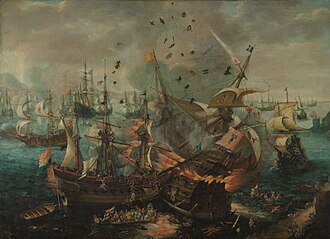
Eighty Years' War and the Anglo-Spanish War: A fleet of Spanish galleys are defeated by English and Dutch galleons in the English Channel.
c. 1566/1568–1648 war in Habsburg Netherlands
The Eighty Years' War or Dutch Revolt was an armed conflict in the Habsburg Netherlands between disparate groups of rebels and the Spanish government. The causes of the war included the Reformation, centralisation, excessive taxation, and the rights and privileges of the Dutch nobility and cities.
1602
Thirty_Years'_War
Thirty Years' War: The Swedish Army defeats the armies of Saxony and the Holy Roman Empire at the Battle of Wittstock.
Major war in Central Europe (1618–1648)
The Thirty Years' War, fought primarily in Central Europe between 1618 and 1648, was one of the most destructive conflicts in European history. An estimated 4.5 to 8 million soldiers and civilians died from the effects of battle, famine, or disease, with parts of Germany reporting population declines of more than 50%. Related conflicts include the Eighty Years' War, the War of the Mantuan Succession, the Franco-Spanish War, the Torstenson War, the Dutch–Portuguese War, and the Portuguese Restoration War.
1636
Nine_Years'_War
Nine Years' War: Piedmontese troops are defeated by the French.
War between France and a European coalition (1688–1697)
The Nine Years' War was a European great power conflict from 1688 to 1697 between France and the Grand Alliance. Fought primarily in Europe, related conflicts include the Williamite war in Ireland, and King William's War in North America.
1693
American_Revolutionary_War
American Revolutionary War: Troops under George Washington are repelled by British troops under William Howe.
1775–1783 conflict in North America
The American Revolutionary War, also known as the Revolutionary War or American War of Independence or simply the American Revolution, was the armed conflict that comprised the final eight years of the broader American Revolution, in which American Patriot forces organized as the Continental Army and commanded by George Washington defeated the British Army. The conflict was fought in North America, the Caribbean, and the Atlantic Ocean. The war's outcome seemed uncertain for most of the war, but Washington and the Continental Army's decisive victory in the Siege of Yorktown in 1781 led King George III and the Kingdom of Great Britain to negotiate an end to the war. In 1783, in the Treaty of Paris, the British monarchy acknowledged the independence of the Thirteen Colonies, leading to the establishment of the United States as an independent and sovereign nation.
1777
13_Vendémiaire
Napoleon first rises to prominence by suppressing counter-revolutionary rioters threatening the National Convention.
1795 battle between French Revolutionary troops and Royalists
13 Vendémiaire, Year 4 in the French Republican Calendar, was a battle between the French Revolutionary troops and Royalist forces in the streets of Paris. This battle was part of the establishing of a new form of government, the Directory, and it was a major factor in the rapid advancement of Republican General Napoleon Bonaparte's career.
1795
1824_Constitution_of_Mexico
Mexico adopts a new constitution and becomes a federal republic.
Fundamental law of Mexico from 1824 to 1857
The Federal Constitution of the United Mexican States of 1824 was the first constitution of Mexico, enacted on October 4 of 1824, inaugurating the First Mexican Republic.
1824
Crimean_War
The Crimean War begins when the Ottoman Empire declares war on the Russian Empire.
Tenth conflict of the Russo-Turkish wars (1853–1856)
The Crimean War was fought between Russia and an alliance of the Ottoman Empire, France, the United Kingdom, and Sardinia from October 1853 to February 1856. Geopolitical causes of the war included the Eastern question, the expansion of Russia in the preceding Russo-Turkish wars, and the British and French preference to preserve the Ottoman Empire to maintain the balance of power in the Concert of Europe.
1853
American_Civil_War
American Civil War: The two-day Second Battle of Corinth ends in a Union victory, with General William Rosecrans protecting the critical rail junction of Corinth, Mississippi from Confederate forces under General Earl Van Dorn.
1861–1865 conflict in the United States
The American Civil War was a civil war in the United States between the Union and the Confederacy, which was formed in 1861 by states that had seceded from the Union to preserve slavery in the United States. The South saw slavery as threatened because of the election of Abraham Lincoln and the growing abolitionist movement in the North. The war ended with Union victory, the dissolution of the Confederacy and the abolition of slavery, freeing four million African Americans.
1862
Texas_A&M_University
The Agricultural and Mechanical College of Texas (now known as Texas A&M) opens as the first public college in Texas.
Public land-grant university in College Station, Texas, US
Texas A&M University is a public land-grant research university in College Station, Texas, United States. It was founded in 1876 and became the flagship institution of the Texas A&M University System in 1948. Since 2021, Texas A&M has enrolled the largest student body in the United States. It is classified among "R1: Doctoral Universities – Very high research activity" and since 2001 has been a member of the Association of American Universities.
1876
Orient_Express
First run of the Orient Express.
Luxury passenger train service in Europe
The Orient Express was a long-distance passenger luxury train service created in 1883 by the Belgian company Compagnie Internationale des Wagons-Lits (CIWL) that operated until 2009. The train traveled the length of continental Europe, with terminal stations in Paris in the northwest and Istanbul in the southeast, and branches extending service to Athens, Brussels, and London.
1883
Boys'_Brigade
First meeting of the Boys' Brigade in Glasgow, Scotland.
Oldest International interdenominational Christian youth organisation
The Boys' Brigade (BB) is an international interdenominational Christian youth organisation, conceived by the Scottish businessman Sir William Alexander Smith to combine drill and fun activities with Christian values. Following its inception in Glasgow in 1883 the BB quickly spread across the United Kingdom, becoming a worldwide organisation by the early 1890s. As of 2018, the Boys' Brigade claimed 750,000 members in 60 countries.
1883
Horace_Rawlins
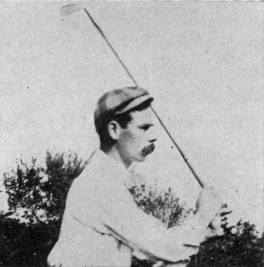
Horace Rawlins wins the first U.S.
Open Men's Golf Championship.
Horace Thomas Rawlins was an English professional golfer who won the first U.S. Open Championship at Newport Country Club in October 1895.
1895
World_War_I
World War I: The Battle of Broodseinde is fought between the British and German armies in Flanders.
Global conflict from 1914 to 1918
World War I, or the First World War, also known as the Great War, was a global conflict between two coalitions: the Allies and the Central Powers. Major theatres of war included Europe and the Middle East, and well as parts of Africa and the Asia-Pacific. One of the deadliest conflicts in history, World War I resulted in an estimated 15 to 22 million deaths, including in mass war crimes against civilians and genocides. The conflict saw important developments in weaponry, including the first large-scale use of machine guns, artillery, aircraft, chemical weapons, and tanks, and was a major factor in the deadly Spanish flu pandemic.
1917
T._A._Gillespie_Company_Shell_Loading_Plant_explosion
World War I: An explosion kills more than 100 people and destroys a Shell Loading Plant in New Jersey.
1918 explosion at American ammunition plant
The T. A. Gillespie Company Shell Loading Plant explosion, sometimes called the Morgan Munitions Depot explosion or similar titles, began at 7:36 pm EDT on Friday, October 4, 1918, at a World War I ammunition plant in the Morgan area of Sayreville in Middlesex County, New Jersey, United States. The initial explosion, generally believed to be accidental, triggered a fire and subsequent series of explosions that continued for three days, totaling approximately six kilotons, killing about 100 people and injuring hundreds more. The facility, one of the largest in the world at the time, was destroyed along with more than 300 surrounding buildings, forcing the evacuation and reconstruction of Sayreville, South Amboy, and Laurence Harbor. Over a century later, explosive debris continues to surface regularly across a 1.2-mile (1.9 km) radius.
1918
Mannerheim_League_for_Child_Welfare
The Mannerheim League for Child Welfare, a Finnish non-governmental organization, is founded on the initiative of Sophie Mannerheim.
Finnish non-governmental organisation
Mannerheim League for Child Welfare is a Finnish non-governmental organization founded in 1920 that promotes the well-being of children, young people and families with children. MLL's goal is a child-friendly Finland. It can be attributed to the construction of a comprehensive counseling system in Finland.
1920
Great_Syrian_Revolt
Great Syrian Revolt: Rebels led by Fawzi al-Qawuqji capture Hama from the French Mandate of Syria.
1925–27 uprising against French rule in Mandatory Syria and Lebanon
The Great Syrian Revolt, also known as the Revolt of 1925, was a general uprising across the State of Syria and Greater Lebanon during the period of 1925 to 1927. The leading rebel forces initially comprised fighters of the Jabal Druze State in southern Syria, and were later joined by Sunni, Druze and Shiite and factions all over Syria. The common goal was to end French occupation in the newly mandated regions, which passed from Ottoman to French administration following World War I.
1925
Finnish_torpedo_boat_S2
S2, a Finnish Sokol class torpedo boat, sinks during a fierce storm near the coast of Pori in the Gulf of Bothnia, taking with it the whole crew of 53.
Torpedo boat
S2 was a Finnish Sokol-class torpedo boat captured from Russia after the Finnish Civil War in 1918. She sank in a severe storm on 4 October 1925, with the loss of all 53 crew members.
1925
Gutzon_Borglum
Gutzon Borglum begins sculpting Mount Rushmore.
American sculptor (1867–1941)
John Gutzon de la Mothe Borglum was an American sculptor best known for his work on Mount Rushmore. He is also associated with various other public works of art across the U.S., including Stone Mountain in Georgia, statues of Union General Philip Sheridan in Washington, D.C., and in Chicago, as well as a bust of Abraham Lincoln exhibited in the White House by Theodore Roosevelt and now held in the United States Capitol crypt in Washington, D.C.
1927
Metropolitan_Police
The Metropolitan Police and various anti-fascist organizations violently clash in the Battle of Cable Street.
Territorial police force of Greater London
The Metropolitan Police Service (MPS), commonly known as the Metropolitan Police, Met Police, or the "Met", is the territorial police force responsible for law enforcement and crime prevention within Greater London. In addition, it is responsible for specialised tasks throughout the United Kingdom, such as dealing with counter-terrorism throughout the UK, and the protection of certain individuals, including the monarch, royal family, governmental officials, and other designated figures. It is also referred to as an eponym as "Scotland Yard" or "the Yard", after the location of its original headquarters in Great Scotland Yard, Whitehall, in the 19th century. The Met is presently headquartered at New Scotland Yard, in a building situated on the Victoria Embankment.
1936
Willie_Gillis
Norman Rockwell's Willie Gillis character debuts on the cover of The Saturday Evening Post.
Fictional character by Norman Rockwell
Willie Gillis, Jr. is a fictional character created by Norman Rockwell for a series of World War II paintings that appeared on the covers of 11 issues of The Saturday Evening Post between 1941 and 1946. Gillis was an everyman with the rank of private whose career was tracked on the cover of the Post from induction through discharge without being depicted in battle. He and his girlfriend were modeled by two of Rockwell's acquaintances.
1941
Constitution_of_France
The current constitution of France is adopted.
The current Constitution of France was adopted on 4 October 1958. It is typically called the Constitution of the Fifth Republic (French: la Constitution de la Cinquième République), and it replaced the Constitution of the Fourth Republic of 1946, keeping its preamble. The current Constitution regards the separation of church and state, democracy, social welfare, and indivisibility as core principles of the French state.
1958
Eastern_Air_Lines_Flight_375
Eastern Airlines flight 375 crashes on takeoff from Boston's Logan International Airport, killing 62 people of the 72 aboard.
1960 aviation bird strike accident
Eastern Air Lines Flight 375, registration N5533, was a Lockheed L-188 Electra aircraft that crashed on takeoff from Logan International Airport in Boston, Massachusetts, on October 4, 1960. Ten survived, nine with serious injuries, but 62 of 72 on board were killed in the accident.
1960
Hurricane_Flora
Hurricane Flora kills 6,000 in Cuba and Haiti.
Category 4 Atlantic hurricane in 1963
Hurricane Flora was an extremely deadly and devastating tropical cyclone that is among the deadliest Atlantic hurricanes in recorded history, with a death total of at least 7,193. The seventh tropical storm and sixth hurricane of the 1963 Atlantic hurricane season, Flora developed from a disturbance in the Intertropical Convergence Zone on September 26 while located 755 miles (1,215 km) southwest of the Cape Verde islands. After remaining a weak depression for several days, it rapidly organized on September 29 to attain tropical storm status. Flora continued to strengthen, reaching Category 3 hurricane status after moving through the Windward Islands and passing over Tobago, and it reached maximum sustained winds of 150 miles per hour (240 km/h) in the Caribbean.
1963
Pope_Paul_VI
Pope Paul VI begins the first papal visit to the Americas.
Head of the Catholic Church from 1963 to 1978
Pope Paul VI was head of the Catholic Church and sovereign of Vatican City from 21 June 1963 until his death on 6 August 1978. Succeeding John XXIII, he continued the Second Vatican Council, which he closed in 1965, implementing its numerous reforms. He fostered improved ecumenical relations with Eastern Orthodox and Protestant churches, which resulted in many historic meetings and agreements.
1965
Basutoland
Basutoland becomes independent from the United Kingdom and is renamed Lesotho.
British Colony from 1884 to 1966
Basutoland was a British Crown colony that existed from 1884 to 1966 in present-day Lesotho, bordered with the Cape Colony, Natal Colony and Orange River Colony until 1910 and completely surrounded by South Africa from 1910. Though the Basotho and their territory had been under British control starting in 1868, the rule by Cape Colony was unpopular and unable to control the territory. As a result, Basutoland was brought under direct authority of Queen Victoria, via the High Commissioner, and run by an Executive Council presided over by a series of British Resident Commissioners.
1966
Omar_Ali_Saifuddien_III
Omar Ali Saifuddien III of Brunei abdicates in favour of his son.
Sultan of Brunei from 1950 to 1967
Omar Ali Saifuddien III Sa'adul Khairi Waddien reigned as the Sultan of Brunei from 1950 until his abdication in 1967.
1967
Richard_Noble
Richard Noble sets a new land speed record of 633.468 miles per hour (1,019.468 km/h) at the Black Rock Desert in Nevada.
Scottish entrepreneur; holder of the land speed record from 1983 to 1997
Richard James Anthony Noble, OBE is a Scottish entrepreneur who was holder of the land speed record between 1983 and 1997. He was also the project director of ThrustSSC, the vehicle which holds the current land speed record, set at Black Rock Desert, Nevada in 1997.
1983
The Free Software Foundation is founded.
Organization supporting the free software movement
The Free Software Foundation (FSF) is a 501(c)(3) nonprofit organization founded by Richard Stallman on October 4, 1985. The organization supports the free software movement, with its preference for software being distributed under copyleft terms, such as with its own GNU General Public License. The FSF was incorporated in Boston where it is also based.
1985
The Protocol on Environmental Protection to the Antarctic Treaty is opened for signature.
1991 international treaty on environmental regulation in Antarctica
The Protocol on Environmental Protection to the Antarctic Treaty, also known as the Madrid Protocol, is a complementary legal instrument to the Antarctic Treaty signed in Madrid on 4 October 1991. It entered into force on 14 January 1998.
1991
The Rome General Peace Accords end a 16-year civil war in Mozambique.
1992 treaty ending the Mozambican Civil War
The Rome General Peace Accords, officially the General Peace Accords, was a peace treaty signed between the government of Mozambique and RENAMO, ending the Mozambican Civil War on October 4, 1992. Negotiations preceding the agreement began in July 1990. They were brokered by a team of four mediators, two members of the Community of Sant'Egidio, Andrea Riccardi and Matteo Zuppi, as well as Bishop Jaime Gonçalves and Italian government representative Mario Raffaelli. The delegation of the Mozambican government was headed by Armando Guebuza, who went on to become President of Mozambique. The RENAMO delegation consisted of Raul Domingos, José de Castro, Vicente Ululu, Agostinho Murrial, João Almirante, José Augusto and Anselmo Victor. The accords were then signed by the then-president of Mozambique Joaquim Chissano, and by the leader of RENAMO, Afonso Dhlakama.
1992
El_Al_Flight_1862
El Al Flight 1862 crashes into two apartment buildings in Amsterdam, killing 43 including 39 on the ground.
1992 aircraft accident in the Netherlands
On 4 October 1992, El Al Flight 1862, a Boeing 747-200 cargo aircraft of the Israeli airline El Al, crashed into the Groeneveen and Klein-Kruitberg flats in the Bijlmermeer neighbourhood of Amsterdam, the Netherlands. The accident is known in Dutch as the Bijlmerramp. The subsequent health effects in survivors, and eventual revelations of the cargo manifest, showed at least three chemical precursors used in the production of the nerve agents sarin and soman.
1992
Battle_of_Mogadishu_(1993)
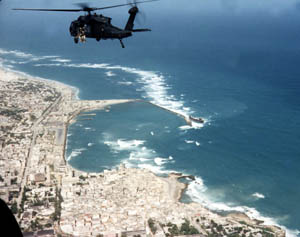
Battle of Mogadishu occurs killing 18 U.S.
Special Forces, two UN Peacekeepers and at least 600 Somalian militia men and civilians.
The Battle of Mogadishu, also known as the Black Hawk Down Incident, was part of Operation Gothic Serpent. It was fought on 3–4 October 1993, in Mogadishu, Somalia, between forces of the United States—supported by UNOSOM II—against Somali National Alliance (SNA) fighters and other insurgents in south Mogadishu.
1993
1993_Russian_constitutional_crisis
Tanks bombard the Russian parliament, while demonstrators against President Yeltsin rally outside.
Conflict between Boris Yeltsin and the parliament
In September and October 1993, a constitutional crisis arose in the Russian Federation from a conflict between the then Russian president Boris Yeltsin and the country's parliament. Yeltsin performed a self-coup, dissolving parliament and instituting a presidential rule by decree system. The crisis ended with Yeltsin using military force to attack Moscow's House of Soviets and arrest the lawmakers. In Russia, the events are known as the "October Coup" or "Black October".
1993
The second largest cash robbery in U.S.
history occurs in North Carolina.
On the evening of October 4, 1997, $17.3 million in cash was stolen from the Charlotte, North Carolina, regional office vault of Loomis, Fargo & Co. The robbery was committed by Loomis vault supervisor David Scott Ghantt, his married girlfriend Kelly Campbell, Steven Eugene Chambers, his wife Michelle Chambers, Michael Gobbies, and four other co-conspirators. An FBI criminal investigation ultimately resulted in the arrest and conviction of eight people directly involved in the heist, as well as sixteen others who had indirectly helped them, and the recovery of approximately 88% of the stolen money.
1997
Siberia_Airlines_Flight_1812
Siberia Airlines Flight 1812 crashes after being struck by an errant Ukrainian missile.
Seventy-eight people are killed.
Siberia Airlines Flight 1812 was a commercial flight shot down by the Ukrainian Air Force over the Black Sea on 4 October 2001, en route from Tel Aviv, Israel, to Novosibirsk, Russia. The aircraft, a Soviet-made Tupolev Tu-154, carried 66 passengers and 12 crew members. There were no survivors. The crash site is about 190 km west-southwest of the Black Sea resort of Sochi, 140 km north of the Turkish coastal town of Fatsa and 350 km south-southeast of Feodosiya in Crimea. The crash was caused by a missile launched during joint Ukrainian-Russian military air-defence exercises at the Russian-controlled training ground of the 31st Russian Black Sea Fleet Research center on Cape Opuk near the city of Kerch in Crimea. Ukraine eventually admitted that it might have caused the crash, probably by an errant S-200 missile fired by its armed forces. Ukraine paid $15 million hryvnia to surviving family members of the 78 victims.
2001
Maxim_restaurant_suicide_bombing
The Maxim restaurant suicide bombing in Israel kills twenty-one Israelis, both Jews and Arabs.
2003 Palestinian terror attack in Haifa, Israel
The Maxim restaurant bombing was a Palestinian suicide bombing which occurred on October 4, 2003, in the beachfront restaurant Maxim in Haifa, Israel. Twenty-one civilians were killed and 60 were injured. Among the victims were two families and four children, including a two-month-old baby.
2003
SpaceShipOne
SpaceShipOne wins the Ansari X Prize for private spaceflight.
American experimental spaceplane
SpaceShipOne is an experimental air-launched rocket-powered aircraft with sub-orbital spaceflight capability at speeds of up to 3,000 ft/s (2,000 mph) / 910 m/s (3,300 km/h) using a hybrid rocket motor. The design features a unique "feathering" atmospheric reentry system where the rear half of the wing and the twin tail booms folds 70 degrees upward along a hinge running the length of the wing; this increases drag while retaining stability. SpaceShipOne completed the first crewed private spaceflight in 2004. That same year, it won the US$10 million Ansari X Prize and was immediately retired from active service. Its mother ship was named "White Knight". Both craft were developed and flown by Mojave Aerospace Ventures, which was a joint venture between Paul Allen and Scaled Composites, Burt Rutan's aviation company. Allen provided the funding of approximately US$25 million.
2004
WikiLeaks
WikiLeaks is launched.
News leak publishing organisation
WikiLeaks is a non-profit media organisation and publisher of leaked documents. It is funded by donations and media partnerships. It has published classified documents and other media provided by anonymous sources. It was founded in 2006 by Julian Assange. Kristinn Hrafnsson is its editor-in-chief. Its website states that it has released more than ten million documents and associated analyses. WikiLeaks' most recent publication of original documents was in 2019, and its most recent publication was in 2021. From November 2022, numerous documents on the organisation's website became inaccessible. In 2023, Assange said that WikiLeaks was no longer able to publish due to his imprisonment and the effect that US government surveillance and WikiLeaks' funding restrictions were having on potential whistleblowers.
2006
Ajka_alumina_plant_accident
The Ajka plant accident in Hungary releases a million cubic metres of liquid alumina sludge, killing nine, injuring 122, and severely contaminating two major rivers.
Ajka alumina 2010 industrial accident in Hungary
A caustic waste reservoir chain collapsed at the Ajkai Timföldgyár alumina plant in Ajka, Veszprém County, in western Hungary in October 2010.
2010
United_States_Army_Special_Forces
Joint Nigerien-American Special Forces are ambushed by Islamic State militants outside the village of Tongo Tongo.
Special operations branch of the U.S. Army
The United States Army Special Forces (SF), colloquially known as the "Green Berets" due to their distinctive service headgear, is a branch of the United States Army Special Operations Command (USASOC).
2017

History runs on facts, and this project runs on coffee!

Your support is incredibly helpful and genuinely appreciated.

Support with a coffee ☕