October 3 in History

The German Democratic Republic is abolished and becomes part of the Federal Repu

1990 — The German Democratic Republic is abolished and becomes part of the Federal Republic of Germany; the event is afterwards celebrated as German Unity Day

October 3 spans 45 recorded events across recorded history, from 2457 BC to 2024. Below is a curated digest of the most significant moments tied to this date.

By · Wikipedia

Historical Events 45 events 2457 BC – 2024

More major events on October 3

The featured story and these ranked highlights form a quick summary. Every recorded event remains available in the chronology below.

  1. 2023 Wab Kinew is elected to be the first First Nations Premier of a Canadian province in the 2023 Manitoba general election Source
  2. 1739 The Treaty of Niš is signed by the Ottoman Empire and Russia ending the Russian–Turkish War. Source
  3. 1951 Korean War: The First Battle of Maryang San pits Commonwealth troops against communist Chinese troops. Source

Did you know

East Germany was formed on 7 October 1949, and its capital was East Berlin.

Did you know

The country was a member of the Warsaw Pact and came under the influence of the Soviet Union.

Did you know

The government of East Germany was led by the Socialist Unity Party, which was founded in 1946.

Did you know

The Berlin Wall, erected in 1961, separated East and West Berlin and became a powerful symbol of the division of Germany.

Did you know

The reunification of East and West Germany on 3 October 1990 led to the creation of five new states in the Federal Republic of Germany.


National_Foundation_Day_(Korea)
Gaecheonjeol, Hwanung (환웅) purportedly descended from heaven.
South Korea's National Foundation Day.
Gaecheonjeol is a public holiday in South Korea on 3 October. Also known by the English name National Foundation Day, this holiday celebrates the legendary formation of the first Korean state of Gojoseon by legendary king Dangun in 2333 BC. This date has traditionally been regarded by Koreans as the date for the founding of the Korean race.
-2457
Gallic_Wars
Gallic Wars: Vercingetorix, leader of the Gauls, surrenders to the Romans under Julius Caesar, ending the siege and battle of Alesia.
Rome-Gaul wars, 58–50 BCE
The Gallic Wars were waged between 58 and 50 BC by the Roman general Gaius Julius Caesar against the peoples of Gaul. Gallic, Germanic, and Brittonic tribes fought to defend their homelands against an aggressive Roman campaign. The wars culminated in the decisive Battle of Alesia in 52 BC, in which a complete Roman victory resulted in the expansion of the Roman Republic over the whole of Gaul. Though the collective Gallic armies were as strong as the Roman forces, internal divisions among the Gallic tribes eased victory for Caesar. Gallic chieftain Vercingetorix's attempt to unite the Gauls under a single banner came too late. Caesar portrayed the invasion as being a preemptive and defensive action, but historians agree that he fought the wars primarily to boost his political career and to pay off his debts. Still, Gaul was of significant military importance to the Romans. Native tribes in the region, both Gallic and Germanic, had repeatedly attacked Roman territory. Conquering Gaul allowed Rome to secure the natural border of the Rhine river.
-52
Liberators'_civil_war
Liberators' civil war: Triumvirs Mark Antony and Octavian fight to a draw Caesar's assassins Brutus and Cassius in the first part of the Battle of Philippi, where Cassius commits suicide believing the battle is lost.
Roman civil war after Caesar's assassination (43–42 BC)
The Liberators' civil war was started by the Second Triumvirate to avenge Julius Caesar's assassination. The war was fought by the forces of Mark Antony and Octavian against the forces of Caesar's assassins, led by Marcus Junius Brutus and Gaius Cassius Longinus, referred to as the Liberatores. The latter were defeated by the Triumvirs at the Battle of Philippi in October 42 BC, and committed suicide. Brutus committed suicide after the second part of the battle.
-42
Theodosius_I
Roman Emperor Theodosius I concludes a peace treaty with the Goths and settles them in the Balkans.
Roman emperor from 379 to 395
Theodosius I, also known as Theodosius the Great, was Roman emperor from 379 to 395. He won two civil wars and was instrumental in establishing the Nicene Creed as the orthodox doctrine for Nicene Christianity. Theodosius was the last emperor to rule the entire Roman Empire. After his death, his sons Arcadius and Honorius ruled from separate courts in the east and the west, continuing the late Roman practice of rule by multiple emperors. He ended the Gothic War (376–382), but did so on terms disadvantageous to the empire, with the Goths remaining politically autonomous within Roman territory, albeit as nominal allies.
382
Muhammed VII becomes the twelfth sultan of the Emirate of Granada.
Sultan of Granada from 1392 to 1408
Muhammad VII, reigned 3 October 1392 – 13 May 1408, was the twelfth Nasrid ruler of the Muslim Emirate of Granada in Al-Andalus on the Iberian Peninsula. He was the son of Yusuf II and grandson of Muhammad V. He came to the throne upon the death of his father. In 1394, he defeated an invasion by the Order of Alcántara. This nearly escalated to a wider war, but Muhammad VII and Henry III of Castile were able to restore peace.
1392
Siege_of_Leiden
The Siege of Leiden is lifted by the Watergeuzen.
1573–74 battle of the Eighty Years' War
The siege of Leiden occurred during the Eighty Years' War in 1573 and 1574, when the Spanish under Francisco de Valdez attempted to capture the rebellious city of Leiden, South Holland, the Netherlands. The siege failed when the city was successfully relieved in October 1574.
1574
Qing_dynasty
Qing dynasty naval commander Shi Lang receives the surrender of the Tungning kingdom on Taiwan after the Battle of Penghu.
Manchu-led dynasty of China (1644–1912)
The Qing dynasty, officially the Great Qing, also known as the Qing Empire or Qing China, was a Manchu-led imperial dynasty of China and an early modern empire in East Asia which existed from 1636/1644 to 1912. The last imperial dynasty in Chinese history, the Qing dynasty was preceded by the Ming dynasty and succeeded by the Republic of China. At the height of its power, the empire stretched from the Sea of Japan in the east to the Pamir Mountains in the west, and from the Mongolian Plateau in the north to the South China Sea in the south. Originally emerging from the Later Jin dynasty founded in 1616 and proclaimed in Shenyang in 1636, the dynasty seized control of the Ming capital Beijing and North China in 1644, traditionally considered the start of the dynasty's rule. The dynasty lasted until the Xinhai Revolution of October 1911 led to the abdication of the last emperor in February 1912. The multi-ethnic Qing dynasty assembled the territorial base for modern China. The Qing controlled the most territory of any dynasty in Chinese history, and in 1790 was the fourth-largest empire in world history to that point. It was also the most populous state at the time, with over 426 million citizens in 1907.
1683
James_Graham,_1st_Duke_of_Montrose
The Duke of Montrose issues a warrant for the arrest of Rob Roy MacGregor.
Scottish politician
James Graham, 1st Duke of Montrose was a Scottish politician.
1712
Treaty_of_Niš_(1739)
The Treaty of Niš is signed by the Ottoman Empire and Russia ending the Russian–Turkish War.
Russo-Turkish peace treaty
The Treaty of Niš was a peace treaty signed on 3 October 1739 in Niš, by the Ottoman Empire and the Russian Empire, to end the Russo-Turkish War (1735–1739). It was preceded by the preliminary Russo-Turkish peace treaty, signed through French mediation on 18 September 1739 in Belgrade, while the peace arrangements were finalized by the treaty of Niš on 3 October.
1739
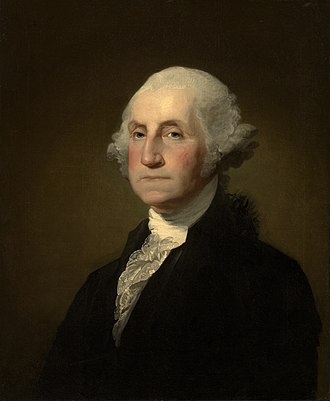
George_Washington
George Washington proclaims Thursday November 26, 1789 as Thanksgiving Day.
U.S. Founding Father and president from 1789 to 1797
George Washington was a Founding Father and the first president of the United States, serving from 1789 to 1797. As commander of the Continental Army, Washington led Patriot forces to victory in the American Revolutionary War against the British Empire. He is commonly known as the Father of His Country for his role in bringing about American independence.
1789
Valdivian_Fort_System
A militia departs from the Spanish stronghold of Valdivia to quell a Huilliche uprising in southern Chile.
Historic forts in Los Ríos Region, Chile
The Fort System of Valdivia is a series of Spanish colonial fortifications at Corral Bay, Valdivia and Cruces River established to protect the city of Valdivia, in southern Chile. During the period of Spanish rule (1645–1820), it was one of the biggest systems of fortification in the Americas. It was also a major supply source for Spanish ships that crossed the Strait of Magellan.
1792
American_Civil_War
American Civil War: The two-day Second Battle of Corinth begins as Confederate forces under General Earl Van Dorn attack Union defenses led by General William Rosecrans around Corinth, Mississippi.
1861–1865 conflict in the United States
The American Civil War was a civil war in the United States between the Union and the Confederacy, which was formed in 1861 by states that had seceded from the Union to preserve slavery in the United States. The South saw slavery as threatened because of the election of Abraham Lincoln and the growing abolitionist movement in the North. The war ended with Union victory, the dissolution of the Confederacy and the abolition of slavery, freeing four million African Americans.
1862
Thanksgiving_(United_States)
The last Thursday in November is declared as Thanksgiving Day by U.S.
President Abraham Lincoln.
Thanksgiving is a federal holiday in the United States celebrated on the fourth Thursday of November. The earliest Thanksgiving can occur is November 22; the latest is November 28. Outside the United States, it is called American Thanksgiving to distinguish it from the Canadian holiday of the same name and related celebrations in other regions. As the name implies, the holiday generally revolves around giving thanks and the centerpiece of most celebrations is a Thanksgiving dinner with family and friends.
1863
Kintpuash
Chief Kintpuash and companions are hanged for their part in the Modoc War of northern California.
19th-century chief of the Modoc tribe of California and Oregon
Kintpuash, also known as Kientpoos, Keintpoos, or by his English name Captain Jack, was a Modoc leader from present-day northern California and southern Oregon. His name in the Modoc language translates to "strikes the water brashly." Kintpuash is best known for leading his people in resisting forced relocation during the Modoc War of 1872–1873. Using the rugged terrain of the Lava Beds in California, his small band of warriors held off vastly superior US Army forces for several months. He remains the only Native American leader to be charged with war crimes. Kintpuash was executed by hanging, along with three others, for their role in the deaths of General Edward Canby and Reverend Eleazar Thomas during peace negotiations.
1873
Battle_of_Coyotepe_Hill
U.S.
forces defeat Nicaraguan rebels at the Battle of Coyotepe Hill.
The Battle of Coyotepe Hill was a significant engagement during the United States occupation of Nicaragua from August through November 1912 during the insurrection staged by Minister of War General Luis Mena against the government of President Adolfo Díaz.
1912
Boris_III_of_Bulgaria
Tsar Boris III of Bulgaria accedes to the throne.
Tsar of Bulgaria from 1918 to 1943
Boris III was the Tsar of the Kingdom of Bulgaria from 1918 until his death in 1943.
1918
Cincinnati_Reds
Cincinnati Reds pitcher Adolfo Luque becomes the first Latin American player to appear in a World Series.
Major League Baseball franchise in Cincinnati, Ohio
The Cincinnati Reds are an American professional baseball team based in Cincinnati. The Reds compete in Major League Baseball (MLB) as a member club of the National League (NL) Central Division. They were a charter member of the American Association in 1882 before joining the NL in 1890.
1919
Kingdom_of_Yugoslavia
The Kingdom of Serbs, Croats and Slovenes is renamed to Yugoslavia by King Alexander I.
Yugoslavia from 1918 to 1941
The Kingdom of Yugoslavia was a country in Southeast and Central Europe that existed from 1918 until 1941. From 1918 to 1929, it was officially called the Kingdom of Serbs, Croats, and Slovenes and was colloquially known as "Yugoslavia" due to its origins.
1929
Kingdom_of_Iraq
The Kingdom of Iraq gains independence from the United Kingdom.
Hashemite Iraqi Kingdom (1932–1958)
The Hashemite Kingdom of Iraq was the Iraqi state located in the Middle East from 1932 to 1958. It was founded on 23 August 1921 as the Kingdom of Iraq, following the defeat of the Ottoman Empire in the Mesopotamian campaign of the First World War. Although a League of Nations mandate was awarded to the United Kingdom in 1920, the 1920 Iraqi revolt resulted in the scrapping of the original mandate plan in favour of a formally sovereign Iraqi kingdom, but one that was under effective British administration. The plan was formally established by the Anglo-Iraqi Treaty. The population of the Kingdom was 2.8 million at the founding in 1928, and by the end of the Kingdom in 1958 it was 6.5 million.
1932
Second_Italo-Ethiopian_War
Second Italo-Abyssinian War: Italy invades Ethiopia.
1935–1936 war between Italy and Ethiopia
The Second Italo-Ethiopian War, also referred to as the Second Italo-Abyssinian War, was a war of aggression waged by Italy against Ethiopia, which lasted from October 1935 to May 1936. In Ethiopia it is often referred to simply as the Italian Invasion, and in Italy as the Ethiopian War. The war is regarded as the largest colonial campaign in history.
1935
V-2_rocket
A German V-2 rocket reaches a record 85 km (46 nm) in altitude.
German long-range ballistic missile
The V-2 rocket, with the development name Aggregat-4 (A4), was the world's first practical, modern ballistic missile and suborbital launch vehicle. The missile, powered by a liquid-propellant rocket engine, was developed during the Second World War in Nazi Germany as a "vengeance weapon" and assigned to attack Allied cities as retaliation for the Allied bombings of German cities. After an altitude of 100 km was selected to define the edge of space, the V2 rocket also became retroactively the first artificial object to travel into space with the vertical launch of MW 18014 on 20 June 1944.
1942
World_War_II
World War II: German forces murder 92 civilians in Lingiades, Greece.
Global conflict (1939–1945)
World War II, or the Second World War, was a global conflict between two coalitions: the Allies and the Axis powers. Nearly all of the world's countries participated, with many engaging in total war on an unprecedented scale. World War II was the deadliest conflict in history, causing the deaths of 60 to 75 million people, a majority of whom were civilians. Millions died as a result of massacres, starvation, disease, and genocides including the Holocaust. After the Allied victory, Germany, Austria, Japan, and Korea were occupied, and German and Japanese leaders were tried for war crimes.
1943
American_Overseas_Airlines
An American Overseas Airlines Douglas DC-4 crashes near Ernest Harmon Air Force Base in Stephenville, Newfoundland and Labrador, Canada, killing 39.
US airline
American Overseas Airlines (AOA) was an airline that operated between the United States and Europe between 1945 and 1950. It was headquartered in Midtown Manhattan, New York City.
1946
WERD, the first black-owned radio station in the United States, opens in Atlanta.
First African-American owned and operated radio station
WERD was the first radio station owned and programmed by African Americans. The station was established in Atlanta, Georgia on October 3, 1949, broadcasting on 860 AM. The National Black Radio Hall of Fame Atlanta Chapter is reopening WERD which still exists at its birth location and will also include a historical museum with it after renovations of the facility are completed.
1949
First_Battle_of_Maryang-san
Korean War: The First Battle of Maryang San pits Commonwealth troops against communist Chinese troops.
Battle of the Korean War
The First Battle of Maryang-san, also known as the Defensive Battle of Maliangshan, was fought during the Korean War between United Nations Command (UN) forces—primarily Australian, British and Canadian—and the Chinese People's Volunteer Army (PVA). The fighting occurred during a limited UN offensive by US I Corps, codenamed Operation Commando. This offensive ultimately pushed the PVA back from the Imjin River to the Jamestown Line and destroyed elements of four PVA armies following heavy fighting. The much smaller battle at Maryang-san took place over a five-day period, and saw the 1st Commonwealth Division dislodge a numerically superior PVA force from the tactically important Kowang-san, Hill 187, and Maryang-san features.
1951
Operation_Hurricane
The United Kingdom successfully tests a nuclear weapon in the Montebello Islands, Western Australia, to become the world's third nuclear power.
1952 British atomic bomb test in Western Australia
Operation Hurricane was the first test of a British atomic device. A plutonium implosion device was detonated on 3 October 1952 in Main Bay, Trimouille Island, in the Montebello Islands in Western Australia. With the success of Operation Hurricane, the United Kingdom became the third nuclear power, after the United States and the Soviet Union.
1952
Superior_Courts_of_California
The California State Superior Court rules that the book Howl and Other Poems is not obscene.
State trial courts with general jurisdiction
The Superior Courts of California are the state trial court system of the U.S. state of California. They have general jurisdiction to hear and decide any civil or criminal action which is not specially designated to be heard in some other court or before a governmental agency. As mandated by the California Constitution, there is a superior court in each of the 58 counties in California. The superior courts also have appellate divisions which hear appeals from decisions in infraction and misdemeanor cases.
1957
Project_Mercury
Project Mercury: US astronaut Wally Schirra, in Sigma 7, is launched from Cape Canaveral for a six-orbit flight.
Initial American crewed spaceflight program (1958–1963)
Project Mercury was the first human spaceflight program of the United States, running from 1958 through 1963. An early highlight of the Space Race, its goal was to put a man into Earth orbit and return him safely, ideally before the Soviet Union. Taken over from the US Air Force by the newly created civilian space agency NASA, it conducted 20 uncrewed developmental flights, and six successful flights by astronauts. The program, which took its name from Roman mythology, cost $2.83 billion. The astronauts were collectively known as the "Mercury Seven", and each spacecraft was given a name ending with a "7" by its pilot.
1962
A violent coup in Honduras begins two decades of military rule.
Military coup against Ramón Villeda Morales
The 1963 Honduran coup d'état was a military takeover of the Honduran government on 3 October 1963, ten days before a scheduled election. Oswaldo López Arellano replaced Ramón Villeda Morales as president and initiated two decades of military rule.
1963
1981_Irish_hunger_strike
The hunger strike at the Maze Prison in Northern Ireland ends after seven months and ten deaths.
Protest by Irish republican prisoners in Northern Ireland
A five-year protest during the Troubles by Irish republican prisoners in Northern Ireland culminated in a hunger strike in 1981. The protest began as the blanket protest in 1976 when the British government withdrew Special Category Status for convicted paramilitary prisoners.
1981
Space_Shuttle_Atlantis
The Space Shuttle Atlantis makes its maiden flight, carrying two DSCS-III Satellites on STS-51-J.
Space Shuttle orbiter (1985–2011)
Space Shuttle Atlantis is a retired Space Shuttle orbiter vehicle which belongs to NASA, the spaceflight and space exploration agency of the United States. Atlantis was manufactured by the Rockwell International company in Southern California and was delivered to the Kennedy Space Center in Eastern Florida in April 1985. Atlantis is the fourth operational and the second-to-last Space Shuttle built. Its maiden flight was STS-51-J made from October 3 to 7, 1985.
1985
TASCC, a superconducting cyclotron at the Chalk River Laboratories in Canada, is officially opened.
Defunct particle accelerator in Chalk River, Ontario, Canada
Tandem Accelerator Superconducting Cyclotron (TASCC) was a Canadian particle accelerator facility constructed at Chalk River Laboratories on October 3, 1986. TASCC was the world's first Tandem Accelerator and able to accelerate most elements to 10 MeV per nucleon. The TASCC facility was decommissioned beginning in 1996.
1986
A coup in Panama City is suppressed and 11 participants are executed.
Failed military coup against dictator Manuel Noriega
The 1989 Panamanian coup d'état attempt was a failed coup d'état which occurred in Panama City on 3 October. The attempt was led by Major Moisés Giroldi, supported by a group of officers who had returned from a United Nations peacekeeping mission in Namibia. Although the plotters succeeded in capturing Panamanian dictator Manuel Noriega, the coup was quickly suppressed. Giroldi and nine other members of the Panamanian Defense Forces were executed on 3 and 4 October 1989. An eleventh participant died in prison after being tortured. These events became known as the "Albrook massacre".
1989
Nadine_Gordimer
Nadine Gordimer is announced as the winner of the Nobel Prize in Literature.
South African writer (1923–2014)
Nadine Gordimer was a South African writer and political activist. She received the Nobel Prize in Literature in 1991, recognised as a writer "who through her magnificent epic writing has ... been of very great benefit to humanity".
1991
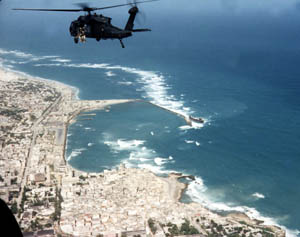
Battle_of_Mogadishu_(1993)
An American attack against a warlord in Mogadishu fails; eighteen US soldiers and over 350 Somalis die.
Military conflict during the Somali Civil War
The Battle of Mogadishu, also known as the Black Hawk Down Incident, was part of Operation Gothic Serpent. It was fought on 3–4 October 1993, in Mogadishu, Somalia, between forces of the United States—supported by UNOSOM II—against Somali National Alliance (SNA) fighters and other insurgents in south Mogadishu.
1993
Murder_trial_of_O._J._Simpson
O.
J. Simpson murder case: O. J. Simpson is acquitted of the murders of Nicole Brown Simpson and Ronald Goldman.
The People of the State of California v. Orenthal James Simpson was a criminal trial in Los Angeles County Superior Court, in which former NFL player and actor O. J. Simpson was tried and acquitted for the murders of his ex-wife Nicole Brown Simpson and her friend Ron Goldman, who were stabbed to death outside Brown's home in Los Angeles on June 12, 1994. The trial spanned eight months, from January 24 to October 3, 1995.
1995
The Emergency Economic Stabilization Act of 2008 for the U.S.
financial system is signed by President George W. Bush.
The Emergency Economic Stabilization Act of 2008, also known as the "bank bailout of 2008" or the "Wall Street bailout", was a United States federal law enacted during the Great Recession, which created federal programs to "bail out" failing financial institutions and banks. The bill was proposed by Treasury Secretary Henry Paulson, passed by the 110th United States Congress, and was signed into law by President George W. Bush. It became law as part of Public Law 110-343 on October 3, 2008. It created the $700 billion Troubled Asset Relief Program (TARP) whose funds would purchase toxic assets from failing banks. The funds were mostly directed to inject capital into banks and other financial institutions as the Treasury continued to review the effectiveness of targeted asset-purchases.
2008
Azerbaijan
Azerbaijan, Kazakhstan, Kyrgyzstan, and Turkey join in the Turkic Council.
Country in Eastern Europe and West Asia
Azerbaijan, officially the Republic of Azerbaijan, is a transcontinental landlocked country at the boundary of Western Asia and Eastern Europe. It is a part of the South Caucasus region and is bounded by the Caspian Sea to the east, Russia's republic of Dagestan to the north, Georgia to the northwest, Turkey and Armenia to the west, and Iran to the south. Baku is the capital and largest city.
2009
At least 360 migrants are killed when their boat sinks near the Italian island of Lampedusa.
Fatal maritime incident near Italy
On 3 October 2013, a boat carrying migrants from Libya to Italy sank off the Italian island of Lampedusa. It was reported that the boat had sailed from Misrata, Libya, but that many of the migrants were originally from Eritrea, Somalia and Ghana. An emergency response involving the Italian Coast Guard resulted in the rescue of 155 survivors. On 12 October it was reported that the confirmed death toll after searching the boat was 359, but that further bodies were still missing; a figure of "more than 360" deaths was later reported.
2013
Kunduz_hospital_airstrike
Forty-two people are killed and 33 go missing in the Kunduz hospital airstrike in Afghanistan.
2015 U.S. air strike on a hospital in Afghanistan
On 3 October 2015, a United States Air Force AC-130U gunship attacked the Kunduz Trauma Centre operated by Médecins Sans Frontières in the city of Kunduz, in the eponymous province in northern Afghanistan. 42 people were killed and over 30 were injured. MSF condemned the incident, calling it a deliberate breach of international humanitarian law and a war crime. It further stated that all warring parties had been notified about the hospital and its operations well in advance.
2015
2021_Milan_Pilatus_PC-12_crash
Eight people are killed in an airplane crash near Milan, Italy.
2021 aviation accident in Italy
On 3 October 2021, a Romanian private plane crashed into a building in Milan, Lombardy, Italy. All eight occupants of the aircraft were killed, including the Romanian businessman and billionaire Dan Petrescu, who owned and piloted the plane.
2021
Svante_Pääbo
Svante Pääbo is awarded the Nobel Prize in Physiology or Medicine.
Swedish geneticist (born 1955)
Svante Pääbo is a Swedish geneticist and Nobel Laureate who specialises in the field of evolutionary genetics. As one of the founders of paleogenetics, he has worked extensively on the Neanderthal genome. In 1997, he became founding director of the Department of Genetics at the Max Planck Institute for Evolutionary Anthropology in Leipzig, Germany. Since 1999, he has been an honorary professor at Leipzig University; he currently teaches molecular evolutionary biology at the university. He is also an adjunct professor at Okinawa Institute of Science and Technology, Japan.
2022
Wab_Kinew
Wab Kinew is elected to be the first First Nations Premier of a Canadian province in the 2023 Manitoba general election
Premier of Manitoba since 2023
Wabanakwut "Wab" Kinew is a Canadian politician who has served as the 25th premier of Manitoba since 2023 and the leader of the Manitoba New Democratic Party (NDP) since 2017. Kinew represents Fort Rouge in the Legislative Assembly of Manitoba and was the leader of the Opposition from 2017 until his party's victory in the 2023 provincial election.
2023
Bengali_language
Bengali, Assamese, Marathi, Pali and Prakrit are accorded the Classical language status by the Government of India
Indo-Aryan language
Bengali, also known by its endonym Bangla, is a classical Indo-Aryan language belonging to the Indo-Iranian branch of the Indo-European language family. It is primarily spoken by the Bengali people, native to the Bengal region as well as in Barak Valley in Assam and Tripura in South Asia. With over 242 million native speakers and another 43 million as second language speakers as of 2025, Bengali is the sixth most spoken native language and the seventh most spoken language by the total number of speakers in the world.
2024

History runs on facts, and this project runs on coffee!

Your support is incredibly helpful and genuinely appreciated.

Support with a coffee ☕