September 25 in History

46 events 275 – 2018

September 25 spans 46 recorded events across recorded history, from 275 to 2018. Below is a curated digest of the most significant moments tied to this date.

By · Wikipedia

1926 — The international Convention to Suppress the Slave Trade and Slavery is first signed

More major events on September 25

The featured story and these ranked highlights form a quick summary. Every recorded event remains available in the chronology below.

  1. 1775 American Revolutionary War: Benedict Arnold's expedition to Quebec sets off to join the American invasion. Source
  2. 1962 The People's Democratic Republic of Algeria is formally proclaimed. Ferhat Abbas is elected President of the provisional government. Source
  3. 1956 TAT-1, the first submarine transatlantic telephone cable system, is inaugurated. Source

Did you know

In 1926, The international Convention to Suppress the Slave Trade and Slavery is first signed. This featured entry focuses on the immediate decision and its direct historical impact.

Did you know

The 1926 Slavery Convention or the Convention to Suppress the Slave Trade and Slavery is an international treaty created under the auspices of the League of Nations and first signed on 25 September 1926. This helps explain why the event mattered beyond the initial announcement.

Did you know

It was registered in League of Nations Treaty Series on 9 March 1927, the same day it went into effect. This clarifies the institutional and public response around the event.

Did you know

The objective of the convention is to confirm and advance the suppression of slavery and the slave trade and was extended in 1956 with the Supplementary Convention on the Abolition of Slavery, under the auspices of the United Nations. This shows how the event shaped policy and public communication in the same period.

Did you know

In 1926, The international Convention to Suppress the Slave Trade and Slavery is first signed had consequences that extended beyond the first headline. The key context is the institutions involved, the policy shift, and how the public response evolved afterward.


Tacitus_(emperor)
For the last time, the Roman Senate chooses an emperor; they elect 75-year-old Marcus Claudius Tacitus.
Roman emperor from 275 to 276
Marcus Claudius Tacitus was Roman emperor from 275 to 276. During his short reign he campaigned against the Goths and the Heruli, for which he received the title Gothicus Maximus.
275
Led by Muhammad al-Nafs al-Zakiyya, the Hasanid branch of the Alids begins the Alid Revolt against the Abbasid Caliphate.
Descendant of Muhammad and revolutionary leader (died 762)
Abū ʿAbd Allāh Muḥammad ibn ʿAbd Allāh ibn al-Ḥasan al-Muthannā ibn al-Ḥasan al-Mujtabā ibn ʿAlī ibn Abī Ṭālib or Muḥammad al-Nafs al-Zakiyya, was a descendant of the Islamic prophet Muhammad, through his daughter Fatimah. Known for his commanding oratory skills, amiable demeanor, and impressive build, he led the Alid Revolt in Medina, a failed rebellion, against the second Abbasid caliph Al-Mansur. He and a few hundred soldiers faced against a large Abbasid force under Isa ibn Musa, and he was killed on December 6, 762 CE.
762
Battle_of_Stamford_Bridge
In the Battle of Stamford Bridge, Harald Hardrada, the invading King of Norway, is defeated by King Harold II of England.
1066 battle in England
The Battle of Stamford Bridge took place at the village of Stamford Bridge, East Riding of Yorkshire, in England, on 25 September 1066, between an English army under King Harold Godwinson and an invading Norwegian force led by King Harald Hardrada and the English king's brother Tostig Godwinson. After a bloody battle, both Hardrada and Tostig, along with most of the Norwegians, were killed. Although Harold Godwinson repelled the Norwegian invaders, his army was defeated by the Normans at Hastings less than three weeks later.
1066
England and Scotland sign the Treaty of York, establishing the location of their common border.
1237 treaty between England and Scotland
The Treaty of York was an agreement between the kings Henry III of England and Alexander II of Scotland, signed at York on 25 September 1237, which affirmed that Northumberland, Cumberland, and Westmorland were subject to English sovereignty. This established the Anglo-Scottish border in a form that remains almost unchanged to modern times. The treaty detailed the future status of several feudal properties and addressed other issues between the two kings, and historically marked the end of the Kingdom of Scotland's attempts to extend its frontier southward.
1237
Battle_of_Nicopolis
Ottoman Emperor Bayezid I defeats a Christian army at the Battle of Nicopolis.
1396 battle during the Ottoman wars in Europe
The Battle of Nicopolis took place on 25 September 1396 and resulted in the rout of an allied Crusader army, assisted by the Venetian navy, at the hands of an Ottoman force, raising the siege of the Danubian fortress of Nicopolis and leading to the end of the Second Bulgarian Empire. It is often referred to as the Crusade of Nicopolis, as it was one of the last major Crusades of the Middle Ages, together with the Crusade of Varna in 1443–1444. By their victory at Nicopolis, the Turks discouraged the formation of European coalitions against them. They maintained their pressure on Constantinople, tightened their control over the Balkans, and became a greater threat to Central Europe.
1396
Vasco_Núñez_de_Balboa
Spanish explorer Vasco Núñez de Balboa reaches what would become known as the Pacific Ocean.
Spanish explorer, governor, and conquistador (c. 1475–1519)
Vasco Núñez de Balboa was a Spanish explorer, governor, conquistador, adelantado, and a pirate. He is best known for being the first European to discover the Pacific Ocean while crossing the Isthmus of Panama in 1513.
1513
Peace_of_Augsburg
The Peace of Augsburg is signed by Emperor Charles V and the princes of the Schmalkaldic League.
1555 treaty between the Holy Roman Emperor and the Schmalkaldic League
The Peace of Augsburg, also called the Augsburg Settlement, was a treaty between Charles V, Holy Roman Emperor, and the Schmalkaldic League, signed on 25 September 1555 in the German city of Augsburg. It officially ended the religious struggle between the two groups and made the legal division of Christianity permanent within the Holy Roman Empire, allowing rulers to choose either Lutheranism or Roman Catholicism as the official confession of their state. Calvinism was not allowed until the Peace of Westphalia.
1555
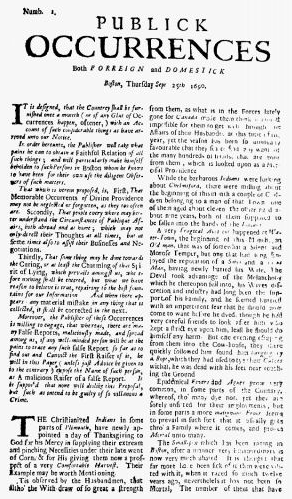
Publick_Occurrences_Both_Forreign_and_Domestick
Publick Occurrences Both Forreign and Domestick, the first newspaper to appear in the Americas, is published for the first and only time.
First multi-page newspaper printed in the Americas
Publick Occurrences Both Forreign and Domestick was the first multi-page newspaper published in British America. After its first issue, which carried an account that offended the colonial governor, the newspaper was promptly closed down by British colonial authorities, only days later. No other newspaper would appear in the colonies until fourteen years later.
1690
Unification_of_Nepal
Unification of Nepal
Series of battles that shaped modern day Nepal
The unification of Nepal was the process of building the modern Nepalese state, by invading fractured Malla kingdoms including the Baise Rajya's 22 kingdoms and the Chaubisi Rajya's 24 kingdoms. It began in 1743 CE, by Prithvi Narayan Shah, King of Gorkha. On 25 September 1768, he officially announced the creation of the Kingdom of Nepal and moved his capital from Gorkha to a city in Kathmandu Valley.
1768
American_Revolutionary_War
American Revolutionary War: Ethan Allen surrenders to British forces after attempting to capture Montreal in the Battle of Longue-Pointe during the invasion of Quebec.
1775–1783 conflict in North America
The American Revolutionary War, also known as the Revolutionary War or American War of Independence or simply the American Revolution, was the armed conflict that comprised the final eight years of the broader American Revolution, in which American Patriot forces organized as the Continental Army and commanded by George Washington defeated the British Army. The conflict was fought in North America, the Caribbean, and the Atlantic Ocean. The war's outcome seemed uncertain for most of the war, but Washington and the Continental Army's decisive victory in the Siege of Yorktown in 1781 led King George III and the Kingdom of Great Britain to negotiate an end to the war. In 1783, in the Treaty of Paris, the British monarchy acknowledged the independence of the Thirteen Colonies, leading to the establishment of the United States as an independent and sovereign nation.
1775
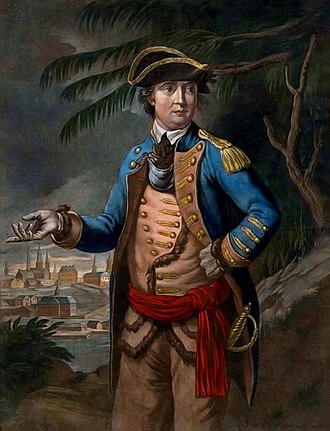
Benedict_Arnold
American Revolutionary War: Benedict Arnold's expedition to Quebec sets off to join the American invasion.
British military officer (1741–1801)
Benedict Arnold was an American-born British military officer who served during the American Revolutionary War. He fought with distinction for the American Continental Army and rose to the rank of major general before defecting to the British in 1780. General George Washington had given him his fullest trust and had placed him in command of West Point in New York. Arnold was planning to surrender the fort to British forces, but the plot was discovered in September 1780, whereupon he fled to the British lines. In the later part of the war, Arnold was commissioned as a brigadier general in the British Army and placed in command of the American Legion. He led British forces in battle against the army which he had once commanded, and his name became synonymous with treason and betrayal in the United States.
1775
Huancavelica
The mine of Huancavelica in the Peruvian Andes collapses, killing more than hundred people.
The event was a major setback for quicksilver production in the Spanish Empire.
Huancavelica or Wankawillka in Quechua is a city in Peru. It is the capital of the department of Huancavelica and according to the 2017 census had a population of 49,570 people. The city was established on August 5, 1572 by the Viceroy of Peru Francisco de Toledo. Indigenous peoples represent a major percentage of the population. It has an approximate altitude of 3,676 meters; the climate is cold and dry between the months of February and August with a rainy season between September and January. It is considered one of the poorest cities in Peru.
1786
United_States_Bill_of_Rights
The United States Congress passes twelve constitutional amendments: the ten known as the Bill of Rights, the (unratified) Congressional Apportionment Amendment, and the Congressional Compensation Amendment.
First ten amendments to the U.S. Constitution
The United States Bill of Rights comprises the first ten amendments to the United States Constitution. It was proposed following the often bitter 1787–88 debate over the ratification of the Constitution and written to address the objections raised by Anti-Federalists. The amendments of the Bill of Rights add to the Constitution specific guarantees of personal freedoms, such as freedom of speech, the right to publish, practice religion, possess firearms, to assemble, and other natural and legal rights. Its clear limitations on the government's power in judicial and other proceedings include explicit declarations that all powers not specifically granted to the federal government by the Constitution are reserved to the states or the people. The concepts codified in these amendments are built upon those in earlier documents, especially the Virginia Declaration of Rights (1776), as well as the Northwest Ordinance (1787), the English Bill of Rights (1689), and Magna Carta (1215).
1789
Hui_opera
Four Great Anhui Troupes introduce Anhui opera to Beijing in honor of the Qianlong Emperor's eightieth birthday.
Traditional Chinese opera
Anhui Opera, also known as Huiju [徽剧], is a traditional Chinese opera form that originated in Anhui Province during the Ming Dynasty. It is a crucial part of Huizhou culture and significantly contributed to the development of Peking Opera.
1790
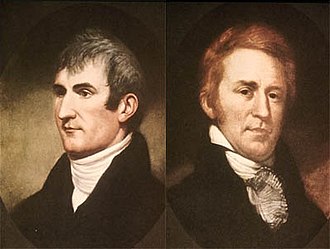
Lewis_and_Clark_Expedition
The Teton Sioux (a subdivision of the Lakota) demand one of the boats from the Lewis and Clark Expedition as a toll for allowing the expedition to move further upriver.
1804–1806 American expedition
The Lewis and Clark Expedition, also known as the Corps of Discovery Expedition, was the United States expedition to cross the newly acquired western portion of the country after the Louisiana Purchase. The Corps of Discovery was a select group of U.S. Army and civilian volunteers under the command of Captain Meriwether Lewis and his close friend Second Lieutenant William Clark. Clark, along with 30 others, set out from Camp Dubois, Illinois, on May 14, 1804, met Lewis and ten other members of the group in St. Charles, Missouri, then went up the Missouri River. The expedition crossed the Continental Divide of the Americas near the Lemhi Pass, eventually coming to the Columbia River, and the Pacific Ocean in 1805. The return voyage began on March 23, 1806, at Fort Clatsop, Oregon, ending six months later on September 23.
1804
Russian_frigate_Alexander_Nevsky
The Imperial Russian steam frigate Alexander Nevsky is shipwrecked off Jutland while carrying Grand Duke Alexei Alexandrovich of Russia.
Screw frigate of the Russian Imperial Navy
Alexander Nevsky was a large screw frigate of the Russian Imperial Navy. The ship was designed as part of a challenge being offered by the Russian Empire to the Royal Navy, but was lost in a shipwreck in 1868 while Grand Duke Alexei, son of Tsar Alexander II, was aboard.
1868
Sequoia_National_Park
The United States Congress establishes Sequoia National Park.
National park in California, United States
Sequoia National Park is a national park of the United States in the southern Sierra Nevada east of Visalia, California. The park was established on September 25, 1890, and today protects 404,064 acres of forested mountainous terrain. Encompassing a vertical relief of nearly 13,000 feet (4,000 m), the park contains the highest point in the contiguous United States, Mount Whitney, at 14,505 feet (4,421 m) above sea level. The park is south of, and contiguous with, Kings Canyon National Park; both parks are administered by the National Park Service together as Sequoia and Kings Canyon National Parks. UNESCO designated the areas as Sequoia-Kings Canyon Biosphere Reserve in 1976.
1890
Leonardo_Torres_Quevedo
Leonardo Torres Quevedo demonstrates the Telekino in the Bilbao Abra (Spain), guiding an electric boat from the shore with people on board, which was controlled at a distance over 2 km (1.2 mi), in what is considered to be the origin of modern wireless remote-control operation principles.
Spanish civil engineer (1852–1936)
Leonardo Torres Quevedo was a Spanish civil engineer, mathematician, and inventor who developed numerous engineering innovations related to aerial trams, airships, catamarans, and remote control. He was also a pioneer in the fields of computing and robotics, while maintaining an active role in several scientific and cultural institutions. He held prominent positions, such as Seat N of the Real Academia Española (1920–1936) and the presidency of the Spanish Royal Academy of Sciences (1928–1934). In 1927, he became a foreign associate of the French Academy of Sciences.
1906
French_battleship_Liberté
An explosion of badly degraded propellant charges on board the French battleship Liberté detonates the forward ammunition magazines and destroys the ship.
French lead ship of Liberté-class
Liberté was a pre-dreadnought battleship built for the French Navy in the mid-1900s. She was the lead ship of the Liberté class, which included three other vessels and was a derivative of the preceding République class, with the primary difference being the inclusion of a heavier secondary battery. Liberté carried a main battery of four 305-millimeter (12 in) guns, like the République, but mounted ten 194 mm (7.6 in) guns for her secondary armament in place of the 164 mm (6.5 in) guns of the earlier vessels. Like many late pre-dreadnought designs, Liberté was completed after the revolutionary British battleship HMS Dreadnought had entered service, rendering her obsolescent.
1911
Columbia University Graduate School of Journalism is founded in New York City.
Journalism school at Columbia University
The Columbia University Graduate School of Journalism is the journalism school of Columbia University, located in the Morningside Heights neighborhood of Manhattan, New York City, New York, United States.
1912
World_War_I
World War I: The Second Battle of Champagne begins.
Global conflict from 1914 to 1918
World War I, or the First World War, also known as the Great War, was a global conflict between two coalitions: the Allies and the Central Powers. Major theatres of war included Europe and the Middle East, and well as parts of Africa and the Asia-Pacific. One of the deadliest conflicts in history, World War I resulted in an estimated 15 to 22 million deaths, including in mass war crimes against civilians and genocides. The conflict saw important developments in weaponry, including the first large-scale use of machine guns, artillery, aircraft, chemical weapons, and tanks, and was a major factor in the deadly Spanish flu pandemic.
1915
Battle_of_Megiddo_(1918)
World War I: The end of the Battle of Megiddo, the climax of the British Army's Sinai and Palestine campaign under General Edmund Allenby.
Part of World War I
The Battle of Megiddo was fought between 19 and 25 September 1918, on the Plain of Sharon, in front of Tulkarm, Tabsor and Arara in the Judean Hills as well as on the Esdralon Plain at Nazareth, Afulah, Beisan, Jenin and Samakh. Its name, which has been described as "perhaps misleading" since very limited fighting took place near Tel Megiddo, was chosen by British commander Edmund Allenby for its biblical and symbolic resonance.
1918
Second_Sino-Japanese_War
Second Sino-Japanese War: The Chinese Eighth Route Army gains a minor, but morale-boosting victory in the Battle of Pingxingguan.
1937–1945 conflict in East Asia
The Second Sino-Japanese War, known in China as the War of Resistance Against Japan, was fought between the Republic of China and the Empire of Japan and its puppet states between 1937 and 1945, following a period of war localized to Manchuria that started in 1931. It is often regarded as the beginning of World War II in Asia, as the wars became heavily intertwined after Japan attacked the United States. It was the largest Asian war in the 20th century.
1937
World_War_II
World War II: Surviving elements of the British 1st Airborne Division withdraw from Arnhem via Oosterbeek.
Global conflict (1939–1945)
World War II, or the Second World War, was a global conflict between two coalitions: the Allies and the Axis powers. Nearly all of the world's countries participated. World War II was the deadliest conflict in history, causing the death of 60 to 75 million people. Millions died as a result of massacres, starvation, disease, and genocides, including the Holocaust. After the Allied victory, Germany, Austria, Japan, and Korea were occupied, and German and Japanese leaders were tried for war crimes.
1944
Royal_Jordanian_Air_Force
The Royal Jordanian Air Force is founded.
Air warfare branch of Jordan's military
The Royal Jordanian Air Force is the aerial warfare branch of the Jordanian Armed Forces. Founded in 1955, the RJAF serves as the primary air defense organization in Jordan, with the mission of defending the nation's airspace, providing ground support, and contributing to the broader national security strategy. Its role has expanded over the years from purely defensive operations to include peacekeeping, humanitarian support, and active participation in regional coalitions.
1955
TAT-1
TAT-1, the first submarine transatlantic telephone cable system, is inaugurated.
First trans-Atlantic telephone cable
TAT-1 was the first submarine transatlantic telephone cable system. It was laid between Kerrera, Oban, Scotland, and Clarenville, Newfoundland. Two cables were laid between 1955 and 1956 with one cable for each direction. It was inaugurated on September 25, 1956. The cable was able to carry 35 simultaneous telephone calls. A 36th channel was used to carry up to 22 telegraph lines.
1956
Little_Rock_Central_High_School
Central High School in Little Rock, Arkansas, is integrated by the use of United States Army troops.
School and historic site in Arkansas, US
Little Rock Central High School (LRCH) is an accredited comprehensive public high school in Little Rock, Arkansas, United States. The school was the site of the Little Rock Crisis in 1957 after the U.S. Supreme Court ruled that segregation by race in public schools was unconstitutional three years earlier. This was during the period of heightened activism in the civil rights movement.
1957
S._W._R._D._Bandaranaike
S.
W. R. D. Bandaranaike, Prime Minister of Ceylon, is mortally shot by a Buddhist monk, Talduwe Somarama, and dies the next day.
Solomon West Ridgeway Dias Bandaranaike, also known as "The Silver Bell of Asia", was a Sri Lankan statesman who served as the fourth Prime Minister of the Dominion of Ceylon, serving from 1956 until his assassination in 1959. The founder of the left-wing and Sinhalese nationalist Sri Lanka Freedom Party, he was elected the fourth Prime Minister of Ceylon after creating a powerful coalition called the Mahajana Eksath Peramuna and contesting on the lines of Sinhalese nationalism and democratic socialism. He achieved a landslide victory over the ruling United National Party in the general elections in 1956.
1959
Algeria
The People's Democratic Republic of Algeria is formally proclaimed.
Ferhat Abbas is elected President of the provisional government.
Algeria, officially the People's Democratic Republic of Algeria, is a country in the Maghreb region of North Africa. Spanning over 2,381,741 square kilometres (919,595 sq mi), it is the largest country in Africa and the tenth largest in the world. It is bordered to the northeast by Tunisia; to the east by Libya; to the southeast by Niger; to the southwest by Mali, Mauritania, and Western Sahara; to the west by Morocco; and to the north by the Mediterranean Sea. With a population of over 47 million, Algeria is the tenth-most populous country in Africa. Its capital and largest city is Algiers.
1962
North_Yemen_civil_war
The North Yemen Civil War begins when Abdullah al-Sallal dethrones the newly crowned Imam al-Badr and declares Yemen a republic under his presidency.
1962–1970 conflict
The North Yemen civil war, also known in Yemen as the 26 September Revolution, was a civil war fought in North Yemen from 1962 to 1970 between partisans of the Mutawakkilite Kingdom and supporters of the Yemen Arab Republic. The war began with a coup d'état carried out in 1962 by revolutionary republicans led by the army under the command of Abdullah al-Sallal. He dethroned the newly crowned King and Imam Muhammad al-Badr and declared Yemen a republic under his presidency. His government abolished slavery in Yemen. The Imam escaped to the Saudi Arabian border where he rallied popular support from northern Zaydi tribes to retake power, and the conflict rapidly escalated to a full-scale civil war.
1962
Tom_Denning,_Baron_Denning
Lord Denning releases the UK government's official report on the Profumo affair.
English lawyer and judge (1899–1999)
Alfred Thompson Denning, Baron Denning,, was an English barrister and judge. He was called to the Bar of England and Wales in 1923 and became a King's Counsel in 1938. Denning became a judge in 1944 when he was appointed to the Probate, Divorce and Admiralty Division of the High Court of Justice, and transferred to the King's Bench Division in 1945. He was made a Lord Justice of Appeal in 1948 after less than five years in the High Court. He became a Lord of Appeal in Ordinary in 1957 and after five years in the House of Lords returned to the Court of Appeal as Master of the Rolls in 1962, a position he held for 20 years. In retirement he wrote several books and continued to offer opinions on the state of the common law through his writing and his position in the House of Lords.
1963
Mozambican_War_of_Independence
The Mozambican War of Independence against Portugal begins.
1964–1974 armed conflict in Southeastern Africa
The Mozambican War of Independence was an armed conflict between the guerrilla forces of the Mozambique Liberation Front (FRELIMO) and Portugal. The war officially started on 25 September 1964, and ended with a ceasefire on 8 September 1974, resulting in a negotiated independence in 1975.
1964
Organisation_of_Islamic_Cooperation
The charter establishing the Organisation of Islamic Cooperation is signed.
International organisation
The Organisation of Islamic Cooperation, formerly the Organisation of the Islamic Conference, is an intergovernmental organisation founded in 1969. It consists of 57 member states, 48 of which are Muslim-majority. The organisation claims to be "the collective voice of the Muslim world" and works to "safeguard and protect the interests of the Muslim world in the spirit of promoting international peace and harmony".
1969
Frank_Jobe
Dr.
Frank Jobe performs first ulnar collateral ligament replacement surgery (better known as Tommy John surgery) on baseball player Tommy John.
Frank Wilson Jobe was an American orthopedic surgeon and co-founder of the Kerlan-Jobe Orthopaedic Clinic. Jobe pioneered both elbow ligament replacement and major reconstructive shoulder surgery for baseball players.
1974
Chicago_Marathon
About 4,200 people take part in the first running of the Chicago Marathon.
Annual footrace held in Chicago, Illinois, US
The Chicago Marathon is a road marathon held in October in Chicago, Illinois. It is one of the seven World Marathon Majors. Thus, it is also a World Athletics Label Road Race. The Chicago Marathon is one of the largest races by number of finishers worldwide. The race was awarded the World Athletics Heritage Plaque in 2024, for "outstanding contribution to the history and development of road running."
1977
Pacific_Southwest_Airlines_Flight_182
PSA Flight 182, a Boeing 727, collides in mid-air with a Cessna 172 and crashes in San Diego, killing all 135 aboard Flight 182, both occupants of the Cessna, as well as seven people on the ground.
1978 mid-air collision over California
Pacific Southwest Airlines Flight 182 was a Pacific Southwest Airlines (PSA) flight on September 25, 1978 from Sacramento (SMF) to San Diego (SAN), with a stopover at Los Angeles (LAX). The aircraft involved were a Boeing 727-214 and a private Cessna 172 which collided mid-air over San Diego. It was PSA's first fatal accident and it remains the deadliest air disaster in California history. At the time, it was the deadliest air crash to occur in the United States and remained so until the crash of American Airlines Flight 191 in May 1979. Excluding intentional crashes, it currently stands as the seventh-deadliest to occur on American soil.
1978
Belize
Belize joins the United Nations.
Country in Central America
Belize is a country on the north-eastern coast of Central America. It is bordered by Mexico to the north, the Caribbean Sea to the east, and Guatemala to the west and south. It also shares a maritime boundary with Honduras to the southeast. Part of the Caribbean region, Belize is a member of the Caribbean Community (CARICOM) and the Commonwealth Caribbean, the historical British West Indies.
1981
Thirty-eight IRA prisoners, armed with six handguns, hijack a prison meals lorry and smash their way out of the Maze Prison.
1983 prison break in Northern Ireland
The Maze Prison escape took place on 25 September 1983 in County Antrim, Northern Ireland. HM Prison Maze was a maximum security prison considered to be one of the most escape-proof prisons in Europe. It held prisoners suspected of taking part in armed paramilitary campaigns during the Troubles, with separate wings for loyalists and for republicans. In the biggest prison escape in UK peacetime history, 38 Provisional Irish Republican Army (IRA) prisoners escaped from H-Block 7 (H7) of the prison. One prison officer died of a heart attack during the escape and twenty others were injured, including two who were shot with guns that had been smuggled into the prison.
1983
Palestine_Liberation_Organization
3 civilians killed by alleged supporters of the Palestine Liberation Organization in Larnaca yacht killings.
Official representative of Palestinians
The Palestine Liberation Organization is a Palestinian nationalist coalition that is internationally recognized as the official representative of the Palestinian people in the occupied Palestinian territories. It is currently represented by the Palestinian Authority based in the West Bank city of Al-Bireh.
1985
Penaia_Ganilau
Fijian Governor-General Penaia Ganilau is overthrown in a coup d'état led by Lieutenant colonel Sitiveni Rabuka.
President of Fiji from 1987 to 1993
Ratu Sir Penaia Kanatabatu Ganilau was a Fijian politician who served as the first President of Fiji, serving from 8 December 1987 until his death in 1993. He had previously served as Governor-General of Fiji, representing Elizabeth II, Queen of Fiji, from 12 February 1983 to 15 October 1987.
1987
NASA
NASA launches the Mars Observer.
Eleven months later, the probe would fail while preparing for orbital insertion.
The National Aeronautics and Space Administration is an independent agency of the U.S. federal government responsible for the United States' civil space program, as well as research in aeronautics and space. Headquartered in Washington, D.C., NASA operates ten field centers across the US and is organized into three mission directorates: Human Spaceflight, Research and Technology, and Science. Established in 1958 amid the Space Race, NASA succeeded the National Advisory Committee for Aeronautics (NACA) to give the US space program a distinct civilian orientation focused on peaceful applications. Since then, it has led most American spaceflight programs, including Project Mercury, Project Gemini, the Apollo program, Skylab, the Space Shuttle, the International Space Station (ISS), and the ongoing multi-national Artemis program.
1992
Space_Shuttle_Atlantis
NASA launches Space Shuttle Atlantis on STS-86 to the Mir space station.
Space Shuttle orbiter (1985–2011)
Space Shuttle Atlantis is a retired Space Shuttle orbiter vehicle which belongs to NASA, the spaceflight and space exploration agency of the United States. Atlantis was manufactured by the Rockwell International company in Southern California and was delivered to the Kennedy Space Center in Eastern Florida in April 1985. Atlantis is the fourth operational and the second-to-last Space Shuttle built. Its maiden flight was STS-51-J made from October 3 to 7, 1985.
1997
PauknAir_Flight_4101
PauknAir Flight 4101, a British Aerospace 146, crashes near Melilla Airport in Melilla, Spain, killing 38 people.
1998 aviation accident
PauknAir Flight 4101 was a British Aerospace 146 that crashed on a flight from Málaga, Spain, to the Spanish North African exclave of Melilla on 25 September 1998. All 38 passengers and crew on board the aircraft were killed in the accident.
1998
2003_Tokachi_earthquake
The 8.3 Mw Hokkaidō earthquake strikes just offshore Hokkaidō, Japan.
Earthquake in Japan
The 2003 Tokachi earthquake, known in Japanese as the 2003 Tokachi-Oki earthquake , occurred off the coast of Hokkaido, Japan on 26 September at 04:50 local time. At a focal depth of 27 km (17 mi), this great undersea earthquake measured 8.3 on the moment magnitude scale, making it the most powerful earthquake of 2003, as well as one of the most intense earthquakes to hit Japan since modern record-keeping began in 1900.
2003
Bill_Cosby
Bill Cosby is sentenced to three to ten years in prison for aggravated sexual assault.
American entertainer (born 1937)
William Henry Cosby Jr. is an American former comedian, actor, and media personality. Often deemed a trailblazer for African Americans in the entertainment industry, Cosby was well known in the United States for his stand-up comedy routines and television career before achieving global recognition for his portrayal of Cliff Huxtable in the sitcom The Cosby Show (1984–1992). He was also prolific in advertising for decades and was the recipient of numerous awards and honorary degrees throughout his career, many of which were revoked after dozens of allegations of sexual assault were made against him, starting in 2014 and culminating in a 2018 conviction for aggravated indecent assault.
2018

History runs on facts, and this project runs on coffee!

Your support is incredibly helpful and genuinely appreciated.

Support with a coffee ☕