
People in this story


Explore this event
 The wider storyHow did the Lesotho military surround State House without declaring a coup?On August 30, 2014, the Lesotho Defence Force executed a series of coordinated moves in Maseru that paralyzed the government without an official declaration of coup. This analysis details the tactical sequence…Read the full history
 Key facts about the 2014 Lesotho political crisis
| Event | Prime Minister Tom Thabane flees to South Africa |
|---|---|
| Date | August 30, 2014 |
| Location | Maseru, Lesotho |
| Key Figure | Tom Thabane |
| Source Detail | Gunshots were heard in Maseru at about 3:00 on the day of the alleged coup. |
| Confirmed Outcome | Deputy Prime Minister Mothetjoa Metsing assumed responsibility for running the government the next day. |

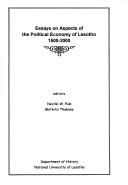 Essays on aspects of the political economy of LesothoMotlatsi Thabane
 Government and change in Lesotho, 1800-1966L. B. B. J. Machobane
 Lesotho and the struggle for AzaniaBernard Leeman
 Dreams for LesothoJohn Aerni-Flessner
 Politics -Fangruida.----- Political Science and Political Philosophy -World Order and Global GovernanceView on Amazon
Reports From the Front
At approximately 3:00 on August 30, 2014, gunshots were heard in Maseru, the capital of Lesotho. Sports Minister Thesele Maseribane provided a detailed account of the situation, stating that soldiers had surrounded State House, as well as government and police headquarters. He noted that an unnamed military commander was searching for Thabane and Mothetjoa Metsing to take to the king. Maseribane described this action as indicative of a coup, yet he insisted that Thabane's government remained in control of the country. The presence of a reinforced military contingent guarding Thabane's official residence further underscored the severity of the situation. In response, the South African government said it was concerned about Lesotho’s political and security crisis and the prorogation of the country’s parliament.
Soldiers patrolled Maseru's streets and disarmed police forces. Thabane fled to South Africa fearing for his life, telling The Guardian he would return only when safety was assured. He called for South African peacekeeping troops to intervene against the military seizure of power.
Timeline: the road to South Africa and its aftermath
- 2012 Tom Thabane elected prime minister after general election
- June 19, 2014 Thabane suspends parliament with sanction from King Letsie III
- August 30, 2014 Tom Thabane flees to South Africa amid alleged coup
- August 31, 2014 Deputy Prime Minister Mothetjoa Metsing assumes government responsibility
- February 2015 Early election held following South African-led SADC mediation
The Military and Political Fallout
The immediate political transition occurred on August 31, 2014, when Deputy Prime Minister Mothetjoa Metsing formally assumed responsibility for running the government. This shift in leadership followed the previous day's events where an unnamed military commander sought to present Thabane and Metsing to King Letsie III. Metsing had earlier indicated his intention to form a new government if Thabane were removed from power. This assumption of duty happened the day after the alleged coup attempt began. No other specific administrative actions or legal proceedings are detailed in the provided text regarding the interim period between Thabane's departure and the subsequent electoral process. The record focuses strictly on the transfer of executive responsibility to the deputy prime minister as the primary documented outcome of the initial crisis phase.
The resolution of the political standoff involved external mediation led by South Africa and the Southern African Development Community. These regional bodies had previously warned against unconstitutional changes of government, citing concerns over the security situation in Maseru. The source explicitly links this election to the SADC mediation process. No further details regarding the specific terms of the mediation agreement or the immediate post-election governance structure are provided in the text. The electoral outcome transferred power to the opposition coalition, effectively ending Thabane's tenure as prime minister and restoring a civilian government through democratic means rather than military rule.
Thabane's suspension of parliament in June 2014 precipitated the August crisis, which ended with his exile and the eventual transfer of power to the opposition through SADC-mediated elections.
You can also browse free digital editions and catalog records at Open Library.
Analysis: 2014 Lesotho political crisis
What the evidence supports and leaves unresolved
What the record supports
- Regional Diplomatic Intervention: The record documents that South Africa and the Southern African Development Community issued explicit warnings against unconstitutional changes of government in Lesotho. These regional bodies expressed grave concern over the unusual movements of Lesotho Defence Force units in Maseru. The source confirms that South African-led SADC mediation was the direct mechanism that resulted in an early election being held in February 2015, providing a concrete institutional response to the political instability.
- Clear Chronological Sequence: The timeline distinguishes between political maneuvers and security actions: Thabane suspended parliament on June 19, 2014, to avoid a vote of confidence, while the alleged coup on August 30 involved soldiers surrounding State House and disarming police.
- Specific Official Testimony: The account relies on the specific testimony of Sports Minister Thesele Maseribane, who detailed the military presence around State House and government headquarters. His statement that an unnamed military commander was seeking to take Thabane and Metsing to the king provides a concrete, named source for the allegations of a coup, grounding the narrative in the direct observations of a high-ranking government official during the crisis.
Limits and unresolved questions
- Unresolved Military Intent: In the 2014 Lesotho political crisis source record, the record does not clarify the specific intentions of the unnamed military commander who sought to take Thabane and Metsing to the king. While the city calmed later in the day, residents stayed home.
- Lack of Immediate Outcome: The record does not specify the immediate outcome of Thabane's call for South African peacekeeping troops or the specific military response to his flight. While it notes that he fled to South Africa amid fear for his life, the source does not detail the security measures taken to protect him upon arrival or the immediate diplomatic negotiations that occurred between the two nations during the critical first 24 hours of the crisis.
- Vague Interim Governance: The source provides limited detail on the administrative actions taken by Deputy Prime Minister Mothetjoa Metsing after assuming responsibility for the government on August 31, 2014. Meanwhile, in addition to South Africa, the Southern African Development Community also warned the political rivals of unconstitutional changes of government which would not be tolerated.
Our reading begins with the verified sequence: Prime Minister Tom Thabane flees to South Africa on August 30, 2014 at Maseru, Lesotho. The record confirms Gunshots were heard in Maseru at about 3:00 on the day of the alleged coup. It also records Deputy Prime Minister Mothetjoa Metsing assumed responsibility for running the government the next day. A responsible account stops there; it does not supply motives, a neat moral, or a verdict that the evidence cannot support. The value of revisiting this event lies in that restraint: precise details, clearly attributed actions, and a visible boundary between documented history and later interpretation.
Evidence Map: How We Checked the Central Claim
What the sources verify and how they were used
This comparison separates the event page selected for the account from the independently verified page used to corroborate it.
Central claim checked: Prime Minister of Lesotho Tom Thabane flees to South Africa as the army allegedly stages a coup.
| Direct source | Verification role | Coverage |
|---|---|---|
| 2014 Lesotho political crisis · Wikipedia Accessed 2026-08-30 | Selected event record | Supports the central claim shown above. |
| Lesotho · theguardian.com Accessed 2026-08-30 | Independent corroboration | Supports the central claim shown above. |
You Might Also Like
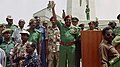

What caused the 2014 Lesotho political crisis?
The lead-up included Tom Thabane elected prime minister after general election; Thabane suspends parliament with sanction from King Letsie III.
Key figures included Tom Thabane, Mothetjoa Metsing.
In the aftermath: Deputy Prime Minister Mothetjoa Metsing assumes government responsibility; Early election held following South African-led SADC mediation.
The record documents that South Africa and the Southern African Development Community issued explicit warnings against unconstitutional changes of government in Lesotho.