July 11 in History

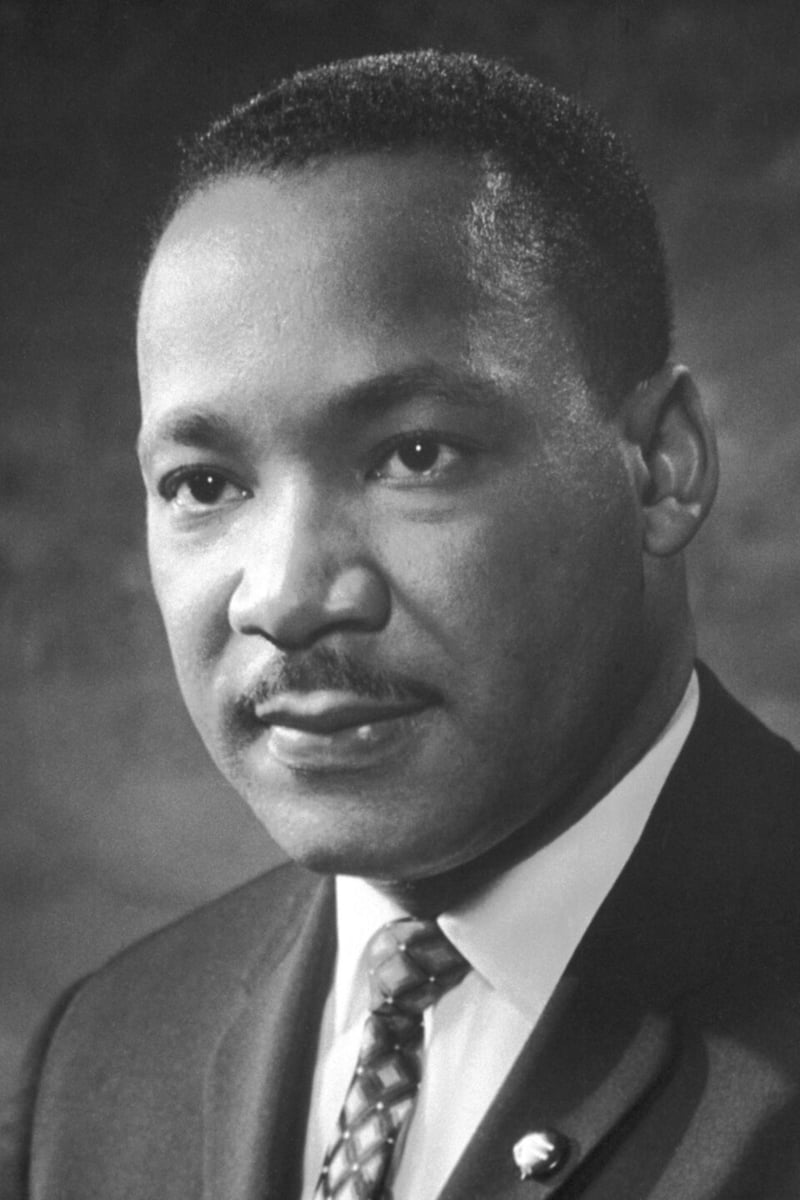
Martin Luther King Jr., assassinated in 1968, is posthumously awarded the Presid

1977 — Martin Luther King Jr

, assassinated in 1968, is posthumously awarded the Presidential Medal of Freedom.

July 11 spans 71 recorded events across recorded history, from 472 to 2021. Below is a curated digest of the most significant moments tied to this date.

By · Wikipedia

Historical Events 71 events 472 – 2021

More major events on July 11

The featured story and these ranked highlights form a quick summary. Every recorded event remains available in the chronology below.

  1. 1960 To Kill a Mockingbird by Harper Lee is first published, in the United States. Source
  2. 1940 World War II: Vichy France regime is formally established. Philippe Pétain becomes Chief of the French State. Source
  3. 1914 The US Navy launches the USS Nevada (BB-36) as its first standard-type battleship. Source

Did you know

The Presidential Medal of Freedom was established by President John F. Kennedy in 1963 through Executive Order 11085.
Did you know

The medal is awarded by the President of the United States to recognize individuals who have made significant contributions to national security, world peace, or cultural endeavors.

Did you know

The Presidential Medal of Freedom is considered the highest civilian honor in the United States, alongside the Congressional Gold Medal.

Did you know

Recipients of the Presidential Medal of Freedom include notable figures such as Nelson Mandela, Rosa Parks, and Stephen Hawking.

Did you know

The medal is designed by Antonucci and is made of gold, with a blue enamel ring and a white enamel star, symbolizing the principles of freedom and democracy.


Roman_emperor
Western Roman Emperor Anthemius is killed by troops of the Roman Gothic general Ricimer.
Ruler of the Roman Empire
The Roman emperor was the ruler of the Roman Empire, starting with the granting of the title augustus to Octavian in 27 BC. The title of imperator, originally a military honorific, was usually used alongside caesar, originally a cognomen. When a given Roman is described as becoming emperor in English, it generally reflects his accession as augustus, and later as basileus. Early emperors also used the title princeps alongside other Republican titles, notably consul and pontifex maximus.
472
Michael_I_Rangabe
Byzantine emperor Michael I, under threat by conspiracies, abdicates in favor of his general Leo the Armenian, and becomes a monk (under the name Athanasius).
Byzantine emperor from 811 to 813
Michael I Rangabe was Byzantine emperor from 811 to 813. A courtier of Emperor Nikephoros I, he survived the disastrous campaign against the Bulgars and was preferred as imperial successor over Staurakios, who was severely injured. He was proclaimed emperor by Patriarch Nicephorus I of Constantinople on 2 October 811.
813
AD_911
Signing of the Treaty of Saint-Clair-sur-Epte between Charles the Simple and Rollo of Normandy.
Calendar year
911 (CMXI) was a common year starting on Tuesday of the Julian calendar.
911
Baldwin_IV_of_Jerusalem
Baldwin IV, 13, becomes King of Jerusalem, with Raymond III, Count of Tripoli as regent and William of Tyre as chancellor.
King of Jerusalem from 1174 to 1185
Baldwin IV (1161–1185), known as the Leper King, was the king of Jerusalem from 1174 until his death in 1185. Baldwin ascended to the throne when he was thirteen despite having leprosy. He launched several attempts to curb the increasing power of the Muslim ruler Saladin, though much of his life was marked by infighting amongst the kingdom's nobles. Throughout his reign, and especially at the end of his life, he was troubled by his succession, working to select a suitable heir and prevent a succession crisis. Choosing competent advisers, Baldwin ruled a thriving crusader state, protecting it from Saladin.
1174
July_1276_conclave
Election of pope Adrian V under the influence of Charles I of Anjou following the death of pope Gregory X earlier that year.
Adrian V dies the following month.
A papal conclave was held from 2–11 July 1276 to elect a new pope to succeed Pope Innocent V who had died suddenly. Following the nine-day conclave, Ottobuono Fieschi, the Cardinal-Deacon of Sant'Adriano al Foro, was elected to succeed him.
1276
Battle_of_the_Golden_Spurs
Battle of the Golden Spurs (Guldensporenslag in Dutch): A coalition around the Flemish cities defeats the king of France's royal army.
1302 battle of the Franco-Flemish War
The Battle of the Golden Spurs or 1302 Battle of Courtrai was a military confrontation between the royal army of France and rebellious forces of the County of Flanders on 11 July 1302 during the 1297–1305 Franco-Flemish War. It took place near the town of Kortrijk in modern-day Belgium and resulted in an unexpected victory for the Flemish.
1302
Charles_IV,_Holy_Roman_Emperor
Charles IV, Count of Luxembourg and King of Bohemia, is elected King of the Romans.
Holy Roman Emperor from 1355 to 1378
Charles IV was Holy Roman Emperor from 1355 until his death in 1378. He was elected King of Germany in 1346 and became King of Bohemia that same year. He was a member of the House of Luxembourg from his father's side and the Bohemian House of Přemyslid from his mother's side; he emphasized the latter due to his lifelong affinity for the Bohemian side of his inheritance, and also because his direct ancestors in the Přemyslid line included two saints.
1346
Ming_dynasty
Ming admiral Zheng He sets sail to explore the world for the first time.
Imperial dynasty of China (1368–1644)
The Ming dynasty, officially the Great Ming, was an imperial dynasty of China that ruled from 1368 to 1644, following the collapse of the Mongol-led Yuan dynasty. The Ming was the last imperial dynasty of China ruled by the Han people, the majority ethnic group in China. Although the primary capital of Beijing fell in 1644 to a rebellion led by Li Zicheng, numerous rump regimes ruled by remnants of the Ming imperial family, collectively called the Southern Ming, survived until 1662.
1405
Ottoman_Interregnum
Ottoman Interregnum: Süleyman Çelebi defeats his brother Musa Çelebi outside the Ottoman capital, Edirne.
Civil war in the early 15th century Ottoman Empire
The Ottoman Interregnum, or Ottoman Civil War, was a civil war in the Ottoman realm between the sons of the Ottoman sultan Bayezid I following their father's defeat and capture by Timur in the Battle of Ankara on 28 July 1402. Although Timur confirmed Mehmed Çelebi as sultan, Mehmed's brothers refused to recognize his authority, each claiming the throne for himself, which resulted in civil war. The Interregnum would last a little under 11 years and culminate in the Battle of Çamurlu on 5 July 1413, when Mehmed Çelebi emerged as victor, crowned himself Sultan Mehmed I, and restored the empire.
1410
Pope_Julius_II
Giuliano della Rovere is appointed bishop of Coutances.
Head of the Catholic Church from 1503 to 1513
Pope Julius II was head of the Catholic Church and leader of the Papal States from 1503 to his death, in February 1513.
1476
Atlantic_Ocean
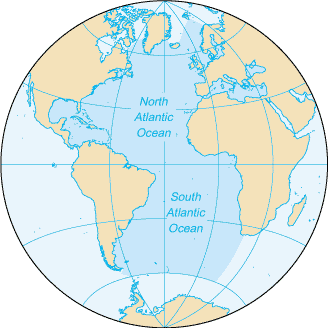
While exploring the North Atlantic Ocean in an attempt to find the Northwest Passage, Martin Frobisher sights Greenland, mistaking it for the hypothesized (but non-existent) island of "Frisland".
Oceanic division
The Atlantic Ocean is the second largest of the world's five oceanic divisions, with an area of about 85,133,000 square kilometers (32,870,000 sq mi). It covers approximately 17% of Earth's surface and about 24% of its water surface area. During the Age of Discovery, it was known for separating the New World of the Americas from the Old World of Afro-Eurasia.
1576
Samuel_de_Champlain
Samuel de Champlain returns to Quebec.
French explorer of North America (1574–1635)
Samuel de Champlain was a French explorer, navigator, cartographer, soldier, geographer, diplomat, and chronicler who founded Quebec City and established New France as a permanent French colony in North America.
1616
John_Churchill,_1st_Duke_of_Marlborough
A coalition army of Dutch, English and German troops under the duke of Marlborough defeats a French army under the duke of Burgundy and the Marshal Vendome in the battle of Oudenarde.
British army officer and statesman (1650–1722)
General John Churchill, 1st Duke of Marlborough, 1st Prince of Mindelheim, 1st Count of Nellenburg, Prince of the Holy Roman Empire was a British army officer and statesman. From a gentry family, he served as a page at the court of the House of Stuart under James, Duke of York, through the 1670s and early 1680s, earning military and political advancement through his courage and diplomatic skill. He is known for never having lost a battle.
1708
Dwarf_planet
Mathematical calculations suggest that it is on this day that dwarf planet Pluto moved inside the orbit of Neptune for the last time before 1979.
Small planetary-mass object
A dwarf planet is a small planetary-mass object that is in direct orbit around the Sun, massive enough to be gravitationally rounded, but insufficient to achieve orbital dominance like the eight classical planets of the Solar System. The prototypical dwarf planet is Pluto, which for decades was regarded as a planet before the "dwarf" concept was adopted in 2006. Many planetary geologists consider dwarf planets and planetary-mass moons to be planets, but since 2006 the IAU and many astronomers have excluded them from the roster of planets.
1735
Jacques_Necker
Jacques Necker is dismissed as France's Finance Minister sparking the Storming of the Bastille.
French statesman (1732–1804)
Jacques Necker was a Genevan banker, financier and statesman who served as finance minister of France for Louis XVI. He was a reformer, but his innovations sometimes caused great discontent. Necker was a constitutional monarchist, a political economist, and a moralist, who wrote a severe critique of the new principle of equality before the law.
1789
Detroit
The United States takes possession of Detroit from Great Britain under terms of the Jay Treaty.
Most populous city in Michigan, United States
Detroit is the most populous city in the U.S. state of Michigan. It is situated on the bank of the Detroit River across from the Canadian city of Windsor, Ontario. It is the 26th-most populous city in the United States and the largest U.S. city on the Canada–United States border, with a population of 639,111 at the 2020 census, and an estimated 2025 population of 649,095. The Metro Detroit area, at over 4.4 million people, is the 14th-largest metropolitan area in the nation and second-largest in the Midwest. The county seat of Wayne County, Detroit is a significant cultural center known for its contributions to music, art, architecture, and design, in addition to its historical automotive and industrial background.
1796
United_States_Marine_Corps
The United States Marine Corps is re-established; they had been disbanded after the American Revolutionary War.
Naval infantry branch of the U.S. military
The United States Marine Corps (USMC), also referred to as the United States Marines or simply the Marines, is the naval infantry service branch of the United States Armed Forces. The service is responsible for conducting expeditionary and amphibious warfare through combined arms, implementing its own infantry, artillery, aerial, and special operations forces. The U.S. Marine Corps is a part of the United States Department of Defense and is one of the six armed forces of the United States and one of the eight uniformed services of the United States.
1798
Jean-Louis_Pons
French astronomer Jean-Louis Pons makes his first comet discovery.
In the next 27 years he discovers another 36 comets, more than any other person in history.
Jean-Louis Pons was a French astronomer. Despite humble beginnings and being self-taught, he went on to become the greatest visual comet discoverer of all time: between 1801 and 1827 Pons discovered thirty-seven comets, more than any other person in history.
1801
Burr–Hamilton_duel
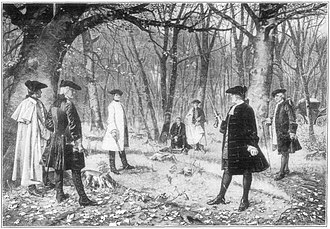
A duel occurs in which the Vice President of the United States Aaron Burr mortally wounds former Secretary of the Treasury Alexander Hamilton.
1804 duel between Aaron Burr and Alexander Hamilton
The Burr–Hamilton duel took place in Weehawken, New Jersey, between Aaron Burr, the U.S. vice president at the time, and Alexander Hamilton, the first and former secretary of the treasury, at dawn on July 11, 1804. The duel was the culmination of a bitter rivalry that had developed over years between both men, who were high-profile politicians in the newly-established United States, founded following the victorious American Revolution and its associated Revolutionary War. It is one of the most famous duels in American history.
1804
Noongar
Noongar Australian aboriginal warrior Yagan, wanted for the murder of white colonists in Western Australia, is killed.
Group of Aboriginal peoples of southwestern Australia
The Noongar are Aboriginal Australian people who live in the south-west corner of Western Australia, from Geraldton on the west coast to Esperance on the south coast. There are 14 different groups in the Noongar cultural bloc: Amangu, Ballardong, Yued, Kaneang, Koreng, Mineng, Njakinjaki, Njunga, Pibelmen, Pindjarup, Wadandi, Whadjuk, Wiilman and Wudjari. The Noongar people refer to their land as Noongar boodja.
1833
The_Fly-fisher's_Entomology
The Fly-fisher's Entomology is published by Alfred Ronalds.
The book transformed the sport and went to many editions.
The Fly-Fisher's Entomology, Illustrated by Coloured Representations of the Natural and Artificial Insect and Accompanied by a Few Observations and Instructions Relative to Trout-and-Grayling Fishing, first published in 1836 by Alfred Ronalds (1802–1860), was the first comprehensive work related to the entomology associated with fly fishing. Although the work was Ronalds' only book, it was published in 11 editions between 1836 and 1913 and has been extensively reprinted in the last 100 years.
1836
London_Waterloo_station
Waterloo railway station in London opens.
Central London terminus on the National Rail network in the United Kingdom
Waterloo station, also known as London Waterloo, is a major central London railway terminus on the National Rail network in the United Kingdom, in the Waterloo area of the London Borough of Lambeth. It is connected to a London Underground station of the same name and is adjacent to Waterloo East station on the South Eastern Main Line. The station is the terminus of the South West Main Line to Weymouth via Southampton, the West of England main line to Exeter via Salisbury, the Portsmouth Direct line to Portsmouth Harbour which connects with ferry services to the Isle of Wight, and several commuter services around west and south-west London, Surrey, Hampshire and Berkshire.
1848
American_Civil_War
American Civil War: Battle of Fort Stevens; Confederate forces attempt to invade Washington, D.C.
1861–1865 conflict in the United States
The American Civil War was a civil war in the United States between the Union and the Confederacy, which was formed in 1861 by states that had seceded from the Union to preserve slavery in the United States. The South saw slavery as threatened because of the election of Abraham Lincoln and the growing abolitionist movement in the North. The war ended with Union victory, the dissolution of the Confederacy and the abolition of slavery, freeing four million African Americans.
1864
Mediterranean_Fleet
The British Mediterranean Fleet begins the Bombardment of Alexandria in Egypt as part of the Anglo-Egyptian War.
Formation of the Royal Navy, active from 1654 to 1967
The British Mediterranean Fleet, also known as the Mediterranean Station, was a formation of the Royal Navy. The Fleet was one of the most prestigious commands in the navy for the majority of its history, defending the vital sea link between the United Kingdom and India. General at Sea Robert Blake was appointed as the first commander in September 1654. The Fleet was in existence until 1967.
1882
Tijuana
Tijuana, Mexico, is founded.
Largest city in Baja California, Mexico
Tijuana is the most populous city of the Mexican state of Baja California, located on the northwestern Pacific Coast of Mexico. It is the municipal seat of the Tijuana Municipality, the hub of the Tijuana metropolitan area and the most populous city in northern Mexico. Tijuana is just south of California and is adjacent to the Mexico–United States border which is part of the San Diego–Tijuana metro area.
1889
Pearl
The first cultured pearl is obtained by Kōkichi Mikimoto.
Hard object produced within a living shelled mollusc
A pearl is a hard, glistening object produced within the soft tissue of a living shelled mollusk or another animal, such as fossil conulariids. Just like the shell of a mollusk, a pearl is composed of calcium carbonate in minute crystalline form, which is deposited in concentric layers. More commercially valuable pearls are perfectly round and smooth, but many other shapes, known as baroque pearls, can occur. The finest quality of natural pearls have been highly valued as gemstones and objects of beauty for many centuries. Because of this, pearls have become a metaphor for something rare, fine, admirable, and valuable.
1893
Revolution
A revolution led by the liberal general and politician José Santos Zelaya takes over state power in Nicaragua.
Rapid and fundamental political change
In political science, a revolution is a rapid, fundamental transformation of a society's class, state, ethnic, or religious structures. According to the sociologist Jack Goldstone, all revolutions contain "a common set of elements at their core: (a) efforts to change the political regime that draw on a competing vision of a just order, (b) a notable degree of informal or formal mass mobilization, and (c) efforts to force change through noninstitutionalized actions such as mass demonstrations, protests, strikes, or violence."
1893
Salomon_August_Andrée
Salomon August Andrée leaves Spitsbergen to attempt to reach the North Pole by balloon.
Swedish engineer, physicist, and explorer (1854–1897)
Salomon August Andrée, during his lifetime most often known as S. A. Andrée, was a Swedish engineer, physicist, aeronaut and polar explorer who died while leading an attempt to reach the Geographic North Pole by hydrogen balloon. The balloon expedition was unsuccessful in reaching the Pole and resulted in the deaths of all three of its participants.
1897
Fiat
Fiat founded by Giovanni Agnelli in Turin, Italy.
Italian automobile manufacturer
Fiat Automobiles S.p.A., commonly known as Fiat, is an Italian automobile manufacturer.
1899
Murder_of_Grace_Brown
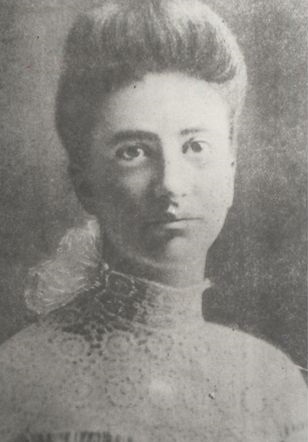
Murder of Grace Brown by Chester Gillette in the United States, inspiration for Theodore Dreiser's An American Tragedy.
1906 homicide in Big Moose Lake, New York
Grace Mae Brown was an American woman who was murdered by her boyfriend, Chester Gillette, on Big Moose Lake, New York, after telling him she was pregnant. The murder, and the subsequent trial of the suspect, attracted national newspaper attention.
1906
Babe_Ruth
Babe Ruth makes his debut in Major League Baseball.
American baseball player (1895–1948)
George Herman "Babe" Ruth was an American professional baseball player whose career in Major League Baseball (MLB) spanned 22 seasons, from 1914 through 1935. Nicknamed "the Bambino" and "the Sultan of Swat", he began his MLB career as a star left-handed pitcher for the Boston Red Sox, but achieved his greatest fame as a slugging outfielder for the New York Yankees. Ruth is regarded as one of the greatest sports heroes in American culture and is considered by many to be the greatest baseball player of all time. In 1936, Ruth was elected to the Baseball Hall of Fame as one of its "first five" members.
1914
USS_Nevada_(BB-36)
The US Navy launches the USS Nevada (BB-36) as its first standard-type battleship.
Dreadnought battleship of the United States Navy
USS Nevada (BB-36), the third United States Navy ship to be named after the 36th state, was the lead ship of the two Nevada-class battleships. Launched in 1914, Nevada was a leap forward in dreadnought technology; four of her new features would be included on almost every subsequent US battleship: triple gun turrets, oil in place of coal for fuel, geared steam turbines for greater range, and the "all or nothing" armor principle. These features made Nevada, alongside her sister ship Oklahoma, the first US Navy "standard-type" battleships.
1914
The eight-hour day and free Sunday become law for workers in the Netherlands.
Social movement to regulate the length of the working day
The eight-hour day movement was a social movement that appeared in various countries to regulate the length of a working day. The goal was preventing excesses and abuses of working time.
1919
1920_East_Prussian_plebiscite
In the East Prussian plebiscite the local populace decides to remain with Weimar Germany.
Referendum on whether to become part of Poland
The East Prussian plebiscite, also known as the Allenstein and Marienwerder plebiscite or Warmia, Masuria and Powiśle plebiscite, was a plebiscite for the self-determination of the regions of southern Warmia (Ermland), Masuria and Powiśle, which had been in parts of the East Prussian Government Region of Allenstein and of the West Prussian Government Region of Marienwerder in accordance with Articles 94 to 97 of the Treaty of Versailles.
1920
Irish_War_of_Independence
A truce in the Irish War of Independence comes into effect.
1919–1921 war between Irish and British forces
The Irish War of Independence, also known as the Anglo-Irish War, was a guerrilla war fought in Ireland from 1919 to 1921 between the Irish Republican Army and British forces: the British Army, along with the quasi-military Royal Irish Constabulary (RIC) and its paramilitary forces the Auxiliaries and Ulster Special Constabulary (USC). It was part of the Irish revolutionary period.
1921
Red_Army
The Red Army captures Mongolia from the White Army and establishes the Mongolian People's Republic.
Soviet army and air force from 1918 to 1946
The Workers' and Peasants' Red Army, often referred by its shortened name as the Red Army, was the army and air force of the Russian Soviet Republic and, from 1922, the Soviet Union. The army was established in January 1918 by a decree of the Council of People's Commissars to oppose the military forces of the new nation's adversaries during the Russian Civil War, especially the various groups collectively known as the White Army. In February 1946, the Red Army was renamed the "Soviet Army". Following the dissolution of the Soviet Union, it was split between the post-Soviet states, with its bulk becoming the Russian Ground Forces, commonly considered to be the successor of the Soviet Army.
1921
President_of_the_United_States
Former president of the United States William Howard Taft is sworn in as 10th chief justice of the U.S.
Supreme Court, becoming the only person ever to hold both offices.
The president of the United States (POTUS) is the head of state and head of government of the United States. The president directs the executive branch of the federal government and is the commander-in-chief of the United States Armed Forces.
1921
Hollywood_Bowl
The Hollywood Bowl opens.
Amphitheater in Los Angeles, California
The Hollywood Bowl is an amphitheatre and public park in the Hollywood Hills of Los Angeles, California. It was named one of the ten best live music venues in the United States by Rolling Stone magazine in 2018 and was listed on the National Register of Historic Places in 2023.
1922
Eric_Liddell
Eric Liddell wins the gold medal in 400m at the 1924 Paris Olympics, after refusing to run in the heats for 100m, his favoured distance, on a Sunday.
Scottish athlete and missionary (1902–1945)
Eric Henry Liddell was a Scottish sprinter, rugby player and a Christian missionary. Born in Tianjin, China to Scottish missionary parents, he attended a boarding school near London, spending time when possible with his family in Edinburgh, and afterwards attended the University of Edinburgh.
1924
Engelbert_Zaschka
Engelbert Zaschka of Germany flies his large human-powered aircraft, the Zaschka Human-Power Aircraft, about 20 meters at Berlin Tempelhof Airport without assisted take-off.
20th-century German engineer and aviation pioneer
Engelbert Zaschka was a German chief engineer, chief designer and inventor. Zaschka is one of the first German helicopter pioneers and he is a pioneer of flying with muscle power and the folding car. Zaschka devoted himself primarily to aviation and automotive topics, but his work was not limited to them.
1934
Robert_F._Kennedy_Bridge
The Triborough Bridge in New York City is opened to traffic.
Bridge complex in New York City
The Robert F. Kennedy Bridge is a complex of bridges and elevated expressway viaducts in New York City. The bridges link the boroughs of Manhattan, Queens, and the Bronx. The viaducts cross Randalls and Wards Islands, previously two islands and now joined by landfill.
1936
World_War_II
World War II: Vichy France regime is formally established.
Philippe Pétain becomes Chief of the French State.
World War II, or the Second World War, was a global conflict between two coalitions: the Allies and the Axis powers. Nearly all of the world's countries participated. World War II was the deadliest conflict in history, causing the death of 60 to 75 million people. Millions died as a result of massacres, starvation, disease, and genocides, including the Holocaust. After the Allied victory, Germany, Austria, Japan, and Korea were occupied, and German and Japanese leaders were tried for war crimes.
1940
Northern_Rhodesian_Labour_Party
The Northern Rhodesian Labour Party holds its first congress in Nkana.
Political party in Northern Rhodesia
The Northern Rhodesian Labour Party was a political party in Northern Rhodesia. It was founded by Roy Welensky of the Rhodesian Railway Workers' Union originally to support white Rhodesian working class interests but also to support the creation of a federal state with Northern Rhodesia, Southern Rhodesia and Nyasaland. It was dissolved in 1944 after losing the elections that year.
1941
Massacres_of_Poles_in_Volhynia_and_Eastern_Galicia
Massacres of Poles in Volhynia and Eastern Galicia by the Ukrainian Insurgent Army within the Reichskommissariat Ukraine (Volhynia) peak.
Massacres of Poles by Ukrainian nationalists during World War II
The massacres of Poles in Volhynia and Eastern Galicia were carried out in German-occupied Poland by the Ukrainian Insurgent Army (UPA), with the support of parts of the local Ukrainian population, against the Polish minority in Volhynia, Eastern Galicia, parts of Polesia, and the Lublin region from 1943 to 1945. The UPA's actions resulted in up to 100,000 Polish deaths.
1943
Allied_invasion_of_Sicily
World War II: Allied invasion of Sicily: German and Italian troops launch a counter-attack on Allied forces in Sicily.
Part of World War II in 1943
The Allied invasion of Sicily, also known as the Battle of Sicily and Operation Husky, was a major campaign of World War II in which Allied forces invaded the Italian island of Sicily in July 1943 and took it from the Axis forces. The island was defended by the Italian 6th Army and the German XIV Panzer Corps. The invasion paved the way for the Allied invasion of mainland Italy and initiated the Italian campaign that removed Italy from the war.
1943
SS_Exodus
The Exodus 1947 heads to Palestine from France.
United States packet steamship
Exodus 1947 was a packet steamship that was built in the United States in 1928 as President Warfield for the Baltimore Steam Packet Company. From her completion in 1928 until 1942 she carried passengers and freight across the Chesapeake Bay between Norfolk, Virginia and Baltimore, Maryland.
1947
Pakistan
Pakistan joins the International Monetary Fund and the International Bank.
Country in South Asia
Pakistan, officially the Islamic Republic of Pakistan, is a country in South Asia. It is the fifth-most populous country, with a population of over 241.5 million, having the second-largest Muslim population as of 2023. Islamabad is the nation's capital, while Karachi is its largest city and financial centre. Pakistan is the 33rd-largest country by area. Bounded by the Arabian Sea on the south, the Gulf of Oman on the southwest, and the Sir Creek on the southeast, it shares land borders with India to the east; Afghanistan to the west; Iran to the southwest; and China to the northeast. It shares a maritime border with Oman in the Gulf of Oman, and is separated from Tajikistan in the northwest by Afghanistan's narrow Wakhan Corridor.
1950
Aga_Khan_IV
Prince Karim Husseini Aga Khan IV inherits the office of Imamat as the 49th Imam of Shia Imami Ismai'li worldwide, after the death of Sir Sultan Mahommed Shah Aga Khan III.
Islamic Imam, 1957–2025
Prince Shah Karim al-Hussaini, known simply as Aga Khan IV, was the 49th Imam of Nizari Isma'ili Shia Islam from 1957 until his death in 2025. He inherited the Nizari imamate and the title of Aga Khan at the age of 20 upon the death of his grandfather, Sultan Muhammad Shah. During his Imamate, he was also known by the religious title Mawlānā Hazar Imam by his Isma'ili followers.
1957
Republic_of_Dahomey
France legislates for the independence of Dahomey (later Benin), Upper Volta (later Burkina Faso) and Niger.
1958–1975 state in West Africa, now known as Benin
The Republic of Dahomey, simply known as Dahomey, was established on 4 December 1958, as a self-governing colony within the French Community. Prior to attaining autonomy, it had been French Dahomey, part of the French Union. On 1 August 1960, it attained full independence from France.
1960
Congo_Crisis
Congo Crisis: The State of Katanga breaks away from the Democratic Republic of the Congo.
1960–1965 political unrest in Central Africa
The Congo Crisis was a period of political upheaval and conflict between 1960 and 1965 in the Republic of the Congo. The crisis began almost immediately after the Congo became independent from Belgium and ended, unofficially, with the entire country under the rule of Joseph-Désiré Mobutu. Constituting a series of civil wars, the Congo Crisis was also a proxy conflict in the Cold War, in which the Soviet Union and the United States supported opposing factions. Around 100,000 people are believed to have been killed during the crisis.
1960
To_Kill_a_Mockingbird
To Kill a Mockingbird by Harper Lee is first published, in the United States.
1960 novel by Harper Lee
To Kill a Mockingbird is a 1960 Southern Gothic novel by American author Harper Lee. It became instantly successful after its release; in the United States, it is widely read in high schools and middle schools. To Kill a Mockingbird won the Pulitzer Prize a year after its release, and it has become a classic of modern American literature. The plot and characters are loosely based on Lee's observations of her family, her neighbors and an event that occurred near her hometown of Monroeville, Alabama, in 1936, when she was ten.
1960
Satellite_television
First transatlantic satellite television transmission.
Broadcasting of television using artificial satellites
Satellite television is a service that delivers television programming to viewers by relaying it from a communications satellite orbiting the Earth directly to the viewer's location. The signals are received via an outdoor parabolic antenna commonly referred to as a satellite dish and a low-noise block downconverter.
1962
Apollo_program
Project Apollo: At a press conference, NASA announces lunar orbit rendezvous as the means to land astronauts on the Moon, and return them to Earth.
1961–1972 American crewed lunar exploration program
The Apollo program, also known as Project Apollo, was the United States human spaceflight program led by NASA, which landed the first humans on the Moon in 1969. Apollo was conceived in 1960 in the Dwight D. Eisenhower presidency during Project Mercury and executed after Project Gemini. Apollo was later dedicated to President John F. Kennedy's national goal, "before this decade is out, of landing a man on the Moon and returning him safely to the Earth" in his address to the U.S. Congress on May 25, 1961.
1962
Chilean_nationalization_of_copper
The nationalization of all large copper mines in Chile is completed.
State acquisition process (1950s-1971)
The nationalization of the Chilean copper industry, commonly described as the Chilenization of copper was the process by which the Chilean government acquired control of the major foreign-owned section of the Chilean copper mining industry. It involved the three large world-class mines known as 'La Gran Mineria' and three smaller operations. The Chilean-owned smaller copper mines were not affected. The process started under the government of President Carlos Ibáñez del Campo (1952–1958), and culminated during the government of President Salvador Allende (1970–1973), who completed the nationalization. This "act of sovereignty" was the espoused basis for a later international economic boycott, which further isolated Chile from the world economy, worsening the state of political polarization that led to the 1973 Chilean coup d'état.
1971
World_Chess_Championship_1972
The first game of the World Chess Championship 1972 between challenger Bobby Fischer and defending champion Boris Spassky starts.
Match between Bobby Fischer and Boris Spassky
The World Chess Championship 1972 was a match for the World Chess Championship between challenger Bobby Fischer of the United States and defending champion Boris Spassky of the Soviet Union. The match took place in the Laugardalshöll in Reykjavík, Iceland, and has been dubbed the Match of the Century. Fischer became the first US-born player to win the world title. Fischer's win also ended, for a short time, 24 years of Soviet domination of the World Championship.
1972
Varig_Flight_820
Varig Flight 820 crashes near Paris on approach to Orly Airport, killing 123 of the 134 on board.
In response, the FAA bans smoking in airplane lavatories.
Varig Flight 820 was a scheduled flight of the Brazilian airline Varig that departed from Galeão International Airport in Rio de Janeiro, Brazil, on 11 July 1973, for Orly Airport, in Paris, France. The Boeing 707, registration PP-VJZ, made an emergency landing in onion fields about 5 km (2.7 nmi) from Orly Airport, due to smoke in the cabin from a lavatory fire. The fire caused 123 deaths; there were only 11 survivors . Relief Captain Antonio Fuzimoto was the pilot who handled the controls and landed the plane in the field.
1973
Los Alfaques disaster: A truck carrying liquid gas crashes and explodes at a coastal campsite in Tarragona, Spain, killing 216 tourists.
1978 tanker truck accident in Spain
The Los Alfaques disaster was caused by the explosion of a road tanker near a holiday campsite on 11 July 1978 in Alcanar, Spain. The exploding tanker, which was carrying 23 tons of highly flammable liquefied propylene, killed 215 people and severely burned 200 more, 178 of those killed were French. Several individuals from the company that owned the vehicle were prosecuted for criminal negligence. The disaster resulted in new legislation in Spain, restricting the transit of vehicles carrying dangerous cargo through populated areas to night time only.
1978
Skylab
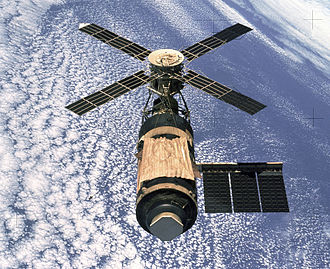
America's first space station, Skylab, is destroyed as it re-enters the Earth's atmosphere over the Indian Ocean.
First space station launched and operated by NASA (1973–1979)
Skylab was the United States' first space station, launched by NASA, occupied for about 24 weeks between May 1973 and February 1974. It was operated by three trios of astronaut crews: Skylab 2, Skylab 3, and Skylab 4.
1979
Italy_national_football_team
Italy defeats West Germany 3–1 to win the FIFA World Cup.
Men's association football team
The Italy national football team has represented Italy in men's international football since its first match in 1910. The national team is controlled by the Italian Football Federation (FIGC), the governing body for football in Italy, which is a co-founder and member of UEFA. Italy's home matches are played at various stadiums throughout Italy, and its primary training ground and technical headquarters, Centro Tecnico Federale di Coverciano, is located in Florence.
1982
TAME
A TAME airline Boeing 737-200 crashes near Cuenca, Ecuador, killing all 119 passengers and crew on board.
Flag-carrier airline of Ecuador (1962–2020)
TAME or TAME EP Linea Aerea del Ecuador was an airline founded in Ecuador in 1962. TAME was the flag carrier and the largest airline of Ecuador. TAME headquarters were in Quito, Pichincha Province and the main hub was Mariscal Sucre International Airport in Quito. The airline was formed by the Air Force of Ecuador. In 2011, it became a commercial entity and provided domestic, international and charter flights. On May 20, 2020, the Ecuadorean government decided to cease all operations and liquidate the airline.
1983
Oka_Crisis
Oka Crisis: First Nations land dispute in Quebec begins.
1990 land dispute between a group of Mohawk people and the town of Oka, Quebec, Canada
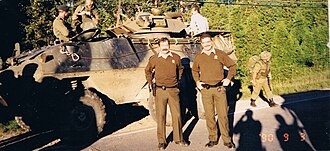
The Oka Crisis, also known as the Mohawk Crisis or Kanehsatà:ke Resistance, was a land dispute between a group of Mohawk people and the town of Oka, Quebec, Canada, over plans to build a golf course on land known as "The Pines" which included an Indigenous burial ground. The crisis began on July 11, 1990, and lasted 78 days until September 26, with two fatalities. The dispute was the first well-publicized violent conflict between First Nations and provincial governments in the late 20th century.
1990
Nigeria_Airways_Flight_2120
Nigeria Airways Flight 2120 crashes in Jeddah, Saudi Arabia, killing all 261 passengers and crew on board.
1991 aviation accident in Saudi Arabia
Nigeria Airways Flight 2120 was a chartered passenger flight from Jeddah, Saudi Arabia, to Sokoto, Nigeria, on 11 July 1991, which caught fire shortly after takeoff from King Abdulaziz International Airport and crashed while attempting to return for an emergency landing, killing all 247 passengers and 14 crew members on board. The investigation traced the fire to underinflated tires which overheated and burst during takeoff, and subsequently discovered that a project manager had prevented those tires from being replaced because the aircraft was behind schedule. The aircraft was a Douglas DC-8 operated by Nationair Canada for Nigeria Airways. Flight 2120 is the deadliest accident involving a DC-8 and the deadliest aviation disaster involving a Canadian airline.
1991
Yugoslav_Wars
Yugoslav Wars: Srebrenica massacre begins, lasting until 22 July.
1991–2001 series of wars in the Balkans
The Yugoslav Wars were a series of separate but related ethnic conflicts, wars of independence, and insurgencies that took place from 1991 to 2001 in what had been the Socialist Federal Republic of Yugoslavia. The conflicts both led up to and resulted from the breakup of Yugoslavia, which began in mid-1991, into six independent countries matching the six republics that had previously constituted Yugoslavia: Slovenia, Croatia, Bosnia and Herzegovina, Montenegro, Serbia, and Macedonia, which was later renamed to North Macedonia. The breakup of Yugoslavia and the accompanying Yugoslav Wars are commonly attributed to increasing nationalism and unresolved ethnic tensions in Yugoslavia. While most of the conflicts ended through peace accords that involved full international recognition of the new states, they resulted in the deaths of many as well as severe economic damage to the region.
1995
2006_Mumbai_train_bombings
Mumbai train bombings: 209 people are killed in a series of bomb attacks in Mumbai, India.
2006 terrorist attack on the Mumbai Suburban Railway by Lashkar-e-Taiba
The 2006 Mumbai train bombings were a series of seven bomb blasts on 11 July 2006. They took place over a period of 11 minutes on the Suburban Railway in Mumbai, the capital of the Indian state of Maharashtra and the nation's financial capital. The bombs were set off in pressure cookers on trains on the Western Line Suburban Section of the Mumbai Division of Western Railway. The blasts killed 209 people and injured over 700 more.
2006
Siege_of_Lal_Masjid
The Siege of Lal Masjid in Islamabad, Pakistan, ends after the Pakistan Army storms the mosque which had been occupied by Islamist militants.
2007 armed confrontation in Pakistan
The siege of Lal Masjid was an armed confrontation in July 2007 between a Islamist fundamentalist private militia and the government of Pakistan, led by president Pervez Musharraf and prime minister Shaukat Aziz. The focal points of the operation were the Lal Masjid and the Jamia Hafsa madrasah complex in Islamabad, Pakistan.
2007
Islamism
The Islamist militia group Al-Shabaab carries out multiple suicide bombings in Kampala, Uganda, killing 74 people and injuring 85 others.
Politico-religious ideology
Islamism is a range of religious and political ideological movements that believe that Islam should influence political systems. Its proponents believe Islam is innately political, and that Islam as a political system is superior to communism, liberal democracy, capitalism, and other alternatives in achieving a just, successful society. The advocates of Islamism are usually affiliated with Islamic institutions or social mobilization movements, emphasizing the implementation of sharia, pan-Islamic political unity, and the creation of Islamic states.
2010
Spain_national_football_team
In Johannesburg, Spain defeat the Netherlands 1–0 after extra time to win their first FIFA World Cup title.
Men's association football team
The Spain national football team have represented Spain in men's international football competition since 1920. They are governed by the Royal Spanish Football Federation, the governing body for football in Spain.
2010
Evangelos_Florakis_Naval_Base_explosion
Ninety-eight containers of explosives self-detonate killing 13 people in Zygi, Cyprus.
2011 self-detonation of a munitions stockpile in Cyprus
On 11 July 2011, at Evangelos Florakis Naval Base, situated at Mari, Larnaca District in Cyprus, a large amount of ammunition and military explosives self-detonated, killing 13 people, including the Commander of the Cyprus Navy, Andreas Ioannides, the base commander, Lambros Lambrou, and six firefighters. A further 62 people were injured. So intense was the explosion that debris was blown as far as 3km from the base. The explosion was the worst peacetime military accident ever recorded in Cyprus, with a yield of approximately 481 tons TNT equivalent, as determined by the official investigation into the accident. It was the largest artificial non-nuclear explosion of the 21st century until the 2020 Beirut explosions.
2011
El_Chapo
Joaquín "El Chapo" Guzmán escapes from the maximum security Altiplano prison in Mexico, his second escape.
Mexican drug lord incarcerated in a US federal prison (born 1957)
Joaquín Archivaldo Guzmán Loera, commonly known as "El Chapo", is a Mexican former drug lord and the former top leader of the Sinaloa Cartel. Guzmán is believed to be responsible for the deaths of over 34,000 people, and was considered to be the most powerful drug trafficker in the world until he was extradited to the United States and sentenced to life in prison.
2015
Virgin_Galactic
Virgin Galactic launches its founder, Richard Branson, into space, the first company ever to do so.
Space tourism company
Virgin Galactic Holdings, Inc. is a British-American spaceflight company founded by Richard Branson and the Virgin Group conglomerate, which retains an 11.9% stake through Virgin Investments Limited.
2021

History runs on facts, and this project runs on coffee!

Your support is incredibly helpful and genuinely appreciated.

Support with a coffee ☕