June 16 in History

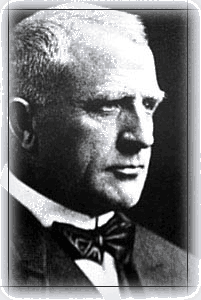
US President Ronald Reagan awards the Congressional Gold Medal to Ken Taylor, Ca

1981 — US President Ronald Reagan awards the Congressional Gold Medal to Ken Taylor, Canada's former ambassador to Iran, for helping six Americans escape from Iran during the hostage crisis of 1979–81; he is the first foreign citizen bestowed the honor

June 16 spans 54 recorded events across recorded history, from 632 to 2019. Below is a curated digest of the most significant moments tied to this date.

By · Wikipedia

Historical Events 54 events 632 – 2019

More major events on June 16

The featured story and these ranked highlights form a quick summary. Every recorded event remains available in the chronology below.

  1. 2012 China successfully launches its Shenzhou 9 spacecraft, carrying three astronauts, including the first female Chinese astronaut Liu Yang, to the Tiangong-1 orbital module. Source
  2. 1925 Artek, the most famous Young Pioneer camp of the Soviet Union, is established. Source
  3. 2015 American businessman Donald Trump announces his campaign to run for President of the United States in the upcoming election. Source

Did you know

In 1981, US President Ronald Reagan awards the Congressional Gold Medal to Ken Taylor, Canada's former ambassador to Iran, for helping six Americans escape from Iran during the hostage crisis of 1979–81; he is the first foreign citizen bestowed the honor. This featured entry focuses on the immediate decision and its direct historical impact.

Did you know

The Congressional Gold Medal is the oldest and joint-highest civilian award in the United States, alongside the Presidential Medal of Freedom. This helps explain why the event mattered beyond the initial announcement.

Did you know

It is bestowed by vote of the United States Congress, signed into law by the president. This clarifies the institutional and public response around the event.

Did you know

The Gold Medal expresses the highest national appreciation for distinguished achievements and contributions by individuals or institutions. This shows how the event shaped policy and public communication in the same period.

Did you know

In 1981, US President Ronald Reagan awards the Congressional Gold Medal to Ken Taylor, Canada's former ambassador to Iran, for helping six Americans escape from Iran during the hostage crisis of 1979–81; he is the first foreign citizen bestowed the honor had consequences that extended beyond the first headline. The key context is the institutions involved, the policy shift, and how the public response evolved afterward.


Yazdegerd_III
Yazdegerd III ascends the throne as king (shah) of the Persian Empire.
He becomes the last ruler of the Sasanian dynasty (modern Iran).
Yazdegerd III was the last Sasanian King of Kings from 632 to 651. His death following successive defeats by the Rashidun Caliphate marked the end of the last pre-Islamic Iranian empire after more than four centuries of rule.
632
Ming_conquest_of_Đại_Ngu
Ming–Hồ War: Retired King Hồ Quý Ly and his son King Hồ Hán Thương of Hồ dynasty are captured by the Ming armies.
1406–1407 Chinese military campaign
The Ming invasion of Viet, known in Vietnam as the Ming–Đại Ngu War was a military campaign against the kingdom of Đại Ngu under the Hồ dynasty by the Ming dynasty of China. The campaign began with Ming intervention in support of a rival faction to the Hồ dynasty which ruled Đại Ngu, but ended with the incorporation of Đại Ngu into the Ming dynasty as the province of Jiaozhi. The invasion is acknowledged by recent historians as one of the most important wars of the late medieval period, whereas both sides, especially the Ming, used the most advanced weapons in the world at the time.
1407
Battle_of_Stoke_Field
Battle of Stoke Field: King Henry VII of England defeats the leaders of a Yorkist rebellion in the final engagement of the Wars of the Roses.
Last battle of the Wars of the Roses
The Battle of Stoke Field, which took place at East Stoke, Nottinghamshire, on 16 June 1487, may be considered the last battle of the Wars of the Roses, since it was the last major engagement between contenders for the throne whose claims derived from descent from the houses of Lancaster and York. The Battle of Bosworth Field, two years previously, had established Henry VII on the throne, ending the last period of Yorkist rule and initiating that of the Tudors. The Battle of Stoke Field was the decisive engagement in an attempt by leading Ricardian Yorkists to unseat the King in favour of the pretender Lambert Simnel.
1487
Plymouth_Company
The Plymouth Company grants a land patent to Thomas Purchase, the first settler of Pejepscot, Maine, settling at the site of Fort Andross.
Division of the Virginia Company
The Plymouth Company, officially known as the Virginia Company of Plymouth, was a company chartered by King James in 1606 along with the Virginia Company of London with responsibility for colonizing the east coast of America between latitudes 38° and 45° N.
1632
War_of_the_Austrian_Succession
War of the Austrian Succession: New England colonial troops under the command of William Pepperrell capture the Fortress of Louisbourg in Louisbourg, New France (Old Style date).
1740–1748 war between European powers
The War of the Austrian Succession, 1740 to 1748, was a conflict between the European great powers, fought primarily in Europe, the Atlantic Ocean and Mediterranean Sea. Related conflicts include King George's War, the War of Jenkins' Ear, the First Carnatic War, and the First and Second Silesian Wars.
1745
War_of_the_Austrian_Succession
War of the Austrian Succession: Austria and Sardinia defeat a Franco-Spanish army at the Battle of Piacenza.
1740–1748 war between European powers
The War of the Austrian Succession, 1740 to 1748, was a conflict between the European great powers, fought primarily in Europe, the Atlantic Ocean and Mediterranean Sea. Related conflicts include King George's War, the War of Jenkins' Ear, the First Carnatic War, and the First and Second Silesian Wars.
1746
French_and_Indian_War
French and Indian War: The French surrender Fort Beauséjour to the British, leading to the expulsion of the Acadians.
North American theater of the Seven Years' War
The French and Indian War (1754–1763) was a conflict in North America between Great Britain and France, along with their respective Indigenous allies, which were called "Indians" at the time. Historians generally consider it part of the global Seven Years' War, which lasted from 1756 to 1763, although in the United States it is often viewed as a distinct conflict unassociated with any larger European war.
1755
Robert_Rogers_(British_Army_officer)
French and Indian War: Robert Rogers and his Rangers surprise French held Fort Sainte Thérèse on the Richelieu River near Lake Champlain.
The fort is raided and burned.
Lieutenant-Colonel Robert Rogers was a British Army officer and frontiersman. Born in Methuen, Massachusetts, he fought in King George's War, the French and Indian War and the American Revolutionary War. During the French and Indian War, Rogers raised and commanded Rogers' Rangers, a light infantry unit trained for carrying out asymmetric warfare.
1760
American_Revolutionary_War
American Revolutionary War: Spain declares war on the Kingdom of Great Britain, and the Great Siege of Gibraltar begins.
1775–1783 conflict in North America
The American Revolutionary War, also known as the Revolutionary War or American War of Independence or simply the American Revolution, was the armed conflict that comprised the final eight years of the broader American Revolution, in which American Patriot forces organized as the Continental Army and commanded by George Washington defeated the British Army. The conflict was fought in North America, the Caribbean, and the Atlantic Ocean. The war's outcome seemed uncertain for most of the war, but Washington and the Continental Army's decisive victory in the Siege of Yorktown in 1781 led King George III and the Kingdom of Great Britain to negotiate an end to the war. In 1783, in the Treaty of Paris, the British monarchy acknowledged the independence of the Thirteen Colonies, leading to the establishment of the United States as an independent and sovereign nation.
1779
French_Revolutionary_Wars
French Revolutionary Wars: In what became known as Cornwallis's Retreat, a British Royal Navy squadron led by Vice Admiral William Cornwallis strongly resists a much larger French Navy force and withdraws largely intact, setting up the French Navy defeat at the Battle of Groix six days later.
1792–1802 wars
The French Revolutionary Wars were a series of sweeping military conflicts resulting from the French Revolution that lasted from 1792 until 1802. They pitted France against Great Britain, Austria, Prussia, Russia, and several other countries. The wars are divided into two periods: the War of the First Coalition (1792–1797) and the War of the Second Coalition (1798–1802). Initially confined to Europe, the fighting gradually assumed a global dimension. After a decade of constant warfare and aggressive diplomacy, France had conquered territories in the Italian peninsula, the Low Countries, and the Rhineland with its very large and powerful military which had been totally mobilized for war against most of Europe with mass conscription of the vast French population. French success in these conflicts ensured military occupation and the spread of revolutionary principles over much of Europe.
1795
Tla-o-qui-aht_First_Nations
Survivors of an attack the previous day by Tla-o-qui-aht on board the Pacific Fur Company's ship Tonquin intentionally detonate a powder magazine on the ship, destroying it and killing about 100 attackers.
Nuu-chah-nulth band government in British Columbia, Canada
The Tla-o-qui-aht First Nations are a Nuu-chah-nulth First Nation in Canada. They live on ten reserves along the Pacific Rim National Park Reserve on Vancouver Island, British Columbia. The band is part of the Nuu-chah-nulth Tribal Council. There were 618 people living in the Tla-o-qui-aht reserves in 1995. Their primary economic activities are fishing and tourism.
1811
Battle_of_Ligny
Battle of Ligny and Battle of Quatre Bras, two days before the Battle of Waterloo.
1815 battle during the War of the Seventh Coalition (Hundred Days)
The Battle of Ligny, in which French troops of the Armée du Nord under the command of Napoleon I defeated part of a Prussian army under Field Marshal Blücher, was fought on 16 June 1815 near Ligny in what is now Belgium. The result was a tactical victory for the French, but the bulk of the Prussian army survived the battle in good order, was reinforced by Prussian troops who had not fought at Ligny, and played a role two days later at the Battle of Waterloo. Ligny was the last victory in Napoleon's military career. In the culminating moment of this battle Blücher was wounded and carried off the battlefield, and was replaced by his chief of staff, Lieutenant General Gneisenau.
1815
1819_Rann_of_Kutch_earthquake
A major earthquake strikes the Kutch district of western India, killing over 1,543 people and raising a 6-metre-high (20 ft), 6-kilometre-wide (3.7 mi), ridge, extending for at least 80 kilometres (50 mi), that was known as the Allah Bund ("Dam of God").
Earthquake and tsunami in Gujarat, India
The 1819 Rann of Kutch earthquake occurred at about 18:45 to 18:50 local time on 16 June 1819. It had an estimated magnitude ranging from 7.7 to 8.2 on the moment magnitude scale and a maximum perceived intensity of XI (Extreme) on the Mercalli intensity scale. It triggered a tsunami and caused at least 1,543 deaths. The earthquake caused an area of subsidence that formed the Sindri Lake and a local zone of uplift to the north about 80 km (50 mi) long, 6 km (3.7 mi) wide and 6 m (20 ft) high that dammed the Nara/Puran river/Koree/Kori River. This natural dam is known as the Allah Bund.
1819
A meeting at Old Slaughter's coffee house in London leads to the formation of what is now the Royal Society for the Prevention of Cruelty to Animals (RSPCA).
Animal welfare charity in England and Wales
The Royal Society for the Prevention of Cruelty to Animals (RSPCA) is a charity operating in England and Wales which promotes animal Activism. The RSPCA is funded primarily by voluntary donations. Founded in 1824, it is the oldest and largest animal welfare organisation in the world, and is one of the largest charities in the UK. The organisation also does international outreach work across Europe, Africa and Asia.
1824
London_Working_Men's_Association
The formation of the London Working Men's Association gives rise to the Chartist Movement.
19th-century British socialist organisation
The London Working Men's Association was an organisation established in London in 1836. It was one of the foundations of Chartism, advocating for universal male suffrage, equally-populated electoral districts, the abolition of property qualifications for MPs, annual Parliaments, the payment of MPs, and the establishment of secret ballot voting. The founders were William Lovett, Francis Place and Henry Hetherington. They appealed to skilled workers rather than the mass of unskilled factory labourers. They were associated with Owenite socialism and the movement for general education.
1836
1846_conclave
The Papal conclave of 1846 elects Pope Pius IX, beginning the longest reign in the history of the papacy.
A conclave was held from 14 to 16 June 1846 to elect a new pope to succeed Gregory XVI, who had died in 1 June. Of the 62 members of the College of Cardinals, all but twelve attended. On the fourth ballot, the conclave elected Cardinal Giovanni Mastai-Ferretti, the archbishop-bishop of Imola. After accepting his election, he took the name Pius IX. This conclave was the last to elect a ruler of the Papal States, the extensive lands around Rome and Central Italy which the Catholic Church governed until 1870.
1846
Abraham_Lincoln
Abraham Lincoln delivers his House Divided speech in Springfield, Illinois.
President of the United States from 1861 to 1865
Abraham Lincoln was the 16th president of the United States, serving from 1861 until his assassination in 1865. He led the United States through the American Civil War, defeating the Confederacy and playing a major role in the abolition of slavery.
1858
Universities_Tests_Act_1871
The Universities Tests Act 1871 allows students to enter the universities of Oxford, Cambridge and Durham without religious tests (except for those intending to study theology).
1871 British law banning religious discrimination in admission to certain universities
The Universities Tests Act 1871 was an act of the Parliament of the United Kingdom. It abolished religious "Tests" and allowed Roman Catholics, non-conformists and non-Christians to take up professorships, fellowships, studentships and other lay offices at the universities of Oxford, Cambridge and Durham. It also forbade religious tests for "any degree ".
1871
Victoria_Hall_disaster
The Victoria Hall theatre panic in Sunderland, England, kills 183 children.
1883 crowd crush in Sunderland, England
On 16 June 1883, a crowd crush caused by the distribution of free prizes resulted in the deaths of 183 children at the Victoria Hall in Sunderland, England.
1883
LaMarcus_Adna_Thompson
The first purpose-built roller coaster, LaMarcus Adna Thompson's "Switchback Railway", opens in New York's Coney Island amusement park.
American inventor and businessman (1848–1919)
LaMarcus Adna Thompson was an American inventor and businessman most famous for developing a variety of gravity rides and roller coasters.
1884
Republic_of_Hawaii
A treaty annexing the Republic of Hawaii to the United States is signed; the Republic would not be dissolved until a year later.
Transitional republic in Hawaii before US annexation, 1894–1898
The Republic of Hawaii was a short-lived one-party state in Hawaiʻi between July 4, 1894, when the Provisional Government of Hawaii had ended, and August 12, 1898, when it became annexed by the United States as an unincorporated and unorganized territory. In 1893, the Committee of Public Safety overthrew Queen Liliʻuokalani, the monarch of the Kingdom of Hawaiʻi, after she rejected the 1887 Bayonet Constitution. The Committee of Public Safety intended for Hawaii to be annexed by the United States; however, President Grover Cleveland, a Democrat opposed to imperialism, refused. A new constitution was subsequently written while Hawaii was being prepared for annexation.
1897
Ford_Motor_Company
The Ford Motor Company is incorporated.
American multinational automobile manufacturer
The Ford Motor Company is an American multinational automobile manufacturer headquartered in Dearborn, Michigan, United States. It was founded by Henry Ford and incorporated on June 16, 1903. The company sells automobiles and commercial vehicles under the Ford brand, and luxury cars under its Lincoln brand. The company is listed on the New York Stock Exchange under the single-letter ticker symbol F and is controlled by the Ford family. They have minority ownership but a plurality of the voting power.
1903
Roald_Amundsen
Roald Amundsen leaves Oslo, Norway, to commence the first east–west navigation of the Northwest Passage.
Norwegian polar explorer (1872–1928)
Roald Engelbregt Gravning Amundsen was a Norwegian explorer of polar regions. He was a key figure of the period known as the Heroic Age of Antarctic Exploration.
1903
Eugen_Schauman
Eugen Schauman assassinates Nikolay Bobrikov, Governor-General of Finland.
Finnish nationalist activist (1875–1904)
Eugen Waldemar Schauman was a Finnish nationalist activist and member of the noble Schauman family. In 1904, Schauman assassinated Nikolai Bobrikov, the Governor-General of Finland.
1904
James_Joyce
Irish author James Joyce begins a relationship with Nora Barnacle and subsequently uses the date to set the actions for his novel Ulysses; this date is now traditionally called "Bloomsday".
Irish novelist and poet (1882–1941)
James Augustine Aloysius Joyce was an Irish novelist, poet, and literary critic. He contributed to the modernist movement and is regarded among the most influential and important writers of the 20th century. Joyce's novel Ulysses (1922) is a landmark in which the episodes of Homer's Odyssey are paralleled in a variety of literary styles, particularly stream of consciousness. His other well-known works include the short-story collection Dubliners (1914) and the novels A Portrait of the Artist as a Young Man (1916) and Finnegans Wake (1939). His other writings include two books of poetry, a play, correspondence, and occasional journalism.
1904
IBM
IBM founded as the Computing-Tabulating-Recording Company in Endicott, New York.
American multinational technology company
International Business Machines Corporation, doing business as IBM, is an American multinational technology company headquartered in Armonk, New York, and present in over 175 countries. It is a publicly traded company and one of the 30 companies in the Dow Jones Industrial Average. IBM is the largest industrial research organization in the world, with 19 research facilities across a dozen countries; for 29 consecutive years, from 1993 to 2021, it held the record for most annual U.S. patents generated by a business.
1911
Irish_Free_State
General election in the Irish Free State: The pro-Treaty Sinn Féin party wins a large majority.
British dominion in Europe from 1922 to 1937
The Irish Free State, also known by its Irish name Saorstát Éireann, was the Irish state established in December 1922 under the Anglo-Irish Treaty of December 1921, initially as a Dominion. The treaty ended the three-year Irish War of Independence between the forces of the Irish Republic—the Irish Republican Army (IRA)—and British Crown forces.
1922
Artek_(camp)
Artek, the most famous Young Pioneer camp of the Soviet Union, is established.
Children's center in Gurzuf, Crimea
Artek is an international children's center on the Black Sea in the town of Gurzuf located on the Crimean Peninsula, near Ayu-Dag. It was established on 16 June 1925 as the V. I. Lenin All-Union Pioneer Camp.
1925
Council_of_People's_Commissars
Sovnarkom establishes decree time in the USSR.
Government institution in the Russian SFSR and the Soviet Union
The Council of People's Commissars (CPC), commonly known as the Sovnarkom (Совнарком), were the highest executive authorities of the Russian Soviet Federative Socialist Republic (RSFSR), the Soviet Union (USSR), and the Soviet republics from 1917 to 1946.
1930
National_Industrial_Recovery_Act_of_1933
The National Industrial Recovery Act is passed in the United States, allowing businesses to avoid antitrust prosecution if they establish voluntary wage, price, and working condition regulations on an industry-wide basis.
US labor law and consumer law
The National Industrial Recovery Act of 1933 (NIRA) was a US labor law and consumer law passed by the 73rd US Congress to authorize the president to regulate industry for fair wages and prices that would stimulate economic recovery. It also established a national public works program known as the Public Works Administration (PWA). The National Recovery Administration (NRA) portion was widely hailed in 1933, but by 1934 business opinion of the act had soured.
1933
World_War_II
World War II: Marshal Henri Philippe Pétain becomes Chief of State of Vichy France (Chef de l'État Français).
Global conflict (1939–1945)
World War II, or the Second World War, was a global conflict between two coalitions: the Allies and the Axis powers. Nearly all of the world's countries participated, with many engaging in total war on an unprecedented scale. World War II was the deadliest conflict in history, causing the deaths of 60 to 75 million people, a majority of whom were civilians. Millions died as a result of massacres, starvation, disease, and genocides including the Holocaust. After the Allied victory, Germany, Austria, Japan, and Korea were occupied, and German and Japanese leaders were tried for war crimes.
1940
Soviet_Union
The Soviet Union occupies Lithuania, which will eventually become the Lithuanian Soviet Socialist Republic (SSR).
Country in Eurasia from 1922 to 1991
The Soviet Union, officially the Union of Soviet Socialist Republics (USSR), was a transcontinental country that spanned much of Eurasia from its formation in 1922 until its dissolution in 1991. It was the world's third-most populous country, the largest by area, and bordered twelve other countries. A diverse multinational state, it was organized as a federal union of national republics, with the largest and most populous being the Russian Soviet Federative Socialist Republic (SFSR). The world's flagship communist state, it was governed by the Communist Party under Marxism–Leninism, through soviet councils. The Soviet economy was also centrally planned. Its capital and largest city was Moscow.
1940
Malayan_Communist_Party
Members of the Malayan Communist Party kill three British plantation managers in Sungai Siput; in response, British Malaya declares a state of emergency.
Far-left political party in Malaya
The Malayan Communist Party (MCP), officially the Communist Party of Malaya (CPM), was a Marxist–Leninist and anti-imperialist communist party which was active in British Malaya and later, the modern states of Malaysia and Singapore from 1930 to 1989. It was responsible for the creation of both the Malayan Peoples' Anti-Japanese Army and the Malayan National Liberation Army.
1948
Juan_Perón
In a futile effort to topple Argentine President Juan Perón, rogue aircraft pilots of the Argentine Navy drop several bombs upon an unarmed crowd demonstrating in favor of Perón in Buenos Aires, killing 364 and injuring at least 800.
At the same time on the ground, some soldiers attempt to stage a coup but are suppressed by loyal forces.
Juan Domingo Perón was an Argentine military officer and politician who was the 29th and 40th president of Argentina, serving from 1946 to his overthrow in 1955, and from 1973 until his death in 1974. He was the only Argentine president elected three times and holds the highest percentage of votes in clean elections. Perón was one of the most important, and controversial, Argentine politicians of the 20th century; his influence extends to today. Perón's ideas, policies and movement are known as Peronism, which continues to be a force in Argentine politics.
1955
Imre_Nagy
Imre Nagy, Pál Maléter and other leaders of the 1956 Hungarian Uprising are executed.
Hungarian politician and leader of the 1956 revolution (1896–1958)
Imre Nagy was a Hungarian Communist politician who served as Chairman of the Council of Ministers of the Hungarian People's Republic from 1953 to 1955. In 1956 Nagy became leader of the Hungarian Revolution of 1956 against the Soviet-backed government, for which he was sentenced to death and executed two years later. He was not related to previous agrarianist Prime Minister Ferenc Nagy.
1958
While on tour with the Kirov Ballet in Paris, Rudolf Nureyev defects from the Soviet Union.
Ballet company in Saint Petersburg, Russia
The Mariinsky Ballet is the resident classical ballet company of the Mariinsky Theatre in Saint Petersburg, Russia.
1961
Soviet_space_program
Soviet Space Program: Vostok 6 mission: Cosmonaut Valentina Tereshkova becomes the first woman in space.
Space exploration program conducted by the Soviet Union from 1951 to 1991
The Soviet space program was the state space program of the Soviet Union, active from 1951 until the dissolution of the Soviet Union in 1991. Unlike its Space Race competitor, the United States, which consolidated its space program under NASA, the Soviet space program was divided between several competing design bureaus led by Korolev, Kerimov, Keldysh, Yangel, Glushko, Chelomey, Makeyev, Chertok and Reshetnev, often under the Ministry of General Machine-Building. The program was an important part of the Soviet claim to superpower status.
1963
Buddhist_crisis
In an attempt to resolve the Buddhist crisis in South Vietnam, a Joint Communique is signed between President Ngo Dinh Diem and Buddhist leaders.
1963 political and religious tension in South Vietnam
The Buddhist crisis was a period of political and religious tension in South Vietnam between May and November 1963, characterized by a series of repressive acts by the South Vietnamese government and a campaign of civil resistance, led mainly by Buddhist activists.
1963
Churchill_Falls_Generating_Station
The largest single-site hydroelectric power project in Canada is inaugurated at Churchill Falls Generating Station.
Hydroelectric power station in Labrador, Canada
The Churchill Falls Generating Station is a hydroelectric underground power station in Labrador, Canada. At 5,428 MW, it is the sixteenth largest in the world, and the second-largest in Canada, after the Robert-Bourassa generating station in northwestern Quebec.
1972
Soweto_uprising
Soweto uprising: A non-violent march by 15,000 students in Soweto, South Africa, turns into days of rioting when police open fire on the crowd.
1976 student-led anti-apartheid protests in South Africa
The Soweto uprising, also known as the Soweto riots or the Soweto rebellion, was a series of demonstrations and protests led by black school children in South Africa during apartheid that began on the morning of 16 June 1976.
1976
Oracle_Corporation
Oracle Corporation is incorporated in Redwood Shores, California, as Software Development Laboratories (SDL), by Larry Ellison, Bob Miner and Ed Oates.
American multinational computer corporation
Oracle Corporation is an American multinational technology company headquartered in Austin, Texas. Co-founded in Santa Clara, California, in 1977 by Bob Miner, Ed Oates, and current chairman of the board and chief technology officer Larry Ellison, Oracle is among the 50 largest companies in the world by market cap, and ranked 66th on the Forbes Global 2000 as of 2025.
1977
Revolutions_of_1989
Revolutions of 1989: Imre Nagy, the former Hungarian prime minister, is reburied in Budapest following the collapse of Communism in Hungary.
Revolutionary wave overthrowing most communist states in Europe
The revolutions of 1989, also known as the Fall of Communism, were a wave of liberal democratic movements that resulted in the collapse of most Marxist–Leninist governments in the Eastern Bloc and other parts of the world. The revolutions of 1989 were a key factor in the dissolution of the Soviet Union—one of the two superpowers—and abandonment of communist regimes in many parts of the world, some of which were violently overthrown. These events drastically altered the world's balance of power, marking the end of the Cold War and beginning of the post–Cold War era.
1989
Astronomy_Picture_of_the_Day
The Astronomy Picture of the Day website is launched.
NASA and MTU website
Astronomy Picture of the Day (APOD) is a website provided by NASA and Michigan Technological University (MTU). Each day it features a different image of the universe accompanied by an explanation written by a professional astronomer. The photograph does not necessarily correspond to a celestial event on the exact day that it is displayed, and images are sometimes repeated. These often relate to current events in astronomy and space exploration. The text has several hyperlinks to more pictures and websites for more information. The images are either visible spectrum photographs, images taken at non-visible wavelengths and displayed in false color, video footage, animations, artist's conceptions, or micrographs that relate to space or cosmology.
1995
Fifty people are killed in the Daïat Labguer (M'sila) massacre in Algeria.
1997 killing of civilians by Islamist rebels in M'sila, Algeria
The Daïat Labguer (M'sila) massacre took place on June 16, 1997, near M'sila, 300 km southeast of Algiers. The massacre came less than two weeks after parliamentary elections in the hamlet of Daïat Labguer (M'sila). Some 50 people were killed by some 30 guerrillas, who also kidnapped women, killed the livestock, and stole valuables. Five days earlier, another 17 had been killed at a village 5 km away. The massacre was attributed to Islamist groups such as the Armed Islamic Group.
1997
United_Nations_Security_Council_Resolution_425
The Secretary-General of the UN reports that Israel has complied with United Nations Security Council Resolution 425, 22 years after its issuance, and completely withdrawn from Lebanon.
The Resolution does not encompass the Shebaa farms, which is claimed by Israel, Syria and Lebanon.
United Nations Security Council Resolution 425, adopted on 19 March 1978, five days after the Israeli invasion of Lebanon in the context of Palestinian insurgency in South Lebanon and the Lebanese Civil War, called on Israel to withdraw immediately its forces from Lebanon and established the United Nations Interim Force In Lebanon (UNIFIL). It was adopted by 12 votes to none; Czechoslovakia and the Soviet Union abstained, and China did not participate.
2000
Padre_Pio
Padre Pio is canonized by the Roman Catholic Church.
20th-century Italian saint, priest, stigmatist and mystic (1887–1968)
Pio of Pietrelcina, widely known as Padre Pio was an Italian friar of the Order of Friars Minor Capuchin, priest, stigmatist and mystic. He is venerated as a saint in the Catholic Church, and his feast day is celebrated on 23 September.
2002
Bhutan
Bhutan becomes the first country to institute a total ban on tobacco.
Country in South Asia
Bhutan, officially the Kingdom of Bhutan, is a landlocked country in South Asia, located in the Eastern Himalayas, bordering China to the north and northwest and India to the south and southeast. With a population of over 800,000 (800,871) and a territory of 38,394 square kilometres (14,824 sq mi), Bhutan ranks 133rd in land area and 160th in population. It is a democratic constitutional monarchy with a King as the head of state and a prime minister as the head of government. The Je Khenpo is the head of the state religion, Vajrayana Buddhism.
2010
Shenzhou_9
China successfully launches its Shenzhou 9 spacecraft, carrying three astronauts, including the first female Chinese astronaut Liu Yang, to the Tiangong-1 orbital module.
2012 Chinese crewed spaceflight to Tiangong-1
Shenzhou 9 was the fourth crewed spacecraft flight of China's Shenzhou program, launched at 18:37:24 CST, 16 June 2012. Shenzhou 9 was the second spacecraft and first crewed mission and expedition to dock with the Tiangong-1 space station, which took place on 18 June. The Shenzhou 9 spacecraft landed at 10:01:16 CST on 29 June in the Inner Mongolia Autonomous Region. The mission's crew included the first Chinese female astronaut, Liu Yang. The next mission was Shenzhou 10, which launched on 11 June 2013.
2012
United_States_Air_Force
The United States Air Force's robotic Boeing X-37B spaceplane returns to Earth after a classified 469-day orbital mission.
Air service branch of the U.S. military
The United States Air Force (USAF) is the air service branch of the United States Armed Forces. It is a part of the United States Department of Defense (DoD) and is one of the six armed forces and one of the eight uniformed services of the United States. Tracing its origins to 1 August 1907, as a part of the United States Army Signal Corps, the Air Force was established by transfer of personnel from the Army Air Forces with the enactment of the National Security Act of 1947. It is the second youngest branch of the United States Armed Forces and the fourth in order of precedence. The United States Air Force articulates its core missions as air supremacy, global integrated intelligence, surveillance and reconnaissance, rapid global mobility, global strike, and command and control.
2012
2013_North_India_floods
A multi-day cloudburst, centered on the North Indian state of Uttarakhand, causes devastating floods and landslides, becoming the country's worst natural disaster since the 2004 tsunami.
Floods that occurred in Northern India in 2013
In June 2013, a mid-day cloudburst centered on the North Indian state of Uttarakhand caused devastating floods and landslides, becoming the country's worst natural disaster since the 2004 tsunami. The rainfall received that month was far greater than the rainfall the state usually received. Debris blocked the rivers, causing major overflow. The main day of the flood was 16 June 2013.
2013
Business_career_of_Donald_Trump
American businessman Donald Trump announces his campaign to run for President of the United States in the upcoming election.
Before running for president of the United States in 2016, Donald Trump pursued a career as a businessman, with a focus on renovating skyscrapers, hotels, casinos, and golf courses. His extravagant lifestyle, outspoken manner, and role on the NBC reality show The Apprentice have made him a well-known public figure in American life for nearly half a century.
2015
Shanghai_Disneyland
Shanghai Disneyland Park, the first Disney Park in mainland China, opens to the public.
Theme park
Shanghai Disneyland is a theme park located in Chuansha New Town, Pudong, Shanghai, China, that is part of the Shanghai Disney Resort. The park is operated by Disney Experiences and Shanghai Shendi Group, through a joint venture between the Walt Disney Company and Shendi. Construction began on April 8, 2011. The park opened on June 16, 2016. The park operated in its first half-year with a visitor attendance of 5.60 million guests.
2016
2019–2020_Hong_Kong_protests
Upwards of 2,000,000 people participate in the 2019–20 Hong Kong protests, the largest in Hong Kong's history.
From 2019 until 2020, protests were held in Hong Kong in response to the Hong Kong government's introduction of a bill to amend the Fugitive Offenders Ordinance in regard to extradition. It was the largest series of demonstrations in the history of Hong Kong.
2019

History runs on facts, and this project runs on coffee!

Your support is incredibly helpful and genuinely appreciated.

Support with a coffee ☕