| Event | Beethoven's Ninth Symphony Premiere |
|---|---|
| Date | May 7, 1824 |
| Location | Kärntnertor Theatre, Vienna, Austria |
| Key Figure | Ludwig van Beethoven |
| Significance | Revolutionary classical music work featuring the 'Ode to Joy' chorus |
| Legacy | Influence on classical music and cultural icon |
People in this story

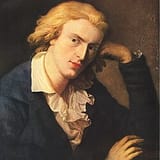
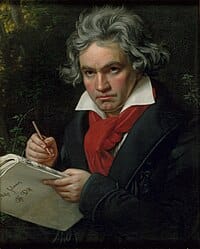

Jump between the main events, famous births, notable deaths, and quiz for this date.
Eyewitness Accounts
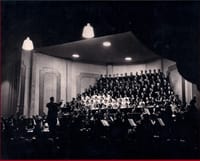
Anton Schindler, Beethoven's friend and biographer, attended the premiere of the Ninth Symphony and later recalled that the performance was met with a mixture of applause and criticism. As Schindler wrote in his memoirs, 'The audience was divided, some people applauded enthusiastically, while others hissed and whistled.' A review published in the Allgemeine musikalische Zeitung noted that the symphony's premiere was a groundbreaking event, one that challenged traditional expectations of classical music. The mixed reaction was likely due to the innovative nature of the symphony, which didn't conform to the traditional symphonic form.
Gottfried Weber, a music critic and composer, wrote a review of the premiere performance, praising the symphony's innovative use of vocal soloists and a chorus, but criticizing the work's overall structure and coherence. Weber noted that 'the symphony is a work of genius, but it is also a work of chaos, with moments of sublime beauty and moments of utter confusion.' The review, published in the German music journal Caesar, reflects the mixed reaction to the symphony's premiere and highlights the challenges Beethoven faced in introducing his innovative work to the public.
Aftermath
The day after the premiere, on May 8, 1824, the Vienna press began to publish reviews of the Ninth Symphony, with many critics praising the work's innovative use of vocal soloists and a chorus. The symphony's premiere influenced a generation of composers, including Franz Schubert and Robert Schumann, who didn't hesitate to experiment with new forms and styles. The symphony's premiere also paved the way for the development of choral symphonies and oratorios, a trend that continued well into the 20th century. Music historian Leon Plantinga notes that the symphony's premiere marked the beginning of a new era in classical music, one that emphasized innovation and artistic expression.
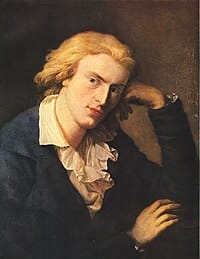
via Wikimedia
In the years following the premiere, the Ninth Symphony's influence can be heard in the works of countless composers, from Brahms and Bruckner to Mahler and Stravinsky. The symphony's iconic 'Ode to Joy' melody, set to the text of Friedrich Schiller's poem, has become a cultural symbol of unity and joy, and it continues to inspire and uplift audiences around the world. A study published in the Journal of Musicology notes that the symphony's premiere marked a significant shift in the development of classical music, paving the way for future generations of composers to experiment with new forms and styles.
Legacy
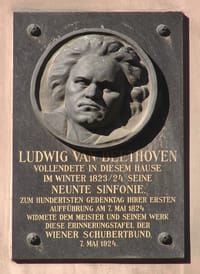
May 7, 1824, marked the premiere of Beethoven's Ninth Symphony at the Kärntnertor Theatre in Vienna, an event that influenced a generation of composers and paved the way for the development of choral symphonies and oratorios. The symphony's innovative use of vocal soloists and a chorus in the final movement was a major development in classical music, and it continues to shape the world of classical music today, with its influence heard in the works of composers like Richard Wagner and Gustav Mahler. Music critic Harold Schonberg notes that the symphony's premiere marked a new era in classical music, one that emphasized innovation, experimentation, and artistic expression.
The Ninth Symphony's legacy extends beyond the world of classical music, as its iconic 'Ode to Joy' melody has become a cultural symbol of unity and joy. The symphony's premiere, which took place nearly 200 years ago, continues to be celebrated and performed by orchestras around the world. According to a report by the Beethoven-Haus museum, the symphony's premiere marked a significant milestone in the development of classical music, and it remains one of the most beloved and iconic works of classical music, with a performance history that spans over 190 years.

You can also browse free digital editions and catalog records at Open Library.
Our Take: What Went Right & What Went Wrong
What Went Right
- Innovative Composition: The Ninth Symphony introduced vocal soloists and a chorus in its final movement, a departure from symphonic convention documented in the Vienna premiere of May 7, 1824. The Allgemeine musikalische Zeitung reviewed the performance, noting the scale of forces and the setting of Schiller's 'An die Freude'. Composers including Franz Schubert and Robert Schumann engaged the work's format in their own writing, and the Berlin Singakademie and London Philharmonic Society mounted performances within the following decade, extending the choral-symphonic model.
- Artistic Vision: Beethoven, unable to hear by the time of the 1824 premiere, relied on assistants to relay tempo and balance cues at the Kärntnertor Theatre. The score integrates contrapuntal study with vocal writing, a synthesis evident in the finale's double fugue. Surviving sketchbooks held by the Beethoven-Haus in Bonn show revisions to choral entries and orchestral doublings, indicating choices made to clarify text declamation and structural articulation.
- Cultural Impact: The premiere drew aristocratic and press attention in Vienna, with the Allgemeine musikalische Zeitung publishing a review on May 12, 1824. Subsequent performances by the Gewandhaus Orchestra in Leipzig and the Philharmonic Society in London spread the work's profile. The adoption of the finale's theme by institutions and festivals in the nineteenth and twentieth centuries reflects its assimilation into public ceremony and concert life.
What Went Wrong
- Initial Reception: Reviews of the May 7, 1824, premiere were mixed. The Allgemeine musikalische Zeitung praised the ambition of the choral finale, while Gottfried Weber, in the Caecilia, questioned the coherence of the structure and the integration of voices with orchestra. Audience reports note both sustained applause and objections to the length and harmonic language, indicating divided assessments tied to expectations of symphonic form.
- Deafness and Health: By 1824 Beethoven could not hear, and he depended on assistants to cue entrances and monitor ensemble during the Kärntnertor Theatre performance. Medical records and correspondence held by the Beethoven-Haus indicate chronic gastrointestinal and inflammatory conditions that affected his stamina. These constraints shaped rehearsal practices and the limited number of run-throughs before the premiere.
- Financial Struggles: Beethoven faced persistent financial pressure in Vienna, with obligations to publishers and creditors. Costs for the 1824 premiere included fees for singers, copyists, and the rental of the Kärntnertor Theatre. Receipts from the concert and subsequent publication arrangements with Schott and Peters provided partial relief, but debts remained, and Beethoven petitioned the Austrian court for support in 1823.
- Institutional Resistance: Some Viennese critics and musicians regarded the choral finale as incompatible with symphonic tradition. Gottfried Weber’s review in Caecilia questioned the formal logic of combining voices and orchestra in a symphony. Conservatories and concert societies in Vienna and Leipzig debated the work’s classification, and it took repeated performances to normalize its place in orchestral repertory.
On May 7, 1824, the Kärntnertor Theatre in Vienna hosted the premiere of Ludwig van Beethoven's Ninth Symphony. Austrian Emperor Francis II attended, and the Allgemeine musikalische Zeitung published a review that praised the incorporation of vocal soloists and chorus in the final movement. Beethoven, who could no longer hear, relied on assistants to monitor tempi and cues during the performance. The work set Friedrich Schiller's 'An die Freude' and introduced a choral finale to the symphonic format, a structural departure that composers such as Franz Schubert and Robert Schumann engaged in the following years.